Good Lovin' Sheet Music Preview

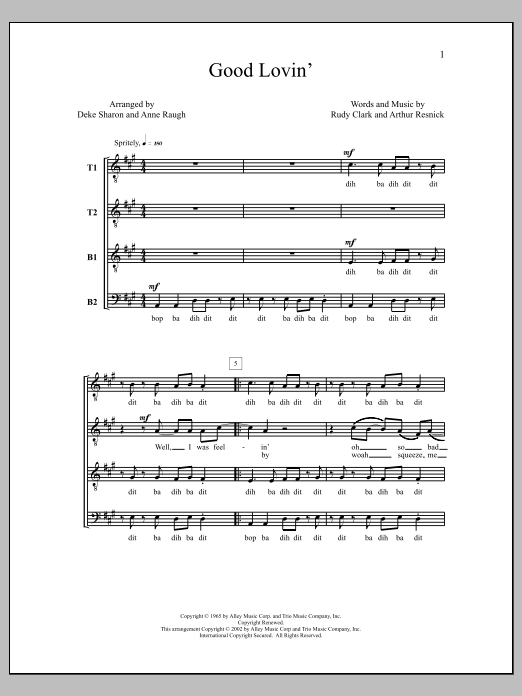
Good Lovin': TTBB Choral Octavo

As performed by Rudy Clark / As performed by Arthur Resnick / As performed by Anne Raugh / Arranged by Deke Sharon

Item: 35-DS00299852

Digital Download
$2.99
Description

Good Lovin': TTBB Choral Octavo isn't in MakeMusic Cloud just yet...but it could be. Let us know you'd like to see it, and you'll help shape what comes next. In the meantime, start a free trial and dive into thousands of interactive titles your students can play along with today.

Sample Audio
No sample audio found.
Sample Video
Additional Details
Publisher: Hal Leonard
Page Count: 7
SKU: 35-DS00299852

More about this title

About the Artist: Rudy Clark

Rudy Clark co-wrote "Good Lovin'" with Arthur Resnick in 1965, creating one of the most enduring pop standards of the era. The song became a massive hit for The Young Rascals and has since been recorded across genres, from soul to rock to a cappella arrangements, proving its melodic strength and universal appeal.

Why we love this

Deke Sharon's arrangement captures the groove and energy of the original while tailoring it for four-part male voices with impressive flexibility. The voicing options (TB/TTB/TBB/TTBB) mean you can perform this with whatever combinations your ensemble has on any given day, and the compact seven-page score makes rehearsal straightforward without sacrificing the song's infectious charm.

What to expect

Smooth, soulful, and impossible to sit still through. The arrangement honors the song's classic R&B backbone while the a cappella texture adds intimacy and showcases the voices themselves as the sole instruments.

Who it's for

Male choirs and groups looking for contemporary a cappella material that audiences know and love. This works equally well for competitive a cappella ensembles seeking a crowd pleasing standard and for traditional male choruses wanting to program something with modern energy.

How to get the most out of it

  • Lock into the rhythmic pocket early. This song lives and dies by its groove, so nail the consistency of rhythm section figures before worrying about blend or expression.
  • Let the Bass and Baritone lines establish the harmonic foundation first during sectionals. Once that's solid, the Tenors can layer their lines with confidence and freedom.
  • Emphasize the call-and-response moments if the arrangement includes them. These passages are where the a cappella texture really shines and keeps the audience engaged.
  • Don't oversing. The intimacy of a cappella performance means every voice is audible, so trust the arrangement and use restraint in dynamics until the marked climactic moments.

How to use it

Position this as a palate cleanser between heavier classical or contemporary pieces, or build an entire set around classic soul and pop standards. The familiarity makes it a strong closer for pops concerts or fundraisers where you want the audience leaving with a smile.

Skills your students will build

  • Singing in a cappella blend and tuning without instrumental support
  • Maintaining rhythmic precision in a groove-based arrangement
  • Adapting to flexible voicing schemes (TB/TTB/TBB/TTBB)
  • Balancing solo or featured lines with ensemble harmonic support
  • Interpreting stylistic inflection in pop and soul music contexts

You May Also Like