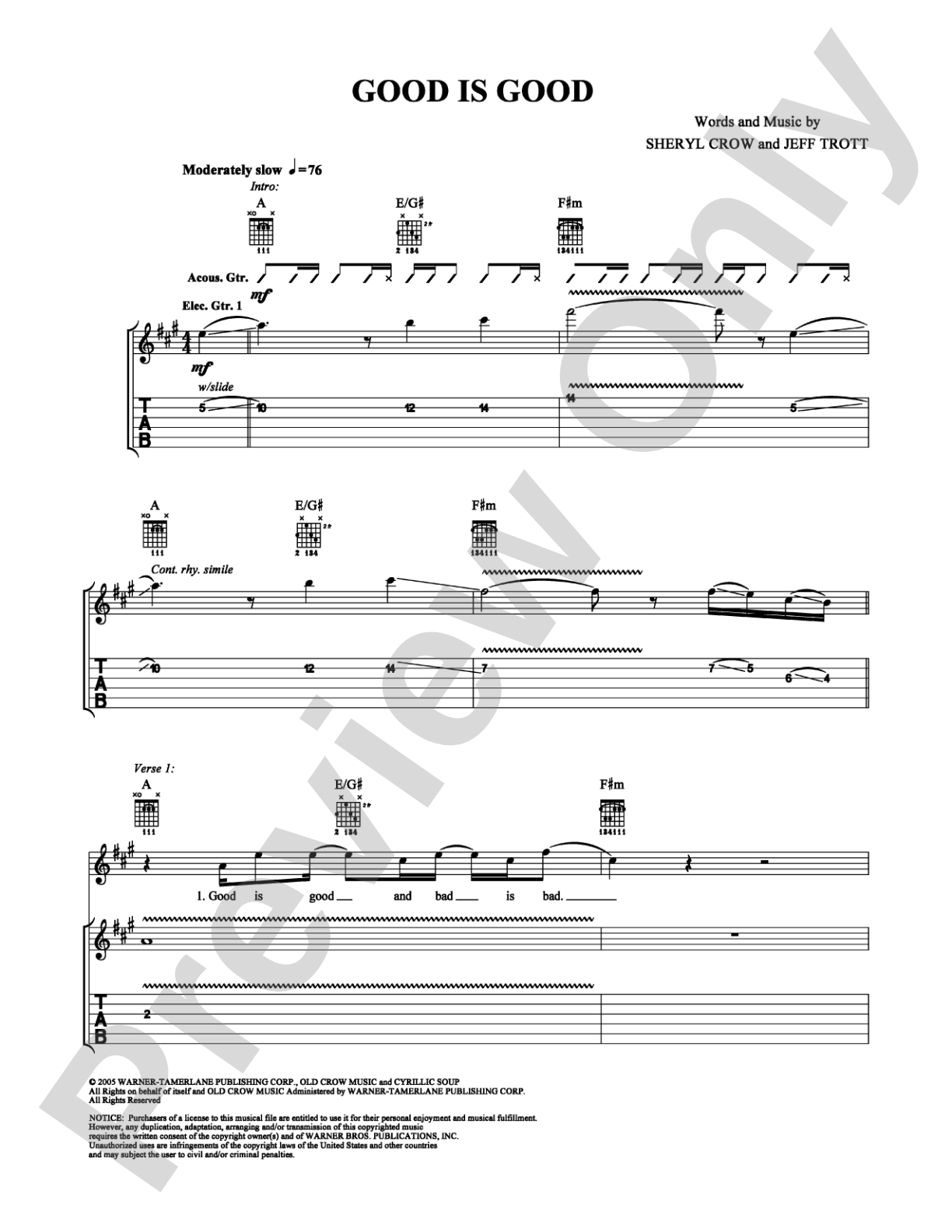
Good Is Good: Guitar TAB Digital Sheet Music

Good Is Good: Guitar TAB Digital Sheet Music

Sheryl Crow, Jeff Trott

Item: 00-PS-0003832

Digital Download
$2.99
Description

Good Is Good: Guitar TAB Digital Sheet Music isn't in MakeMusic Cloud just yet...but it could be. Let us know you'd like to see it, and you'll help shape what comes next. In the meantime, start a free trial and dive into thousands of interactive titles your students can play along with today.

Sample Audio
No sample audio found.
Sample Video
Additional Details
SKU: 00-PS-0003832

More about this title

About the Artist: Sheryl Crow

Sheryl Crow emerged as one of the defining voices of 1990s pop-rock, blending country, rock, and pop sensibilities into a sound that felt both polished and deeply personal. A multi-Grammy winner with a career spanning three decades, Crow has written and performed some of the most recognizable songs in American popular music, combining strong melodic instincts with lyrics that balance vulnerability and confidence.

Her guitar work is integral to her artistry. Crow is a capable and thoughtful guitarist who understands how to serve a song, whether through fingerpicked accompaniment or rhythmic rock parts. Her influence extends across generations of musicians who have learned from her approach to songwriting, arrangement, and performance.

Why we love this

Sheryl Crow's catalog includes some of the most accessible and engaging pop-rock songs available for guitarists of intermediate skill. 'Good Is Good' showcases the kind of straightforward, memorable songwriting and solid rhythmic guitar work that rewards focused practice without requiring virtuosic technique. Students learn from studying how a professional approaches groove, dynamics, and song structure in a contemporary pop-rock context.

What to expect

Confident and grounded, with the kind of easy-listening appeal that masks the thoughtfulness underneath. The song sits comfortably in a place where rock edge and pop accessibility coexist, neither overshadowing the other. There's an inherent satisfaction in playing something that sounds polished and recognizable without requiring you to stretch beyond your current abilities.

Who it's for

Intermediate guitarists who want to expand their contemporary pop-rock repertoire with a song that feels current and rewards careful listening. This TAB works well for students preparing recital pieces, building setlists for local performances, or simply wanting to learn from a well-crafted professional recording. It's particularly valuable for guitarists who gravitate toward singer-songwriter and pop-rock styles.

How to get the most out of it

  • Nail the rhythmic feel first. Even if your fingers aren't perfectly clean on every note transition, locking into the groove of the song is what makes it work. Record yourself and compare the pocket to the original recording.
  • Pay close attention to dynamics and dynamics shifts between sections. Pop-rock relies on contrast between verse and chorus; under-emphasizing this difference flattens the performance.
  • Use the TAB to verify fingering choices that feel awkward, but also experiment with alternate positions that let you move more smoothly through chord changes. TAB shows one option, not the only option.
  • If you're playing this in a band context, focus on locking in with the bass player and drummer rather than trying to carry the harmonic weight alone. Your role may shift between rhythm and texture depending on the arrangement.

How to use it

Include this in a recital or performance series focused on contemporary pop-rock songwriting, alongside other artists from the same era and style. It works equally well as a solo piece or as part of a student set list for a coffeehouse performance or informal concert. For studio classes, it's an excellent choice for studying how professional recordings translate to TAB and how arrangement decisions affect what a guitarist actually plays.

Skills your students will build

  • Reading and executing guitar TAB in a pop-rock context
  • Playing with dynamic control across verse, chorus, and bridge sections
  • Listening for and replicating groove and rhythmic feel from a recorded reference
  • Navigating chord changes fluidly at a moderate tempo
  • Understanding how rhythm guitar supports rather than dominates a song's texture

You May Also Like