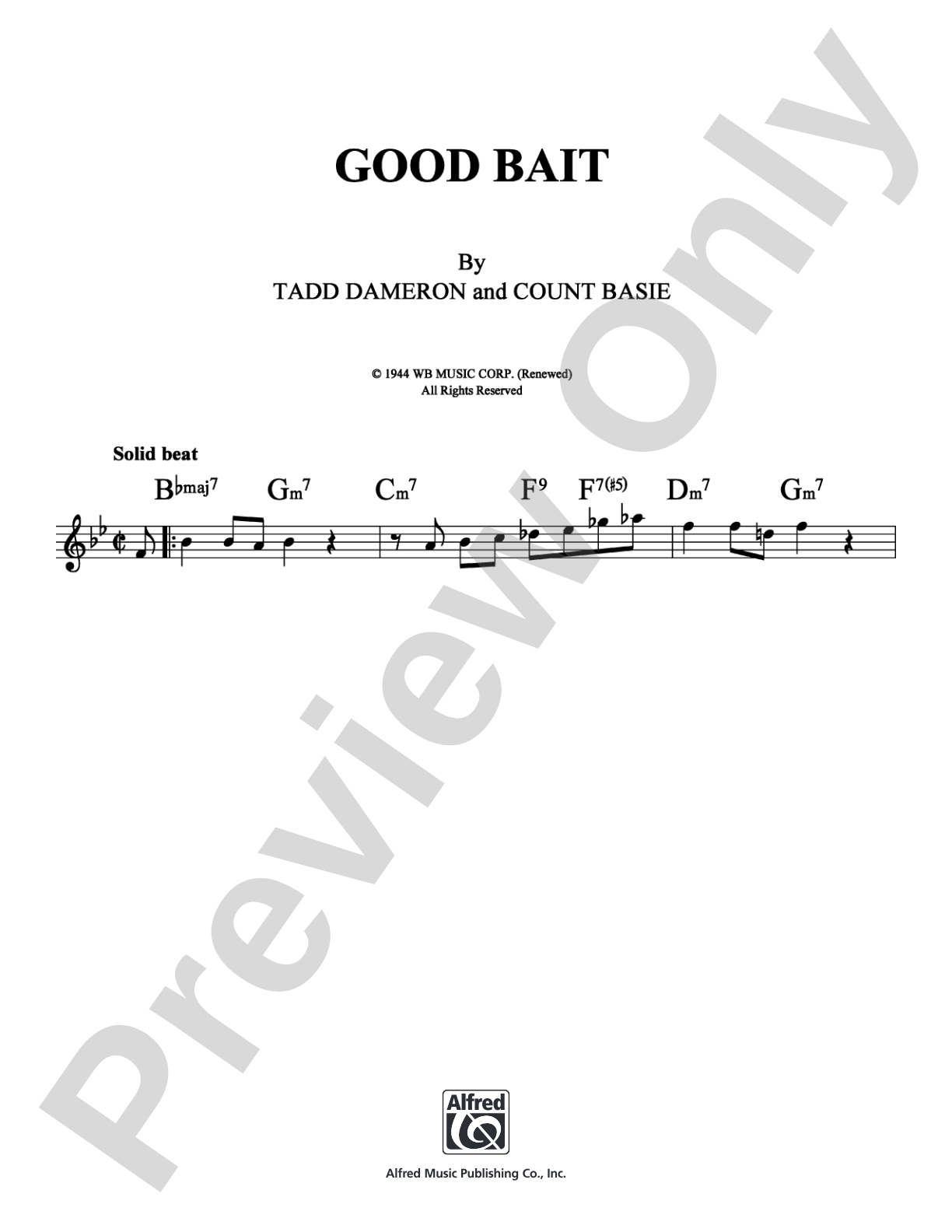
Good Bait: Lead Sheet Digital Sheet Music

Good Bait: Lead Sheet Digital Sheet Music

Tadd Dameron, Count Basie

Item: 00-PS-0009044

Digital Download
$1.99
Description

Good Bait: Lead Sheet Digital Sheet Music isn't in MakeMusic Cloud just yet...but it could be. Let us know you'd like to see it, and you'll help shape what comes next. In the meantime, start a free trial and dive into thousands of interactive titles your students can play along with today.

Sample Audio
No sample audio found.
Sample Video
Additional Details
SKU: 00-PS-0009044

More about this title

About the Artist: Tadd Dameron

Tadd Dameron (1917-1965) was a composer and bandleader whose harmonic sophistication and melodic inventiveness shaped the sound of bebop and cool jazz. His compositions for big band and small combo settings became standards of the jazz repertoire, recorded and reinterpreted by musicians across decades. Dameron's approach to writing combined complex chord changes with singable, memorable lines, making his work equally valued by improvisers and educators studying jazz harmony and composition.

Why we love this

Dameron's compositions demand real harmonic literacy from soloists while remaining deeply playable across skill levels. This lead sheet captures a melody with genuine character and a chord progression sophisticated enough to sustain serious study, yet accessible enough for musicians building their jazz standards vocabulary.

What to expect

Sophisticated yet unforced, with a melody that curves gracefully over intricate harmonic movement. The progression creates forward momentum and genuine harmonic surprise, inviting soloist and accompanist into genuine musical conversation rather than routine changes.

Who it's for

Jazz musicians preparing repertoire for jam sessions, combos, or study; bandleaders seeking addition to their standard charts; students of jazz composition and harmony interested in Dameron's approach to melody and chord progressions.

How to get the most out of it

  • Approach the melody with conversational phrasing rather than metronomic precision; Dameron's lines breathe between harmonic changes.
  • Lock into the harmonic movement before improvising. The changes reward clear chord tone awareness and guide natural solo development.
  • Treat the form as a compositional idea, not a restriction. Dameron's structures often suggest logical places to modulate or reharmonize during repeated choruses.
  • Listen to multiple recordings to hear how different improvisers navigate the harmonic landscape and shape their time across the changes.

How to use it

Feature this in a jazz ensemble concert or combo performance to showcase musicians comfortable with bebop-era harmony and composition. Include it in a program exploring essential Dameron standards or in a set demonstrating post-bebop compositional thinking.

Skills your students will build

  • Reading chord changes in real time and anticipating harmonic movement
  • Recognizing and improvising over ii-V progressions and extended jazz harmonies
  • Interpreting swing feel and conversational phrasing across complex melodies
  • Understanding how melody relates to underlying harmony in modern jazz composition

You May Also Like