

Gone, Gone, Gone: Choral Instrumental Pak
As performed by Phillip Phillips / Arranged by Mark Brymer
Item: 35-PK00286578
$20.00
Pickup currently not available
Buy Extra Parts (Digital PDF Download)
| Product | Price | Quantity |
|---|---|---|
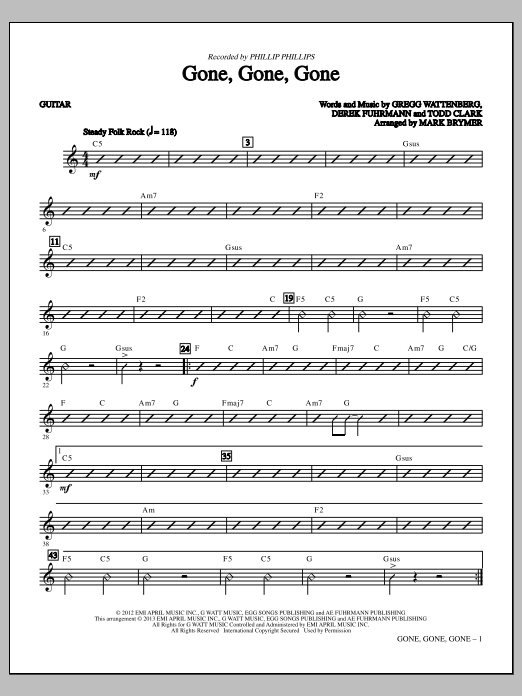
| Gone, Gone, Gone - Guitar: Choral Instrumental Pak | $7.00 | |
| Gone, Gone, Gone - Bass: Choral Instrumental Pak | $7.00 | |
| Gone, Gone, Gone - Drums: Choral Instrumental Pak | $7.00 |
Parts Added to Cart!
Description
From singer-songwriter and American Idol winner Phillip Phillips, this uplifting follow-up to his mega-hit "Home" is a tribute to the powerful connections between people, written in a rousing folk-rock style with pounding cadence-like drums and irresistible choruses.


Gone, Gone, Gone: Choral Instrumental Pak isn't in MakeMusic Cloud just yet...but it could be. Let us know you'd like to see it, and you'll help shape what comes next. In the meantime, start a free trial and dive into thousands of interactive titles your students can play along with today.
Request This Title
Tell us you want it.
Start Your Free Trial
Explore everything that's ready to play right now.
Sample Audio
No sample audio found.
Sample Video
No sample videos found.
Additional Details
Publisher:
Hal Leonard
SKU:
35-PK00286578
More about this title
About the Artist: Phillip Phillips
Phillip Phillips rose to prominence as the Season 11 American Idol winner in 2012, bringing authentic folk-rock sensibilities to a competition typically dominated by pop vocals. His debut single "Home" became a cultural phenomenon, introducing millions to his stripped-down, emotionally direct songwriting style. Beyond chart success, Phillips represents a valuable model for music educators: an artist who builds connection through honest melody and straightforward harmonic language rather than technical flash.
Why we love this
Mark Brymer's arrangement captures the infectious momentum of Phillips' original without sacrificing the folk-rock authenticity that made the song resonate. The pounding drums and rousing chorus provide exactly what ensemble singers crave: a clear rhythmic anchor and genuine energy that feels earned rather than manufactured. Your singers will recognize the song immediately, but the arrangement gives them something substantive to sink their teeth into.
What to expect
Warm, open-hearted, and propulsive. The arrangement builds from intimate verses into a swelling, communal chorus that celebrates human connection without sentimentality. It carries the musical honesty of folk music alongside the drive of rock, creating something that feels both intimate and stadium-ready.
Who it's for
Choirs seeking contemporary repertoire that lands immediately with student singers and audiences alike. Directors who want their singers engaged by music students actually know and care about. Groups that need an accessible, high-energy selection for pops concerts or end-of-year programs.
How to get the most out of it
- Lock the rhythm section into the drum pattern from the start; those pounding cadences are the heartbeat of the arrangement, so they need to sit rock-solid before the voices enter.
- Shape the chorus dynamics thoughtfully. The song invites belting, but clarity matters more than volume. Build through repetition and text emphasis rather than simply turning up the volume.
- Emphasize the folk-rock character by keeping the feel conversational in verses. This isn't a ballad or a classical chorale; the phrasing should feel natural and speech-like before the chorus hits.
- Balance solo moments (if your arrangement includes them) with the ensemble, making sure the lead voice sits within the overall sound rather than soaring above it.
How to use it
Pair this with other contemporary pop-rock selections for a modern set that showcases your ensemble's versatility beyond traditional choral literature. It works equally well as a closing number (the energy sustains through a full final chorus and out) or as a centerpiece of a themed program about connection and community. Consider programming it alongside acoustic folk arrangements to highlight how Brymer honors the original songwriting.
Skills your students will build
- Singing with rhythmic precision against a driving rock beat
- Maintaining phrase shape and legit tone while singing contemporary material
- Blending with instrumental accompaniment (drums, guitar, bass) rather than relying solely on vocal blend
- Understanding folk-rock musical idioms and authentic phrasing in modern contexts