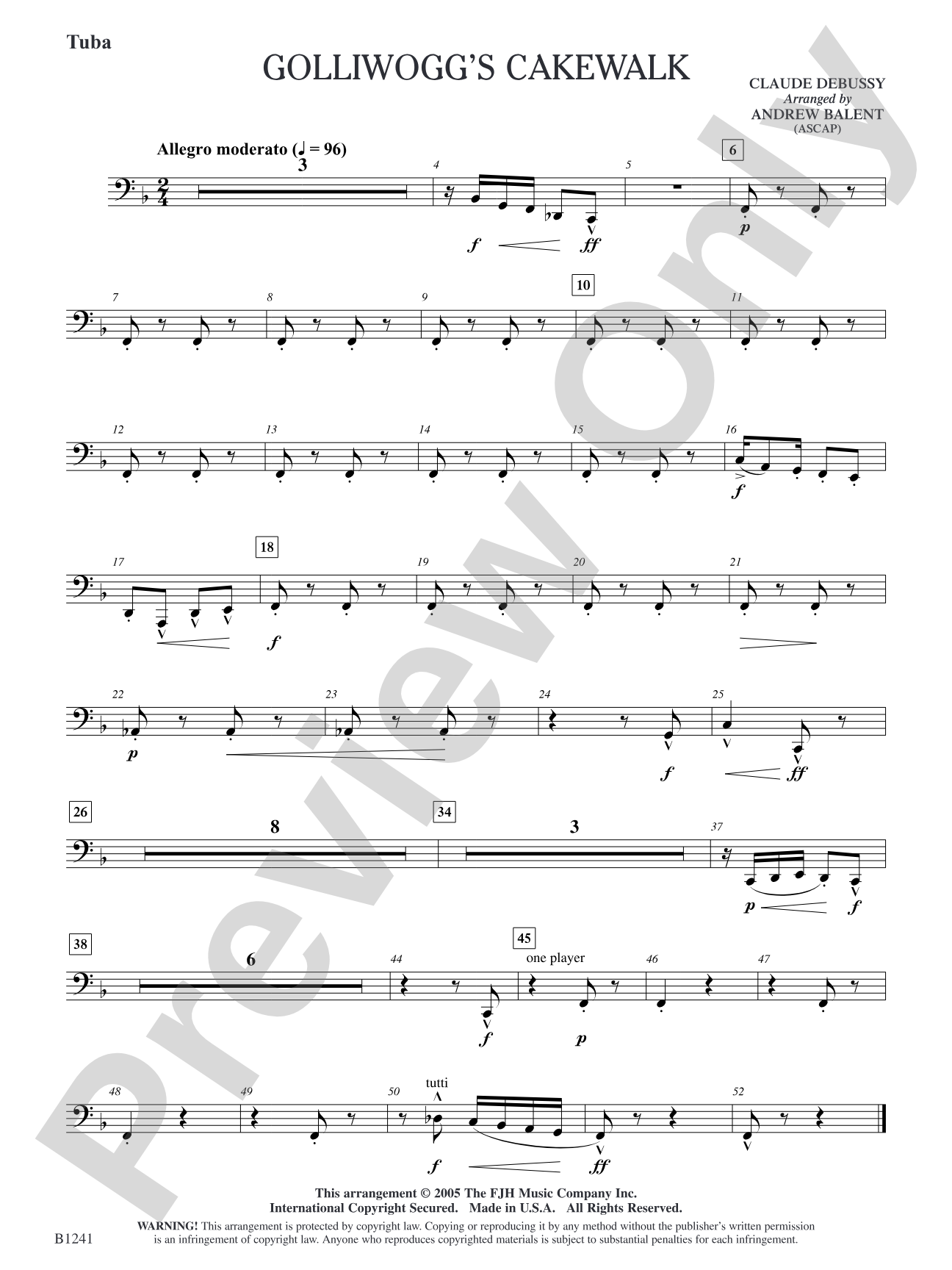
Golliwogg's Cakewalk: Tuba Sheet Music Preview

Golliwogg's Cakewalk: Tuba

By Claude Debussy / arr. Andrew Balent

Grade: 2.5

Item: 98-PC-DB1241_TB1

Digital Download
$7.00
Description
This excellent arrangement for young band captures all the musical intent of Debussy's original while being extremely accessible to young bands. Andrew Balent has edited the piece so that it remains largely in tact, yet holds student and audience interest throughout. A great choice for a light concert piece that also happens to be a classic.

Golliwogg's Cakewalk: Tuba isn't in MakeMusic Cloud just yet...but it could be. Let us know you'd like to see it, and you'll help shape what comes next. In the meantime, start a free trial and dive into thousands of interactive titles your students can play along with today.

Sample Audio
0:00
0:00
Sample Video
Additional Details
Series: FJH Young Band
Publisher: The FJH Music Company, Inc.
SKU: 98-PC-DB1241_TB1

More about this title

About the Composer: Claude Debussy

Claude Debussy (1862-1918) fundamentally reshaped how composers approached harmony, timbre, and form in the late 19th and early 20th centuries. His piano works, orchestral pieces, and songs prioritized sensory impression and color over rigid harmonic structure, influencing generations of composers across all genres. Debussy's output remains a cornerstone of music education because it demonstrates how constraint and restraint can communicate as powerfully as technical complexity.

Golliwogg's Cakewalk comes from the 1908 solo piano collection Children's Corner, where Debussy combines ragtime rhythms with his signature impressionistic harmonic language. The piece is often programmed as a concert opener or standalone novelty number because its playful character and memorable melody make it immediately accessible to audiences of all ages.

Why we love this

Andrew Balent's arrangement preserves Debussy's harmonic language and the infectious syncopated charm of the original without asking inexperienced musicians to navigate unnecessary doublings or exposed voicings. The Grade 2.5 scoring lets your ensemble sound sophisticated while remaining grounded in what young players can actually execute cleanly. It's the rare light piece that feels genuinely musical rather than filler.

What to expect

Lighthearted and rhythmically playful, with an undercurrent of Debussian sophistication. The piece moves between syncopated moments of ragtime energy and passages of gentle, shimmering harmony that remind listeners they're hearing an Impressionist master's sensibility filtered through American popular music of the early 20th century.

Who it's for

Grade 2.5 concert bands looking for a polished opening or closing number that combines musical substance with audience appeal. This works equally well for ensembles still building fundamental ensemble skills and for stronger groups that benefit from playing a Debussy classic arranged thoughtfully for their level.

How to get the most out of it

  • Shape the ragtime rhythms with precision rather than heaviness; the syncopation should swing naturally, not laboriously.
  • Balance the melodic line so it cuts through the accompaniment texture without sacrificing the harmonic support underneath.
  • Keep the tempo steady and resist the urge to rush during busier passages; young ensembles often accelerate when engaged by faster rhythmic figures.

How to use it

Use this as an opening concert piece to set an upbeat, engaging tone for your audience while demonstrating your ensemble's rhythmic precision and ability to balance clarity with ensemble blend. It pairs well with more serious repertoire on the same program because its lightness provides natural variety without undermining the concert's overall musicality.

Skills your students will build

  • Executing syncopated rhythms with accuracy and musicality
  • Balancing melody and harmonic accompaniment in a full ensemble texture
  • Maintaining steady tempo through rhythmic complexity
  • Playing with stylistic understanding of ragtime influences within a classical framework

You May Also Like