
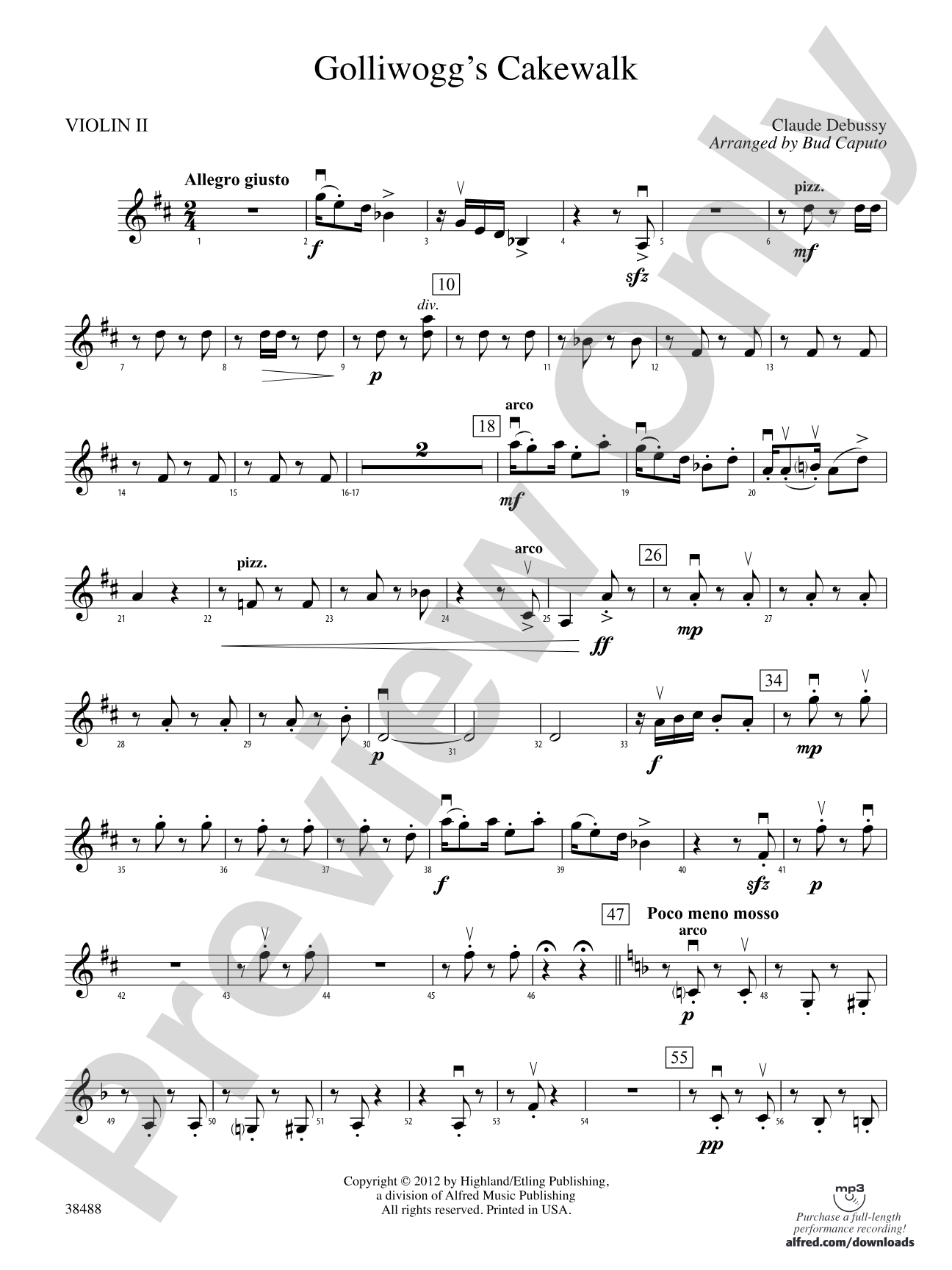

Golliwogg's Cakewalk: 2nd Violin
By Claude Debussy / arr. Bud Caputo
Grade: 3
Item: 00-PC-0015536_VN2
$5.99
Pickup currently not available
Description
Inspired by ragtime, this arrangement celebrates Claude Debussy's 150th birthday. Lively and fun to play, this piece offers the chance to explore various dynamic changes and accented playing.


Don't just read it, hear it, play along with it, and watch your students grow with it. In MakeMusic Cloud, Golliwogg's Cakewalk: 2nd Violin comes alive with professional accompaniment, adjustable tempo, and built-in practice tools that turn solo practice into real progress.
Open in the Player
Jump straight in and assign it today.
Start Your Free Trial
Open this title and explore the full library in minutes.
Sample Audio
1
Audio File
--:--
0:00
0:00
Sample Video
No sample videos found.
Additional Details
Series:
Highland/Etling String Orchestra
Publisher:
Alfred Music
Page Count:
124
SKU:
00-PC-0015536_VN2
More about this title
About the Composer: Claude Debussy
Claude Debussy (1862-1918) was a French composer who fundamentally reshaped how musicians think about harmony, orchestration, and color. Rather than following the dense harmonic structures of his Romantic predecessors, Debussy explored impressionistic sonorities, using whole-tone scales, parallel chords, and innovative orchestration to paint musical landscapes. His influence extends across all musical traditions; his work taught composers and arrangers how to prioritize timbre and atmosphere alongside melody and form.
Debussy's "Golliwogg's Cakewalk" appears in his 1908 suite for solo piano, "Children's Corner," where it captures the playful energy of American ragtime and cakewalk music that fascinated European audiences at the time. The piece balances humor and sophistication, making it an enduring favorite for educators seeking repertoire that combines accessible joy with genuine compositional craft.
Why we love this
This arrangement brings Grade 3 ensembles into genuine contact with Impressionistic orchestration without oversimplifying Debussy's harmonic language. The ragtime character makes it immediately engaging for young players, while the dynamic and articulation markings demand real attention to detail, lifting the piece beyond simple entertainment into a learning tool for nuanced musical expression.
What to expect
The piece sparkles with mischief and infectious rhythm. Debussy captures the energy of early 20th-century American entertainment with a wink; the orchestration dances between shimmering harmonic blocks and driving syncopated lines, creating an irresistible sense of movement and humor. Players feel the buoyant character immediately, making rehearsals feel more like play than work.
Who it's for
Conductors of Grade 3 string orchestras who want to program a piece that satisfies the "fun and accessible" requirement while introducing students to a major compositional voice in classical music. This works equally well for concert performance and festival competition, offering enough musical substance to impress adjudicators and audiences alike.
How to get the most out of it
- Shape each dynamic shift deliberately rather than rushing through them; the contrast between accented passages and softer sections creates the piece's rhythmic vitality.
- Anchor the ragtime rhythm in the lower strings while allowing the upper voices rhythmic independence; this captures Debussy's playful approach to syncopation.
- Listen across the string sections during the shifting harmonic colors; Debussy's orchestration relies on blend and balance to create the intended impressionistic wash.
- Treat the accented notes as points of emphasis, not aggression; they should sparkle and surprise rather than overwhelm the texture.
How to use it
This arrangement fits perfectly as a concert opener or closer; its upbeat character and manageable length (124 pages of score and parts) make it ideal for establishing audience rapport. It also pairs effectively with other Impressionistic works or lighter classical pieces when you're building a program that celebrates orchestral color and accessibility.
Skills your students will build
- Dynamic control and contrast (shifting between accented and soft articulation)
- Syncopated rhythm reading and ensemble coordination
- Listening for harmonic color and blend across string sections
- Articulation precision (particularly accented vs. unaccented notes)
- Stylistic awareness of Impressionistic orchestration and ragtime idioms