
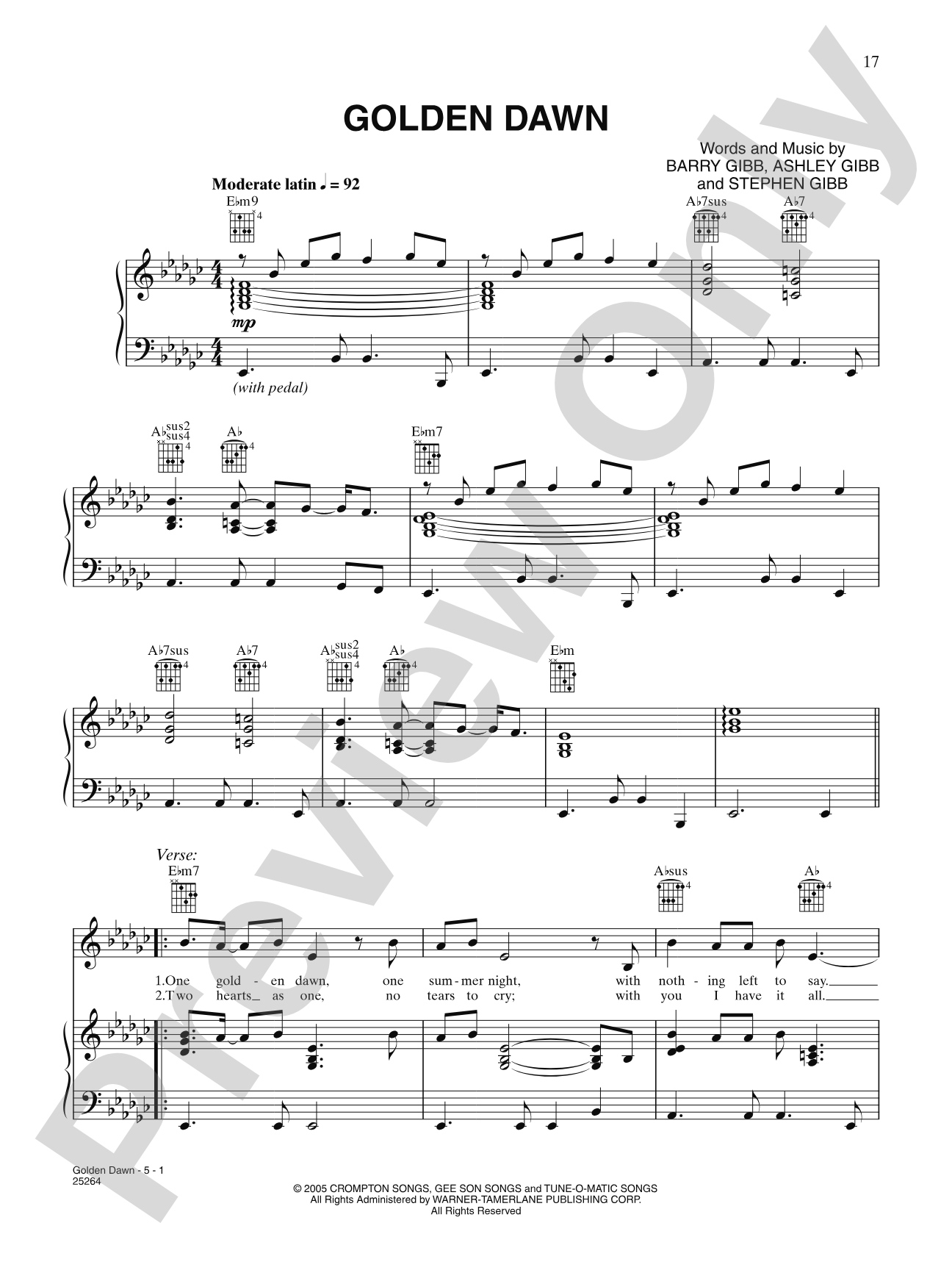

Golden Dawn: Piano/Vocal/Chords
Barbra Streisand
Item: 00-PSP-000019
$4.99
One moment…
Related Items
(Our Love) Don'T Throw It All Away: Piano/Vocal/Chords |
$5.99
|
View | |
Above The Law: Piano/Vocal/Chords |
$5.99
|
View | |
All The Children: Piano/Vocal/Chords |
$5.99
|
View | |
Come Tomorrow: Piano/Vocal/Chords |
$9.99
|
View | |
Hideaway: Piano/Vocal/Chords |
$5.99
|
View | |
Letting Go: Piano/Vocal/Chords |
$4.99
|
View | |
Night Of My Life: Piano/Vocal/Chords |
$5.99
|
View | |
Stranger In A Strange Land: Piano/Vocal/Chords |
$5.99
|
View | |
Without Your Love: Piano/Vocal/Chords |
$5.99
|
View |
Description
Alfred is pleased to present the album-matching folio for Barbra Streisand's CD, Guilty Pleasures. Guilty Pleasures is Barbra Streisand's 2005 collaborative album with producer/songwriter/vocalist Barry Gibb. The release of Guilty Pleasures comes 25 years after the pair's first multi-platinum album, Guilty, which made pop music history as a worldwide chart-topping smash released in 1980. This book provides the lyrics with piano and chord arrangements for all the songs on the record.
Titles are: Come Tomrrow * Stranger in a Strange Land * Hideaway * It's Up to You * Night of My Life * Above the Law * Without Your Love * All the Children * Golden Dawn * (Our Love) Don't Throw It All Away * Letting Go.


Titles are: Come Tomrrow * Stranger in a Strange Land * Hideaway * It's Up to You * Night of My Life * Above the Law * Without Your Love * All the Children * Golden Dawn * (Our Love) Don't Throw It All Away * Letting Go.
Golden Dawn: Piano/Vocal/Chords isn't in MakeMusic Cloud just yet...but it could be. Let us know you'd like to see it, and you'll help shape what comes next. In the meantime, start a free trial and dive into thousands of interactive titles your students can play along with today.
Request This Title
Tell us you want it.
Start Your Free Trial
Explore everything that's ready to play right now.
Sample Audio
No sample audio found.
Sample Video
No sample videos found.
Additional Details
Publisher:
Alfred Music
Page Count:
72
SKU:
00-PSP-000019
More about this title
About the Artist: Barbra Streisand
Barbra Streisand stands as one of the most technically accomplished vocalists in popular music, with a career spanning over six decades. Her interpretive gifts and precise control across a three-octave range have made her a gold standard for singers studying phrasing, dynamics, and emotional communication through song.
Why we love this
This folio captures a landmark collaboration between two legendary artists at their peak, pairing Streisand's vocal sophistication with Barry Gibb's melodic sensibility. The chord voicings and piano arrangements are thoughtfully crafted to support both singers and pianists, making these songs accessible for varied skill levels while preserving the album's emotional depth. Guilty Pleasures offers a refreshing departure from typical pop repertoire commonly seen in voice studios and rehearsal rooms.
What to expect
These songs balance introspection with warmth, moving between intimate confession and soaring melodic statements. The production aesthetic emphasizes lush harmonies and conversational phrasing, creating a sense of two artists in genuine dialogue rather than performing for an audience.
Who it's for
This folio serves pianists and vocalists preparing audition or recital material from contemporary pop repertoire, as well as duet singers exploring the Streisand-Gibb catalog. It works equally well for musicians in community theater, cabaret, or jazz settings who want accessible arrangements of sophisticated popular songs.
How to get the most out of it
- Study Streisand's phrasing on the original recordings; her use of rubato and breath placement shape the melodic line in ways that notation alone cannot capture.
- Balance the vocal melody with piano accompaniment by thinking of the keyboard as a harmonic foundation rather than a competing voice.
- Lean into the chord colors Gibb favors; these voicings often sit in unexpected registers that create warmth and intimacy when played with intention.
- Use the lyrical arc to shape dynamics across entire phrases rather than individual measures; these songs reward long-line singing.
How to use it
Pair individual tracks from this collection with art song or musical theater repertoire to create a recital that spans multiple genres and eras. The accessibility of these arrangements makes them useful for studio teachers looking to build students' confidence with contemporary material before tackling more classical vocal literature.
Skills your students will build
- Reading chord symbols and realizing accompaniments in contemporary pop style
- Interpreting lyrical subtext and emotional storytelling in popular song
- Balancing vocal melody with keyboard accompaniment
- Understanding harmonic color and voice-leading in contemporary arrangements
- Phrasing and rubato in non-classical contexts