
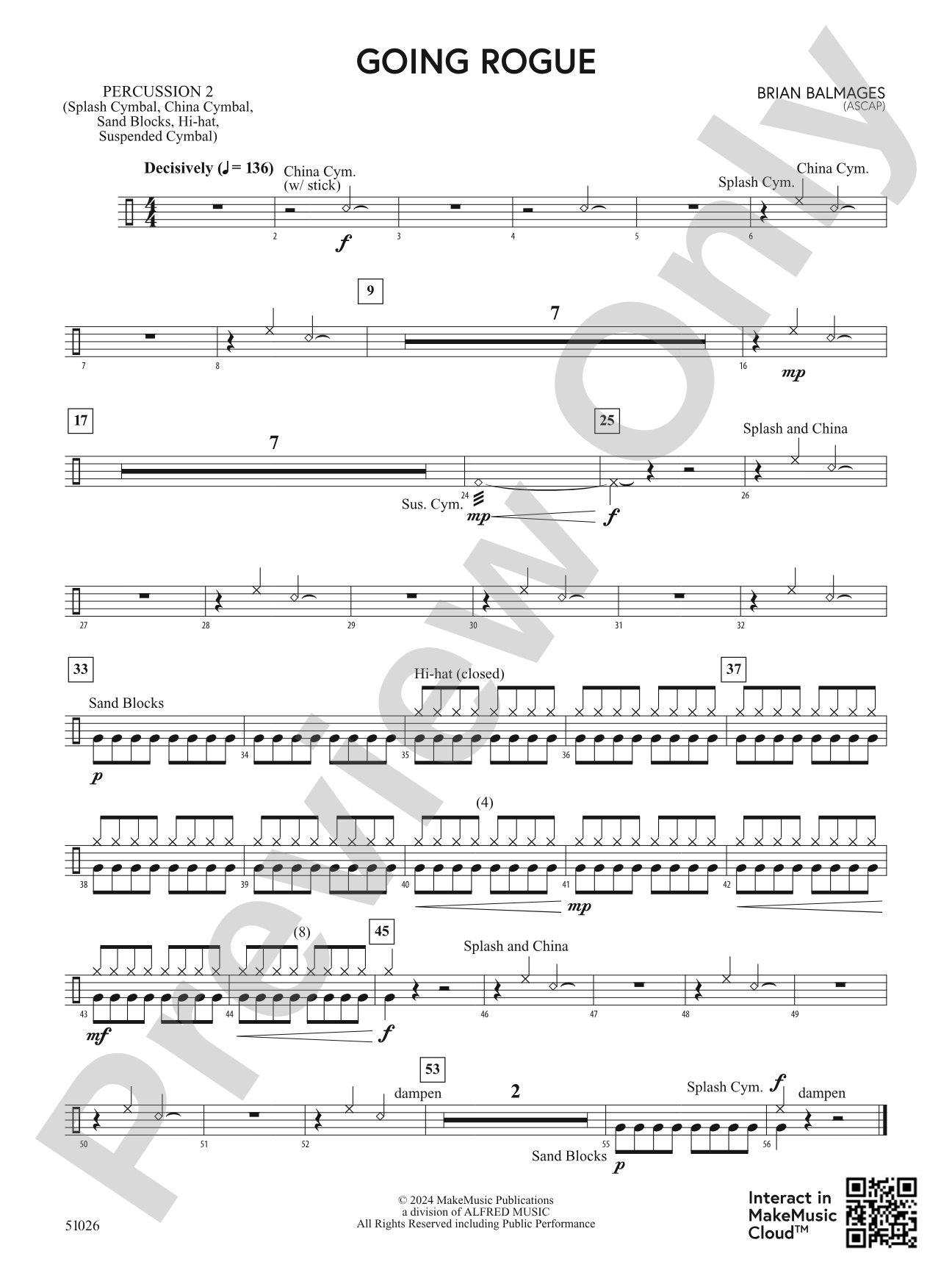

Going Rogue: 2nd Percussion
By Brian Balmages
Grade: 0.5
Item: 00-PC-0019237_PC2
$5.99
Pickup currently not available
Description
The plan is set. The team is assembled. Everything is in motion until one person goes rogue in a brazen attempt to keep everyone else out of harm's way. Will they save the mission, or will they jeopardize the entire team? Only time will tell. Going Rogue by Brian Balmages is a high-stakes adventure with incredible harmonies and colors, yet extremely playable by first-year students! (1:45)


Don't just read it, hear it, play along with it, and watch your students grow with it. In MakeMusic Cloud, Going Rogue: 2nd Percussion comes alive with professional accompaniment, adjustable tempo, and built-in practice tools that turn solo practice into real progress.
Open in the Player
Jump straight in and assign it today.
Start Your Free Trial
Open this title and explore the full library in minutes.
Sample Audio
1
Audio File
--:--
0:00
0:00
Sample Video
Additional Details
Series:
MakeMusic First Performance Band
Publisher:
MakeMusic Publications
SKU:
00-PC-0019237_PC2
More about this title
About the Composer: Brian Balmages

Brian Balmages has built an international reputation as a composer and conductor working across orchestral, band, and chamber music. His works have been heard at Carnegie Hall, the Kennedy Center, Sydney Opera House, and the Toronto Centre for the Arts, performed by ensembles ranging from professional orchestras to school groups. He received the A. Austin Harding Award from the American School Band Directors Association, won the 2020 NBA William D. Revelli Composition Contest for Love and Light, and holds membership in the American Bandmasters Association.
Balmages has served as a guest conductor at the Midwest Clinic, Western International Band Clinic, College Band Directors Conference, and numerous regional and state conferences. His music was performed during the 2013 Presidential Inaugural Prayer Service. He currently serves as Director of MakeMusic Publications and Digital Education for Alfred and MakeMusic, and earned the inaugural James Madison University Distinguished Alumni Award from the School of Visual and Performing Arts.
Why we love this
Balmages delivers a rare combination here: a programmatic work that captures genuine dramatic tension without overwhelming first-year musicians. The story unfolds naturally through accessible orchestration and inventive colors, so students experience the emotional arc while staying confident with their parts. Contest and festival seasons need pieces like this one that engage audiences while keeping rehearsal demands reasonable.
What to expect
Going Rogue pulses with mission-driven energy and calculated risk. The harmonies shift beneath a clear dramatic arc, building from coordinated precision to a moment of bold defiance, then settling into resolution. You feel the tension of a single person acting alone against the group, rendered in instrumental color and momentum.
Who it's for
First-year and second-year concert band students who are ready to engage with a narrative that demands musical maturity. Directors building programs around contest or festival opportunities will find a piece that impresses without excessive technical demand.
How to get the most out of it
- Balance the harmonic layers so the melodic ideas read clearly even when supported by thicker accompaniment; use dynamics as your guide to highlight the central narrative moment.
- Let the opening tempo establish the mission's precision, then allow subtle rubato in the dramatic climax to heighten the stakes before resolving.
- Shape phrases by listening for where harmonic tension builds rather than treating measures as isolated units; this approach unifies the band's interpretation.
- Encourage woodwinds and brass to commit fully to the color changes Balmages writes; these moments define the character's journey and make the story land with audiences.
How to use it
This piece works powerfully as a centerpiece for a contest or festival program where the story resonates with audiences beyond the school walls. Its accessibility also makes it an excellent choice for early-season concerts that showcase growth, since students can perform it confidently while still discovering its programmatic depth through rehearsal.
Skills your students will build
- Shaping phrase contours through dynamic control and harmonic awareness
- Responding to programmatic cues to inform musical choices
- Blending within harmonic textures to support the ensemble sound
- Interpreting stylistic indications that build dramatic tension