
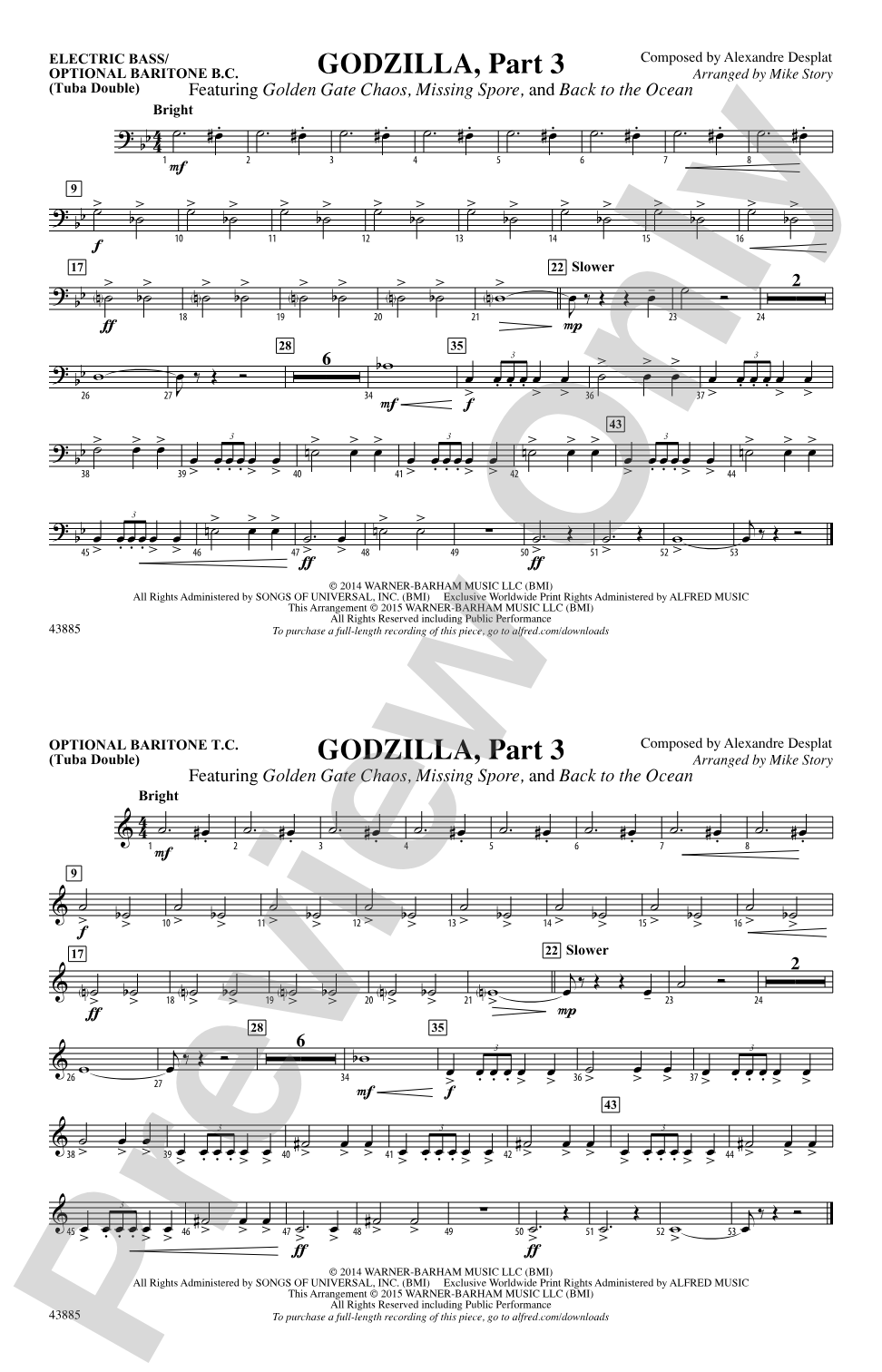

Godzilla, Part 3: Electric Bass
Featuring: Golden Gate Chaos / Missing Spore / Back to the Ocean
Composed by Alexandre Desplat / arr. Mike Story
Grade: 2 (Easy)
Item: 00-PC-0016969_EB
$3.00
Pickup currently not available
Description
To conclude our Godzilla show, Mike Story opens with a powerful theme that gives way to a short trumpet solo, followed by a quiet section featuring wistful chords in the woodwinds and mallets. This quickly builds to the heroic final theme, which in turn builds in intensity to bring the show to a stunning conclusion. (2:05)


Don't just read it, hear it, play along with it, and watch your students grow with it. In MakeMusic Cloud, Godzilla, Part 3: Electric Bass comes alive with professional accompaniment, adjustable tempo, and built-in practice tools that turn solo practice into real progress.
Open in the Player
Jump straight in and assign it today.
Start Your Free Trial
Open this title and explore the full library in minutes.
Sample Audio
1
Audio File
--:--
0:00
0:00
Sample Video
No sample videos found.
Additional Details
Series:
Big and Easy
Publisher:
Alfred Music
Page Count:
136
SKU:
00-PC-0016969_EB
More about this title
About the Composer: Alexandre Desplat
Alexandre Desplat has become one of the most recorded film composers of the 21st century, with a gift for crafting memorable themes that serve narrative arcs across multiple films. His work spans fantasy, drama, and action; he's composed for the Harry Potter series, Fantastic Beasts, The Grand Budapest Hotel, and many others. His music is characterized by lyrical melodies balanced with orchestral sophistication, making his themes ideal for adaptation across ensemble sizes.
Why we love this
Mike Story's arrangement respects Desplat's cinematic architecture while building something entirely effective for marching ensemble. The structure mirrors a complete story in just over two minutes: a strong opening statement, a lyrical interlude that gives your ensemble breathing room, and a climactic finale that builds naturally without requiring advanced technique. Grade 2 scoring means your students get to play genuinely satisfying music, not stripped-down approximations.
What to expect
The opening hits like a monster revealed, all presence and urgency. Then the music pulls back into something reflective and mysterious, with shimmering woodwind textures that suggest wonder or unease. The final push toward resolution feels inevitable and earned, building from whisper to roar without ever asking your students to play beyond their ability.
Who it's for
Directors building a Godzilla show or executing a multi-movement film music program will find this conclusion piece essential. It works for bands with solid fundamentals in brass and woodwind blend but without the technical demands of advanced Grade 3 or 4 literature. The part-writing ensures every section has engaging material.
How to get the most out of it
- Shape the opening theme with dynamic clarity. The power comes from ensemble cohesion and precise articulation, not volume alone. Lock the weight of the opening statement before the trumpet solo enters.
- Slow the tempo slightly during the wistful woodwind section to let the chords register with the audience. This moment works as contrast only if the ensemble collectively shifts its approach.
- Build intensity gradually through the final theme rather than jumping to full energy immediately. Marching bands often rush climaxes; incremental crescendos across 8 or 16 bars feel more dramatic than jumping straight to fortissimo.
- Balance the mallets throughout. They carry harmonic color in the quiet section and rhythmic momentum in the finale. Ensure they're heard without overpowering melodic lines.
How to use it
This functions as the payoff movement in a multi-part show structure, so pair it with the earlier Godzilla movements for dramatic continuity. Alternately, it stands alone as a closer to a concert featuring other film or contemporary music, where its accessible Grade 2 writing lets you showcase your ensemble's musicianship without technical barriers. The clear arc and satisfying conclusion make it memorable for audiences.
Skills your students will build
- Shaping phrases across 8 and 16-bar sections with dynamic control
- Balancing texture between melody, harmony, and percussion
- Contrast in articulation and tone quality between sections (powerful vs. wistful)
- Ensemble cohesion in exposed ensemble passages
- Reading and executing dynamic marking precision as part of form