
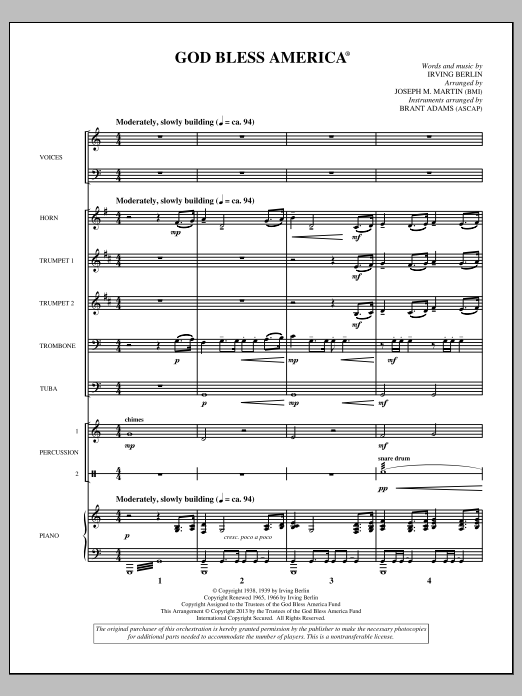

God Bless America: Choral Instrumental Pak
By Irving Berlin / Arranged by Joseph Martin
Item: 35-PK00278679
$40.00
Pickup currently not available
Buy Extra Parts (Digital PDF Download)
Parts Added to Cart!
Description
Uses: Patriotic
Scripture: II Chronicles 7:14; Psalm 33:12
Truly a song that needs no introduction! This national treasure is arranged for success with power and respect for the original song. Quoting "America the Beautiful," the arrangement begins with a flourish before settling into the opening, less performed verse of the Irving Berlin standard. Gradually building to a massive finale, this anthem will have the audience singing along and cheering even before the final notes are sounded.


God Bless America: Choral Instrumental Pak isn't in MakeMusic Cloud just yet...but it could be. Let us know you'd like to see it, and you'll help shape what comes next. In the meantime, start a free trial and dive into thousands of interactive titles your students can play along with today.
Request This Title
Tell us you want it.
Start Your Free Trial
Explore everything that's ready to play right now.
Sample Audio
No sample audio found.
Sample Video
No sample videos found.
Additional Details
Publisher:
Hal Leonard
SKU:
35-PK00278679
More about this title
About the Composer: Irving Berlin
Irving Berlin (1888-1989) stands as one of America's most prolific songwriters, composing over 1,000 songs across Broadway musicals, Hollywood films, and popular standards. His gift for melody and his ability to capture the American spirit made him a central figure in 20th-century music. Berlin wrote "God Bless America" in 1918, initially as a patriotic song for a World War I benefit, and it became an unofficial second national anthem.
For music educators, Berlin's work offers straightforward, singable material grounded in functional harmony and clear form. His songs have shaped generations of singers and remain invaluable teaching tools for understanding popular song structure, text setting, and how melody serves emotional intent.
Why we love this
Joseph Martin's arrangement respects the integrity of Berlin's melody while creating genuine drama through orchestration and structural pacing. The decision to open with a quotation from "America the Beautiful" gives the piece a grounded, recognizable entry point, and the choice to feature the lesser-known opening verse adds substance and prevents the arrangement from feeling predictable. By the time the finale arrives, the build feels earned rather than imposed.
What to expect
The piece unfolds with reverence before gathering momentum into something celebratory and unifying. There is genuine majesty in the orchestration, yet the arrangement never becomes overstuffed; instead, it feels spacious and allows the text to carry weight alongside the melody. By the finale, it becomes a shared experience rather than a performance.
Who it's for
This arrangement serves directors programming patriotic or civic occasions, from Independence Day concerts to Veterans Day tributes and community celebrations. It works equally well for high school and college choirs and pairs naturally with other Americana repertoire or national commemorative events.
How to get the most out of it
- Balance the opening "America the Beautiful" quotation clearly so audiences recognize it before settling into Berlin's familiar tune.
- Shape the verse dynamically; resist the temptation to let it sit quietly just because it's less familiar. The gradual building works only if the verse has musical presence.
- Trust the arrangement's pacing toward the finale rather than pushing the tempo. The power comes from the cumulative effect, not from rushing.
- Engage the audience participation in the closing section deliberately. Rehearse the exact moment where you want them to join and prepare your singers to lead that moment with conviction.
How to use it
Position this as a finale or near-finale on any program centered around American identity, patriotism, or gratitude. It also serves powerfully as an opener for a concert where you want to establish a civic or ceremonial tone. The arrangement's respect for the original means it can anchor a program mixing standards with contemporary work without feeling out of place.
Skills your students will build
- Singing with textual clarity and emotional resonance in a standard American song
- Responding to dynamic architecture and phrasing across an extended piece
- Balancing vocal line with orchestral accompaniment in varying textures
- Engaging ensemble cohesion during moments designed for audience participation