
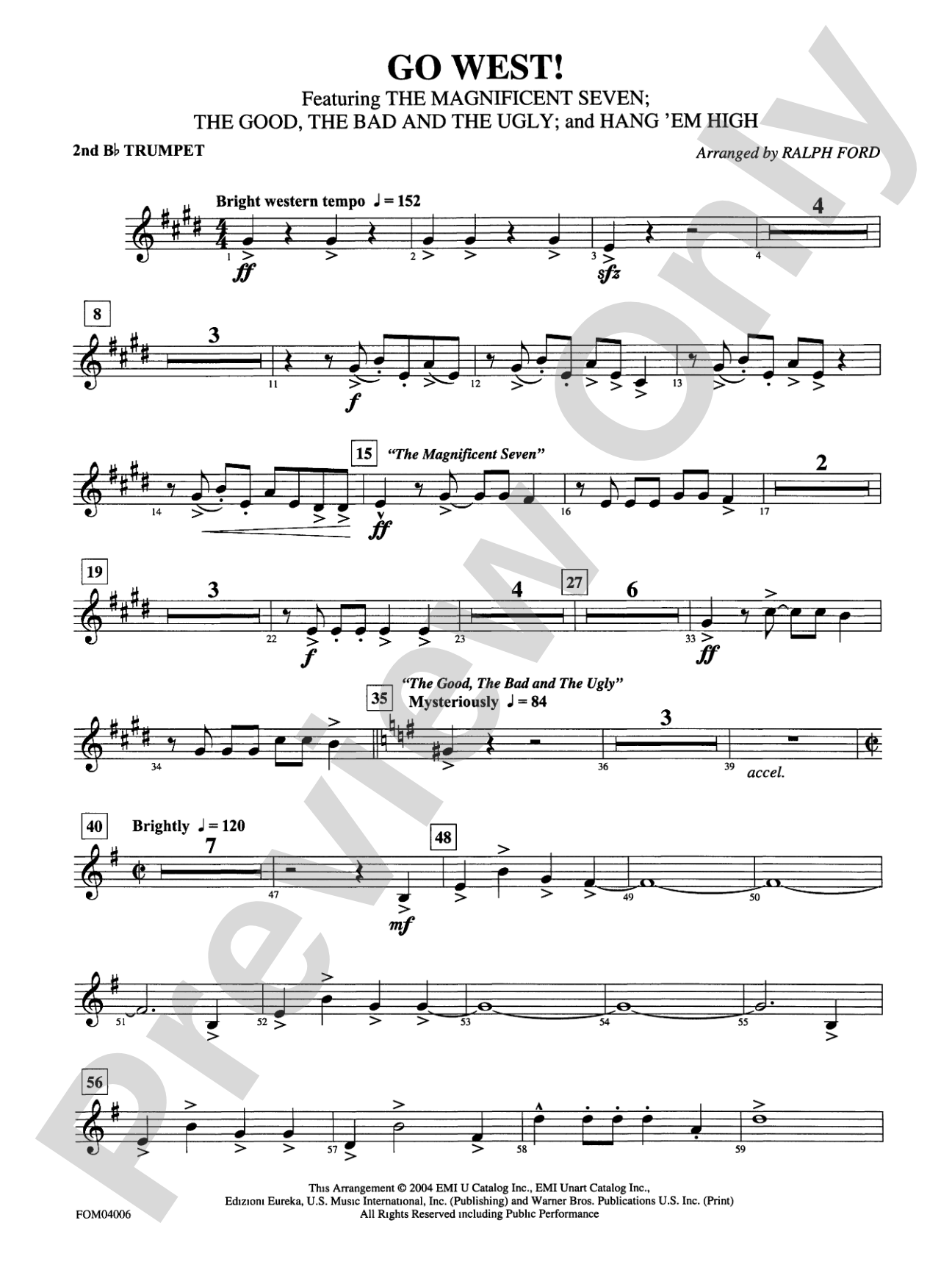

Go West! (Medley): 2nd B-flat Trumpet
Featuring: The Magnificent Seven / The Good, the Bad, and the Ugly / Hang 'Em High
Various / arr. Ralph Ford
Grade: 2
Item: 00-PC-0016109_T2
$3.00
Pickup currently not available
Description
Ride 'em Cowboy! In 2007 Ennio Morricone was awarded the Lifetime Achievement Award at the Academy Awards. Here's a high-energy medley of western favorites for the intermediate full or string orchestra. Favorite themes included "The Magnificent Seven," "Hang 'Em High," and "The Good, the Bad, and the Ugly." This spirited arrangement will bring the crowd to their feet! (2:50)


Don't just read it, hear it, play along with it, and watch your students grow with it. In MakeMusic Cloud, Go West! (Medley): 2nd B-flat Trumpet comes alive with professional accompaniment, adjustable tempo, and built-in practice tools that turn solo practice into real progress.
Open in the Player
Jump straight in and assign it today.
Start Your Free Trial
Open this title and explore the full library in minutes.
Sample Audio
1
Audio File
--:--
0:00
0:00
Sample Video
Additional Details
Series:
Pop Intermediate String/Full Orchestra
Publisher:
Alfred Music
Page Count:
248
SKU:
00-PC-0016109_T2
More about this title
About the Arranger: Ralph Ford
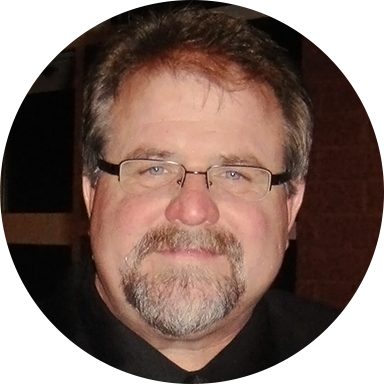
Ralph Ford has built a career spanning composition, arrangement, conducting, and education across multiple musical and media contexts. Since the mid-1980s, he has maintained a faculty position while simultaneously working as an exclusive composer and arranger for Alfred Music's Belwin division, accumulating over 250 published titles for orchestra, concert band, jazz ensemble, and marching band.
Beyond the concert hall, Ford has contributed extensively to broadcast and commercial media, including radio and television production, jingle composition, and news package creation for national networks. His early experience as a student arranger in Panama City, Florida, led to his appointment as Director of Jazz Ensemble I during his undergraduate years at Troy State University, a role he maintained for fifteen years alongside his faculty work in orchestration, theory, and applied instruction.
Why we love this
Ford's arrangement captures the swagger and drama of these iconic western themes without losing the accessibility your intermediate orchestra needs. The medley format lets you program major film moments in one engaging package, and at Grade 2, your players can focus on character and energy rather than fighting the notes.
What to expect
Dust, sunsets, and forward motion. Ford's orchestration brings these classic western themes to vivid life with driving rhythms, soaring melodies, and the kind of cinematic sweep that makes audiences sit up and pay attention. It's energetic without being frantic, memorable without being trivial.
Who it's for
Intermediate full orchestras and string orchestras seeking repertoire with immediate appeal and straightforward technical demands. This works equally well for school orchestras building confidence with familiar material or community ensembles prioritizing engagement and fun without sacrificing musicality.
How to get the most out of it
- Emphasize the rhythmic drive in the opening. These themes thrive on crisp articulation and forward momentum; a sluggish tempo drains the western spirit entirely.
- Balance the brass section carefully during the melodic statements. They should support rather than overshadow the primary themes, especially when strings carry the main line.
- Mark clear transitions between movements of the medley. Conductor precision here prevents the piece from feeling like a collection of fragments instead of a cohesive adventure.
- Lean into the dramatic moments without sentimentality. The scoring asks for character, but restraint makes the peaks more effective.
How to use it
Program this as a concert closer or early-season piece to establish audience connection and build orchestra confidence. The recognizable material and high energy make it ideal for pops concerts, family matinees, or any program that benefits from a crowd-pleasing finale with substance behind it.
Skills your students will build
- Reading and executing syncopated rhythmic figures across ensemble sections
- Balancing exposed melodies with accompanying figures in a medley format
- Responding to conductor cues during thematic transitions and tempo changes
- Sustaining rhythmic integrity in repeated figures while maintaining musical line
- Coordinating articulation and dynamic contrast across mixed orchestral voicings