
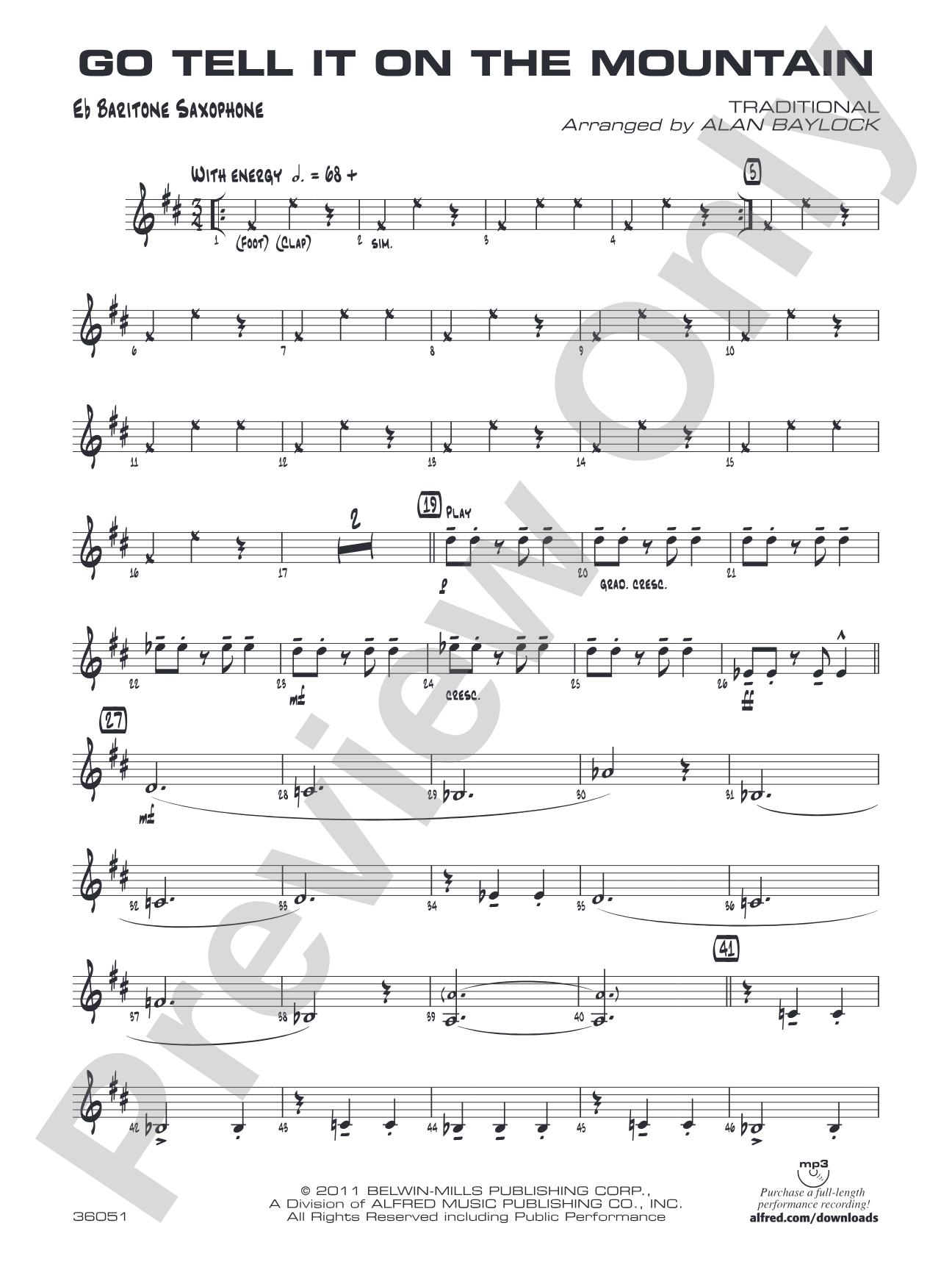

Go Tell It on the Mountain: E-flat Baritone Saxophone
Traditional / arr. Alan Baylock
Grade: 3 (Medium)
Item: 00-PC-0017196_BTX
$3.00
Pickup currently not available
Description
Play this jazz waltz will work for the holidays or any season! Beginning with claps and foot stomps, the chart builds throughout. Includes a written-out alto solo and lead trumpet range to written B-flat above the staff. Adapted from a chart originally written for the USAF Airmen of Note. (4:35) This title is available in MakeMusic Cloud.


Don't just read it, hear it, play along with it, and watch your students grow with it. In MakeMusic Cloud, Go Tell It on the Mountain: E-flat Baritone Saxophone comes alive with professional accompaniment, adjustable tempo, and built-in practice tools that turn solo practice into real progress.
Open in the Player
Jump straight in and assign it today.
Start Your Free Trial
Open this title and explore the full library in minutes.
Sample Audio
1
Audio File
--:--
0:00
0:00
Sample Video
No sample videos found.
Additional Details
Series:
Jazz Band Series
Publisher:
Alfred Music
Page Count:
98
SKU:
00-PC-0017196_BTX
More about this title
About the Arranger: Alan Baylock

Alan Baylock has shaped the sound of American jazz through decades of arranging and composing at the highest levels. His 20-year tenure as Chief Arranger for the U.S. Air Force Band's Airmen of Note established him as a master orchestrator, and he has since guest-conducted over 100 jazz ensembles from high school through professional ranks while leading the Grammy-nominated One O'Clock Lab Band at the University of North Texas. His compositions and arrangements have been performed by an extraordinary array of artists including Melissa Aldana, the Brecker Brothers, Joshua Redman, and Maynard Ferguson, among many others.
Beyond his performing and composing work, Baylock is deeply invested in jazz education and equity in the field. He served as faculty at the National Jazz Workshop and as Jazz Composer-in-Residence at Shenandoah University, and in 2022 co-founded Brava Jazz Publishing with Annie Booth to advance the publication and performance of women composers and arrangers in big band jazz. His work bridges the professional and educational worlds, making him uniquely positioned to write charts that both challenge and inspire student musicians.
Why we love this
Baylock's deep experience writing for the Airmen of Note means this chart combines professional-level sophistication with genuine accessibility for Grade 3 ensembles. The written-out alto solo and carefully managed lead trumpet range give your soloists real showcase moments without demanding virtuosity, while the rhythmic foundation (claps, foot stomps, building arrangement) keeps the entire ensemble engaged and visible in the performance.
What to expect
The piece unfolds from a rhythmic, participatory opening into a swinging waltz with warmth and lift. Claps and foot stomps ground the ensemble in tactile musicality, while the arrangement blooms gracefully, inviting listeners to move with its unforced momentum and creating moments of real ensemble pride.
Who it's for
Jazz ensembles at the Grade 3 level (middle school through early high school) ready for a chart with professional roots and genuine musical architecture. Directors seeking a holiday or secular seasonal piece that works year-round and features accessible but meaningful solo moments will find this especially useful.
How to get the most out of it
- Establish the groove pocket with your rhythm section before rehearsing the full ensemble; the claps and foot stomps need to feel organic rather than metronomic.
- Balance the alto solo against the ensemble background so the written part cuts through without asking the soloist to play above the staff.
- Work the dynamic build intentionally section by section so the chart's cumulative energy feels earned rather than sudden.
- Let the lead trumpet breathe at its high points (written B-flat and above); secure intonation matters more than relentless volume.
How to use it
Program this during winter concerts, holiday showcases, or spring performances when you want a sophisticated secular piece that feels accessible and celebratory. It works equally well as a concert opener (the claps draw the audience in immediately) or as a mid-set energy lift on a longer program.
Skills your students will build
- Jazz waltz time feel and swing phrasing in 3/4 meter
- Balancing solo and ensemble roles with appropriate dynamic control
- Reading chord changes and jazz voicings at Grade 3 difficulty
- Rhythmic precision with written percussion and ensemble claps
- Intonation and tone control at exposed high register (lead trumpet to written B-flat)