
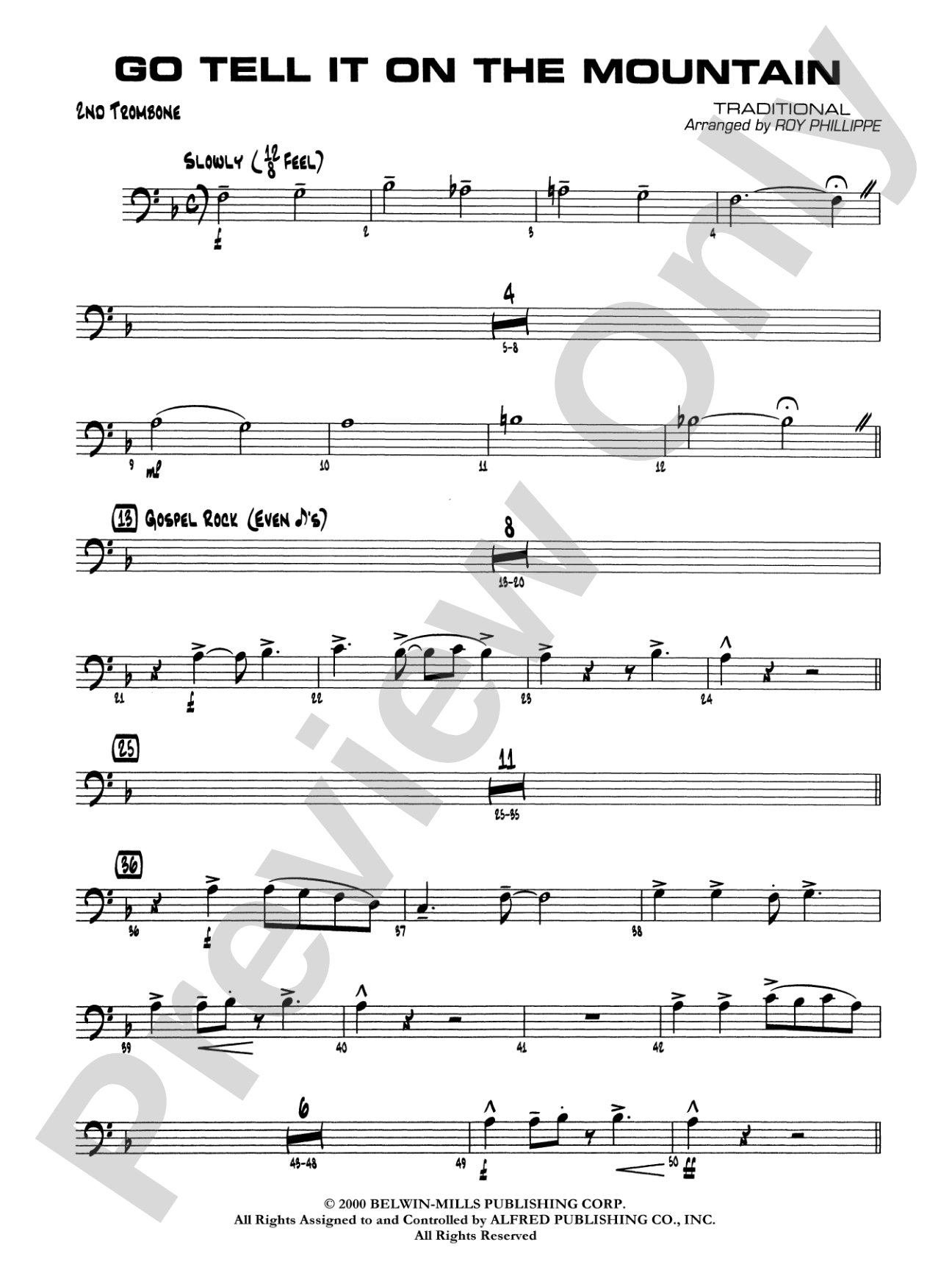

Go Tell It on the Mountain: 2nd Trombone
Arr. Roy Phillippe
Grade: 2 (Medium Easy)
Item: 00-PC-0002421_TN2
$3.00
Pickup currently not available
Description
This great gospel-style chart will work not only for the holidays, but also for any time of the year. Designed for the younger band, this arrangement takes you through a slow gospel, a gospel rock and then a swing feel, and it all works like a charm. Roy Phillippe's first-class chart makes teaching and learning these jazz styles so easy because it's user-friendly for your students. It features slow gospel block chord scoring with an easy 12/8 feel, straight-eighths gospel rock and full ensemble swings for the shout chorus. A brief trumpet solo, a written tenor solo with ensemble backgrounds and the customary flexible instrumentation options complete this package. It's a super chart with great appeal. You'll love it!


Don't just read it, hear it, play along with it, and watch your students grow with it. In MakeMusic Cloud, Go Tell It on the Mountain: 2nd Trombone comes alive with professional accompaniment, adjustable tempo, and built-in practice tools that turn solo practice into real progress.
Open in the Player
Jump straight in and assign it today.
Start Your Free Trial
Open this title and explore the full library in minutes.
Sample Audio
1
Audio File
--:--
0:00
0:00
Sample Video
Additional Details
Series:
Young Jazz Ensemble
Publisher:
Alfred Music
Page Count:
94
SKU:
00-PC-0002421_TN2
More about this title
About the Arranger: Roy Phillippe

Roy Phillippe studied composition and arranging at Kent State University, where he earned his Bachelor of Music degree. He went on to study privately with Phil Rizzo, a theorist and director for the Stan Kenton Jazz Orchestra in Residence program, deepening his craft in orchestration and large ensemble writing.
Based in Los Angeles since the early part of his career, Phillippe has arranged for film, television, and concert settings. His work has been performed and recorded by ensembles including Count Basie, L.A. Express, and the Everett Symphony, as well as by student jazz groups worldwide. Beyond his arranging work, he served as editor of Henry Mancini's film scoring text and maintains active memberships in ASCAP, JEN, and the American Federation of Musicians.
Why we love this
Phillippe delivers three distinct and teachable jazz styles in a single package, each one authentic enough to feel real yet scaled perfectly for younger ensembles. The progression from slow gospel through rock to swing feels natural and rewarding, and the flexible instrumentation means you're not locked into a specific band size. Directors return to this chart year after year because it teaches legitimate jazz vocabulary without overwhelming students.
What to expect
You'll move through three distinct moods: the spacious, soulful opening with slow gospel harmonies; the driving, rhythmic energy of gospel rock with straight eighths pushing the pulse; and finally the infectious swing of the shout chorus that brings the whole band together. The piece breathes naturally between these sections, making it feel like a genuine journey rather than a collection of exercises.
Who it's for
This chart works for jazz ensembles in grades 2-4 and younger high school groups building confidence with jazz styles. It's ideal for ensembles that can balance tuning and intonation in block chord voicings but don't yet need complex reharmonization or advanced soloing demands.
How to get the most out of it
- Lock in the 12/8 feel during the slow gospel section by having the rhythm section play the quarter-note pulse underneath the block chords; this foundation makes the harmonic motion clearer for the ensemble.
- Contrast the straight-eighths feel of the gospel rock section by asking the band to push slightly behind the beat, which gives the section its characteristic groove and energy.
- Shape the shout chorus by bringing out the full ensemble sound; Phillippe has written this to cut through, so encourage confidence in the section rather than restraint.
- Spotlight the tenor solo and trumpet solo by balancing the written backgrounds; these moments give soloists room to breathe while maintaining ensemble texture.
How to use it
Program this during the winter holidays for its gospel roots and festive energy, but don't limit it to December concerts. The jazz vocabulary and clear style differentiation make it valuable for spring jazz festivals or end-of-year performances where you want to showcase student growth in ensemble swing and style interpretation. It also works as a strong opener or closer on any jazz concert because it engages audiences immediately.
Skills your students will build
- Slow gospel voicing and block chord balance (12/8 feel)
- Straight-eighths feel and rhythmic precision in gospel rock style
- Swing rhythm and ensemble articulation in the shout chorus
- Solo accompaniment and written background figures
- Jazz style independence within an ensemble context