Go, Lassie Go (arr. Carol Canning) Sheet Music Preview

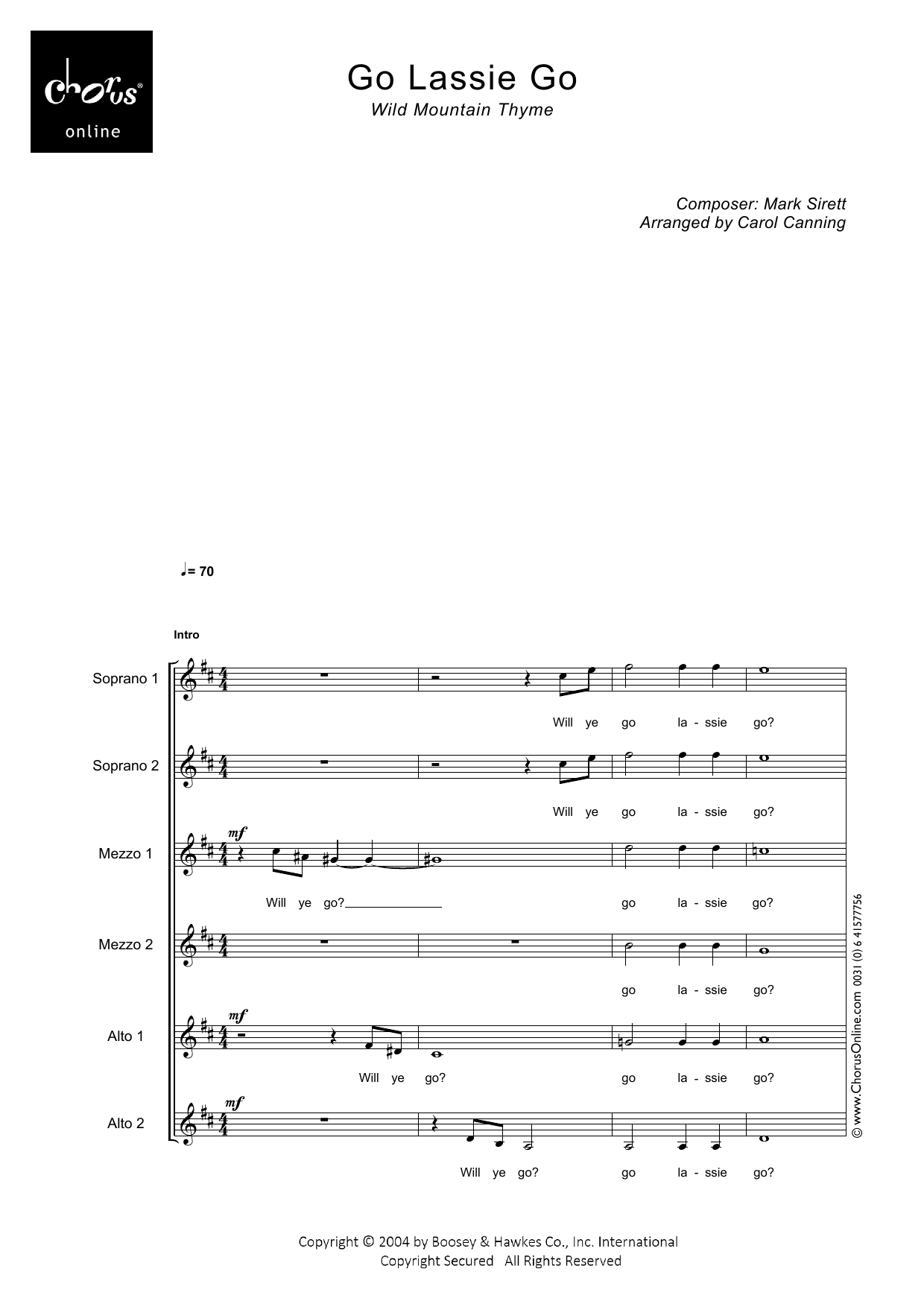
Go, Lassie Go (arr. Carol Canning): SSMMAA Choral Octavo

As performed by Mark Sirett / Arranged by Carol Canning

Item: 35-DS00487941

Digital Download
$2.99
Description

Go, Lassie Go (arr. Carol Canning): SSMMAA Choral Octavo isn't in MakeMusic Cloud just yet...but it could be. Let us know you'd like to see it, and you'll help shape what comes next. In the meantime, start a free trial and dive into thousands of interactive titles your students can play along with today.

Sample Audio
No sample audio found.
Sample Video
Additional Details
Publisher: Hal Leonard
Page Count: 11
SKU: 35-DS00487941

More about this title

Why we love this

Carol Canning's arrangement strips this Scottish folk favorite down to its essence while writing for an unusually warm voicing. The six-part texture creates dense, resonant harmonies without requiring soloists, making it accessible for mixed ensembles that don't have strong top sopranos.

What to expect

A stroll through a Scottish countryside at twilight. The melody feels familiar and singable, but Canning's harmonies create moments of unexpected depth and shadow beneath the tune's brightness. It settles into the voice comfortably, neither soaring nor diving.

Who it's for

Mixed choirs (adult, collegiate, or advanced high school) seeking repertoire that showcases vocal blend without demanding exceptional soloists. This works equally well for ensembles exploring Celtic traditions or directors needing a folk arrangement that feels substantial rather than novelty.

How to get the most out of it

  • Balance the two soprano lines carefully in the upper register; they carry the melody but shouldn't overshadow the rich middle voices beneath them.
  • Keep the tempo buoyant but resist the urge to rush. The arrangement's power comes from its harmonic movement, which needs breathing room.
  • Shape phrases through vowel consistency across all six parts rather than through dynamic swells. The a cappella texture demands precision to land harmonic colors cleanly.
  • Work the alto and mezzo sections as a unit during rehearsal. The lower voices anchor the tune and deserve as much attention as the soprano melody.

How to use it

Pair this with other international folk material to build a cultural program, or use it as a palate cleanser between more dramatic classical works. Its unaccompanied nature makes it ideal for concert programs where you want to highlight vocal tone without instrumental support.

Skills your students will build

  • Sustaining independent melodic lines within dense harmonic textures
  • Blending and balance across six-part voicing
  • A cappella tuning and intonation awareness
  • Phrasing through harmonic rhythm rather than text or dynamics
  • Scottish folk style and idiom

You May Also Like