
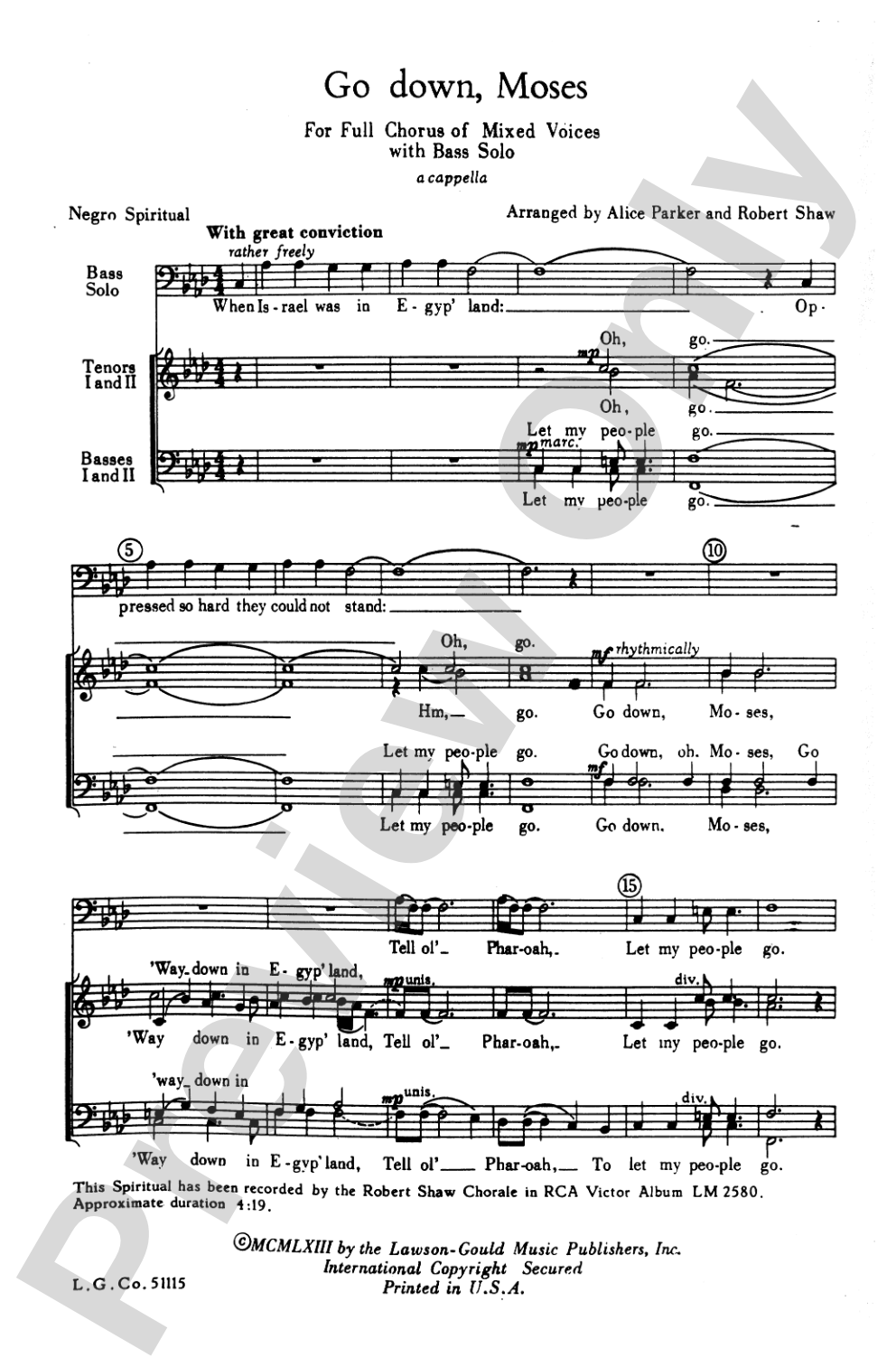
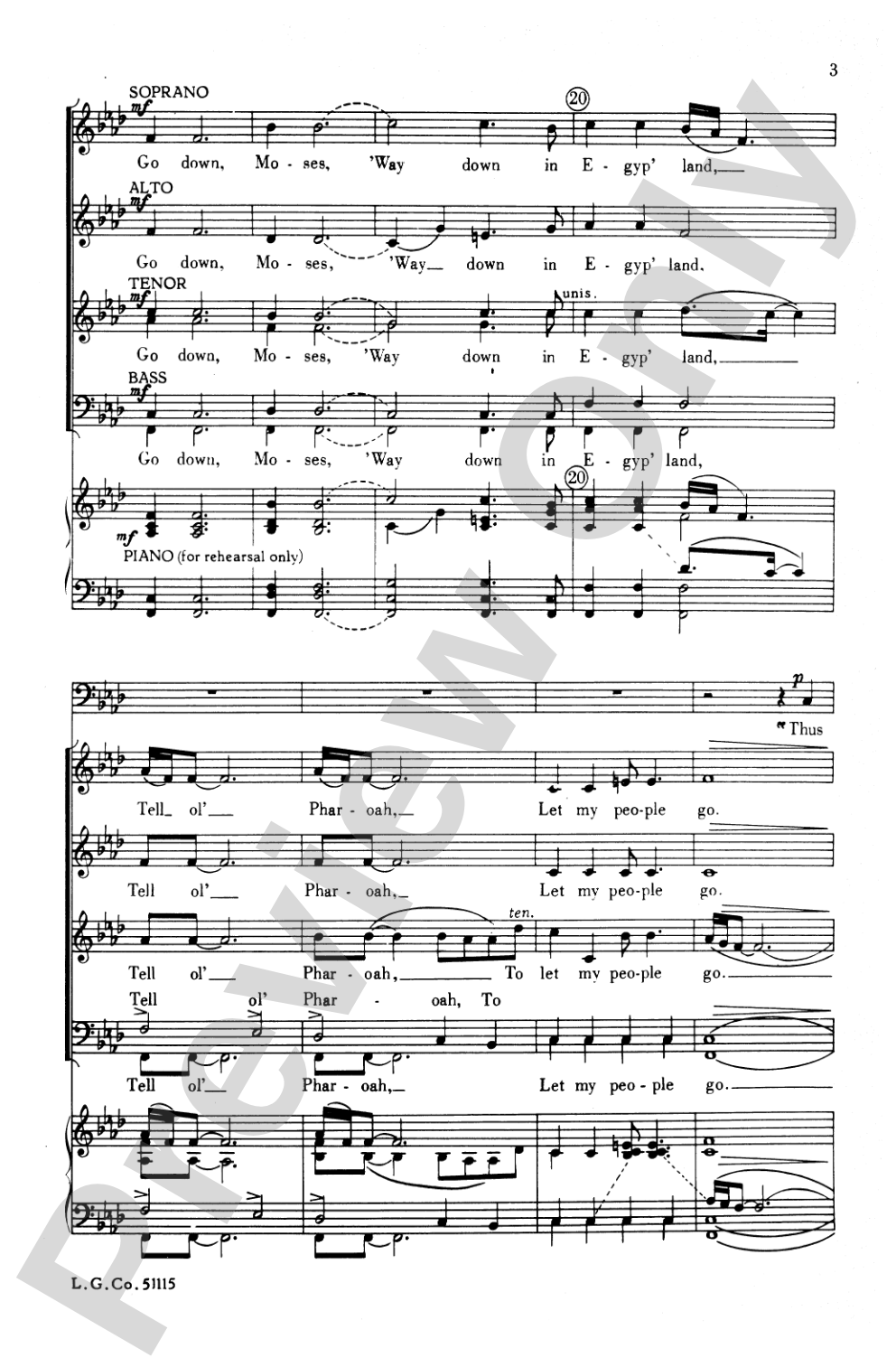

Go Down, Moses: SATB Choral Octavo
Arr. Robert Shaw and Alice Parker
Item: 00-PO-0004977
$2.25
Minimum order quantity: 20 copies
Pickup currently not available
Related Items
Go Down, Moses: SATB Choral Octavo |
$2.25
|
View |
Description


Go Down, Moses: SATB Choral Octavo isn't in MakeMusic Cloud just yet...but it could be. Let us know you'd like to see it, and you'll help shape what comes next. In the meantime, start a free trial and dive into thousands of interactive titles your students can play along with today.
Request This Title
Tell us you want it.
Start Your Free Trial
Explore everything that's ready to play right now.
Sample Audio
No sample audio found.
Sample Video
No sample videos found.
Additional Details
Series:
Alfred Archive Edition: Robert Shaw Choral Series
Publisher:
Alfred Music
Page Count:
8
SKU:
00-PO-0004977
More about this title
About the Arranger: Robert Shaw
Robert Shaw (1916–1999) was an American conductor and arranger whose career fundamentally shaped how American choirs approached both classical repertoire and spiritual music. He founded the Robert Shaw Chorale in 1948, an ensemble that became synonymous with pristine intonation, clarity of diction, and interpretive depth. Shaw's arrangements of spirituals and folk songs are distinguished by their respect for the vernacular tradition while elevating the harmonic language through sophisticated voice leading and architectural design.
His work as a conductor, educator, and arranger at institutions including the Atlanta Symphony Orchestra established him as a major figure in choral music. Shaw's legacy rests not only on his own performances and recordings but on the countless directors and singers who learned his exacting standards through his published arrangements. His editions remain central to the choral repertoire because they balance musical substance with pedagogical clarity.
Why we love this
Shaw and Parker's arrangement of this spiritual demonstrates why their work remains the gold standard for this repertoire. The harmonic language is sophisticated without obscuring the melody's spiritual power, and every voice part sings with independence and purpose. This is an arrangement that works equally well in concert, contest, and church settings because the musicality is built into the writing itself, not dependent on a director's interpretation to rescue it.
What to expect
The emotional landscape moves between quiet determination and yearning hope, with a harmonic language that deepens the spiritual's meditation on freedom and faith. The a cappella texture creates intimacy while the four-part writing generates warmth through blended voices. There is dignity in every measure, and the arrangement never condescends to the tradition it represents.
Who it's for
This arrangement suits choirs with solid intonation skills and experience balancing multiple voice parts in a cappella literature. It works for high school choirs, community choirs, college ensembles, and church choirs seeking a spiritually grounded and musically substantial arrangement.
How to get the most out of it
- Establish the spiritual's inherent pulse through breath and phrasing rather than mechanical metering. The emotional weight of the text should guide tempo and breathing patterns, not a click track.
- Balance the soprano line against the other three parts so the melody projects without drowning out the harmonic support beneath it. This arrangement rewards singers who listen to the whole chord.
- Shape phrases toward cadential moments and text-important words, maintaining the contemplative quality throughout. Avoid letting the a cappella texture drift into monotone; each phrase should have direction.
- Attend carefully to vowel shapes in spirituals, where the dialect and cultural tradition inform both pronunciation and tone color. Shaw's arrangements expect singers to honor the roots of the music.
How to use it
Program this in concert contexts where spiritual arrangements anchor a set of choral music, allowing it to stand as a centerpiece rather than filler. It works equally well in festival or contest settings where judging committees recognize the sophistication of the harmonic writing. Many directors pair it with other Shaw or Parker arrangements of spirituals to build a cohesive program segment.
Skills your students will build
- Balancing four independent voice parts in a cappella texture
- Maintaining intonation stability without instrumental support
- Singing with stylistic awareness of spiritual traditions and dialect
- Shaping long phrases with textual and emotional intent
- Building harmonic understanding through listening to voice parts other than the melody