
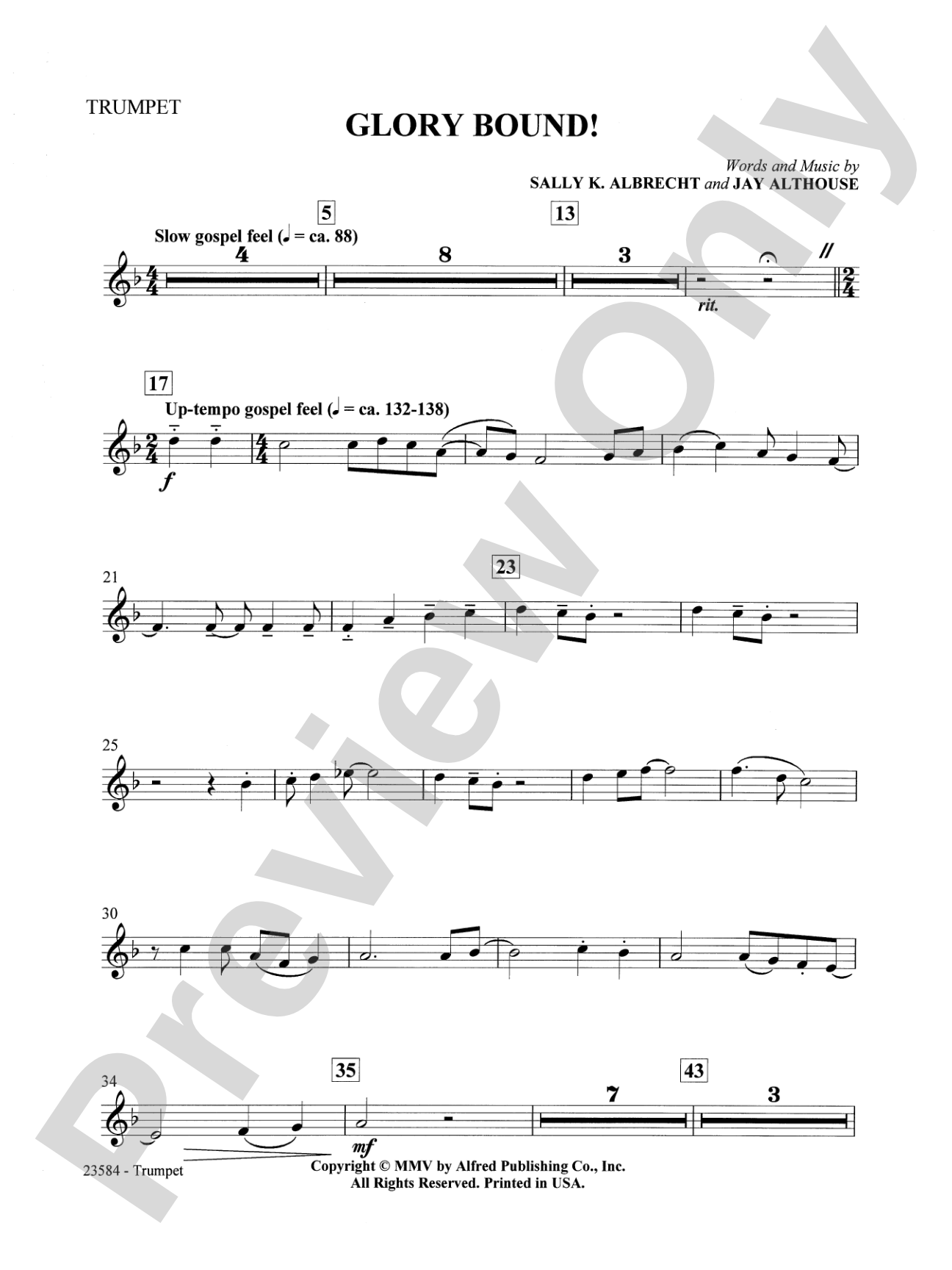

Glory Bound!: 1st B-flat Trumpet: Choral SoundPax
Music by Sally K. Albrecht and Jay Althouse
Item: 00-PC-0000730_T1
$3.00
Pickup currently not available
Description
The choir serves as back-up singers for your best gospel soloist during the ballad-like opening, but the whole group shines when the inspired introduction explodes into an up-tempo chorus bound to be a crowd pleaser like none other. You'll really feel the spirit when "Climbin' Up the Mountain" makes a short appearance, and you'll shout out a cheer when the gospel treble trio is added for the final vibrant verse. Awesome SoundTrax and Pax are available. Staging is featured on "Follow Me to the Top!" DVD #23853, VHS #23855. SoundPax includes parts for a. sax., t. sax., tpt., tbn., rhy., tamb.


Don't just read it, hear it, play along with it, and watch your students grow with it. In MakeMusic Cloud, Glory Bound!: 1st B-flat Trumpet: Choral SoundPax comes alive with professional accompaniment, adjustable tempo, and built-in practice tools that turn solo practice into real progress.
Open in the Player
Jump straight in and assign it today.
Start Your Free Trial
Open this title and explore the full library in minutes.
Sample Audio
1
Audio File
--:--
0:00
0:00
Sample Video
No sample videos found.
Additional Details
Series:
Alfred Choral Designs
Publisher:
Alfred Music
SKU:
00-PC-0000730_T1
Instrumentation:
SoundPax
More about this title
About the Composer: Sally K. Albrecht

Sally K. Albrecht has shaped American choral music for decades as a composer, conductor, and movement specialist. Since 1987, she has received the ASCAP Special Music Award annually and published over 600 choral works alongside 75 larger musicals and songbooks. Her conducting has graced honor choirs at major venues including Lincoln Center, Carnegie Hall, and The Kennedy Center, while her three-decade tenure as Director of School Choral, Vocal, and Elementary Publications at Alfred Music established her as a trusted voice in choral pedagogy.
Albrecht earned degrees from Rollins College (B.A., 1976), the University of Miami (M.A. in Drama, 1977; M.M. in Accompanying, 1979), and has taught at Oakland University, Jersey City State College, and Meredith College. She served as Chair of the Board of Trustees for the Omicron Delta Kappa National Leadership Honor Society and received their "Pillar of Leadership" award. In 2021, she was honored with the Distinguished Alumna Award from both the University of Miami Frost School of Music and Rollins College.
Why we love this
Albrecht and Althouse craft a piece that showcases a soloist while keeping the full ensemble deeply engaged through shifting textures and energy. The contrast between the supportive ballad opening and the jubilant up-tempo chorus creates natural drama that audiences feel immediately, and the addition of the treble trio in the final verse gives you multiple ways to highlight different singers within one performance.
What to expect
The piece captures the spiritual journey of a congregation: it begins in quiet reflection as the soloist testifies, then builds into communal joy when everyone joins the celebration. There's an infectious, uplifting groove that makes singers feel the pulse in their bodies, and the familiar gospel reference point ('Climbin' Up the Mountain') lands like a moment of shared recognition.
Who it's for
Choirs with at least one confident gospel soloist and a mix of treble voices ready to handle both intimate support and energetic ensemble singing. Directors seeking a gospel piece that feels complete and celebratory without requiring extensive staging knowledge will appreciate the optional movement guidance available separately.
How to get the most out of it
- Establish the dynamics contrast early in rehearsal: the opening requires the choir to listen intently and support the soloist's lead, while the chorus demands full, confident ensemble sound. These aren't the same energy.
- Layer the gospel trio gradually during the final verse. Have the full choir find their part first, then introduce the three treble voices one at a time so the transition feels fresh and intentional, not chaotic.
- Shape the "Climbin' Up the Mountain" moment by adjusting tempo slightly to honor its spiritual weight, then drive forward into the final chorus with renewed momentum.
- Use the recorded accompaniment to lock the rhythmic groove during the up-tempo sections; the syncopation reads cleaner when the band foundation is solid.
How to use it
This works beautifully as a spring concert centerpiece or as a standalone celebration piece for Ascension, Christ the King, or All Saints Day services. Pair it with a more introspective anthem to bookend a program, or use it as your finale when you want the audience to leave energized and moved.
Skills your students will build
- Gospel vocal production and phrasing (call-and-response, rhythm-driven articulation)
- Ensemble listening and texture awareness (supporting vs. leading roles)
- Syncopated rhythm reading in up-tempo sections
- Blending treble voices in divisi passages
- Musical confidence in an unfamiliar genre