
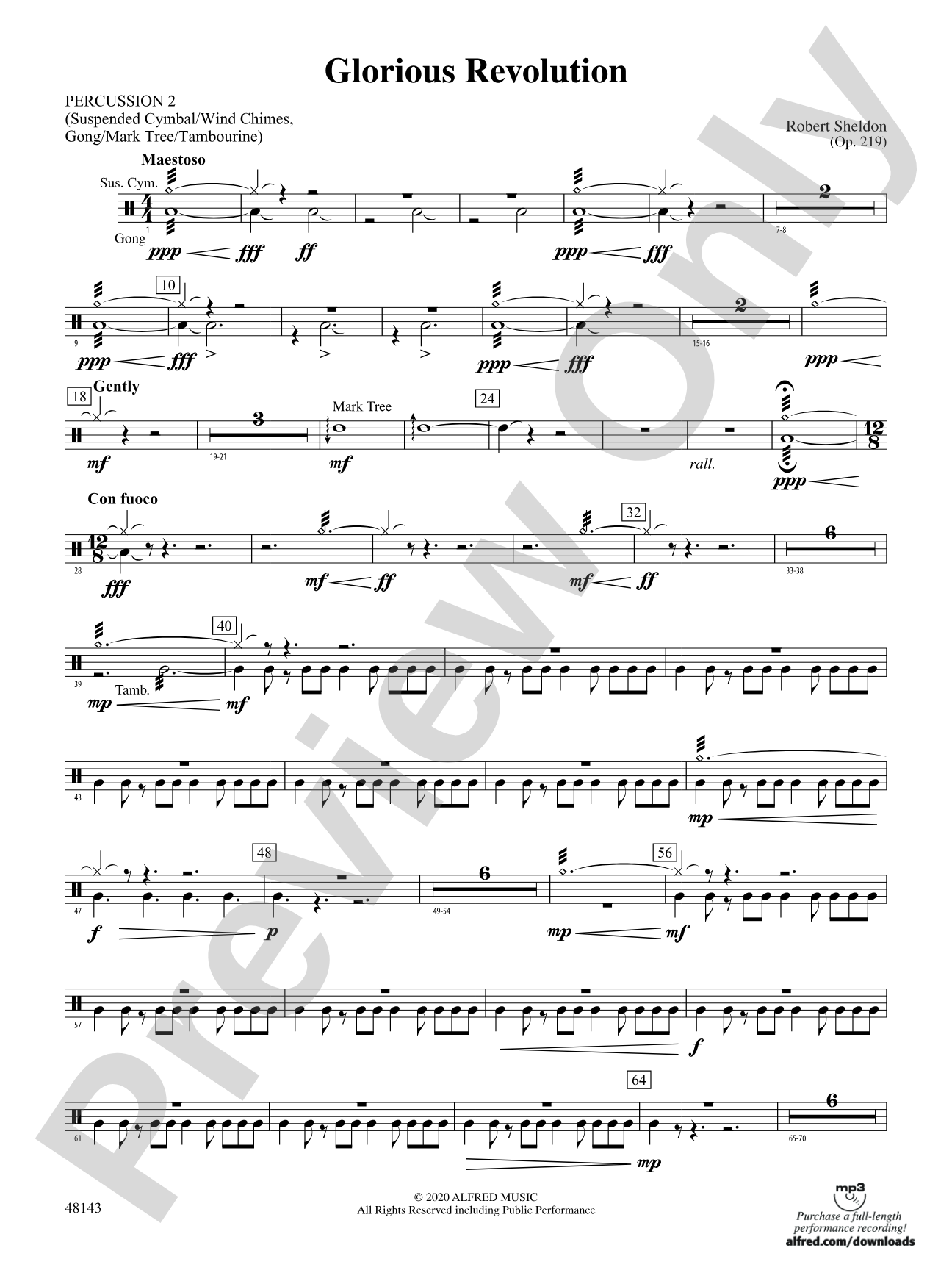

Glorious Revolution: 2nd Percussion
By Robert Sheldon
Grade: 4 (Medium Advanced)
Item: 00-PC-0018459_PC2
$3.00
Pickup currently not available
Description
Inspired by the overthrow of King James II of England in what was later called the Glorious Revolution of 1688, this dramatic musical essay by Robert Sheldon is rife with powerful, ominous chords and poignant themes. Celtic-style motifs and colorful, rhythmic percussion parts help to energize this striking work for wind band. (6:25) This title is available in MakeMusic Cloud.
Print-on-demand Grade 2.5 parts compatible to this arrangement are available (item 00-48143IB) as well as Grade 1 parts (item 00-48143YB).


Don't just read it, hear it, play along with it, and watch your students grow with it. In MakeMusic Cloud, Glorious Revolution: 2nd Percussion comes alive with professional accompaniment, adjustable tempo, and built-in practice tools that turn solo practice into real progress.
Open in the Player
Jump straight in and assign it today.
Start Your Free Trial
Open this title and explore the full library in minutes.
Sample Audio
1
Audio File
--:--
0:00
0:00
Sample Video
Additional Details
Series:
Alfred Concert Band
Publisher:
Alfred Music
Page Count:
296
SKU:
00-PC-0018459_PC2
More about this title
About the Composer: Robert Sheldon

Robert Sheldon stands among today's most widely performed composers for wind band. His works appear regularly on contest lists and concert programs internationally, performed by ensembles ranging from school bands to professional orchestras. He has received recognition from the American School Band Directors Association, Phi Beta Mu, and ASCAP, and was honored with a doctorate from VanderCook College of Music in 2020.
Beyond composing, Sheldon shaped instrumental music education as lead author of Sound Innovations for Concert Band. He maintains an active schedule as guest conductor for All-State and Regional Honor Bands, clinician at universities and state conferences, and commission composer. His conducting has taken him across the United States and internationally to Japan, Canada, Italy, Germany, Australia, and China, including performances at Carnegie Hall, Boston Symphony Hall, Sydney Opera House, and the Kennedy Center.
Why we love this
Sheldon crafts a work that balances narrative weight with musical accessibility. The piece sustains dramatic momentum across a Grade 4 score without relying on extreme difficulty, making it an excellent choice for bands ready to tackle concert programming with genuine artistic substance. The Celtic influences and percussion writing give every section something distinctive to play, building ensemble confidence and audience engagement simultaneously.
What to expect
A musical journey through conflict and consequence. The score evokes both the turbulence of historical upheaval and moments of poignant reflection, layering Celtic melodic warmth against darker harmonic undercurrents. The result is dramatic without being bombastic, accessible without sacrificing artistic depth.
Who it's for
Grade 4 bands with solid technical foundation and developing interpretive skills. This work suits ensembles ready to engage with programmatic content and complex harmonic language while still building toward advanced repertoire.
How to get the most out of it
- Balance the ominous harmonic language against the lyrical Celtic themes. These contrasts drive the dramatic arc, so resist the urge to smooth everything into one dynamic level.
- Give the percussion parts their full rhythmic character. The colorful textures depend on precision and independence from the rest of the band, not just timekeeping.
- Shape the poignant sections with clear phrase direction. Allow the ensemble time to breathe at phrase endings so the emotional weight lands before momentum resumes.
How to use it
Program this as a centerpiece work on a concert exploring historical themes or programmatic storytelling. Its six-and-a-half-minute duration and Grade 4 level make it substantial enough to anchor a set without overwhelming bands still building stamina for longer works. Consider pairing it with lighter character pieces or more lyrical selections to showcase its dramatic qualities by contrast.
Skills your students will build
- Reading and executing complex harmonic progressions with accuracy
- Sustaining focused phrasing across extended sections
- Balancing independent percussion textures with ensemble cohesion
- Responding to programmatic context to shape musical interpretation