
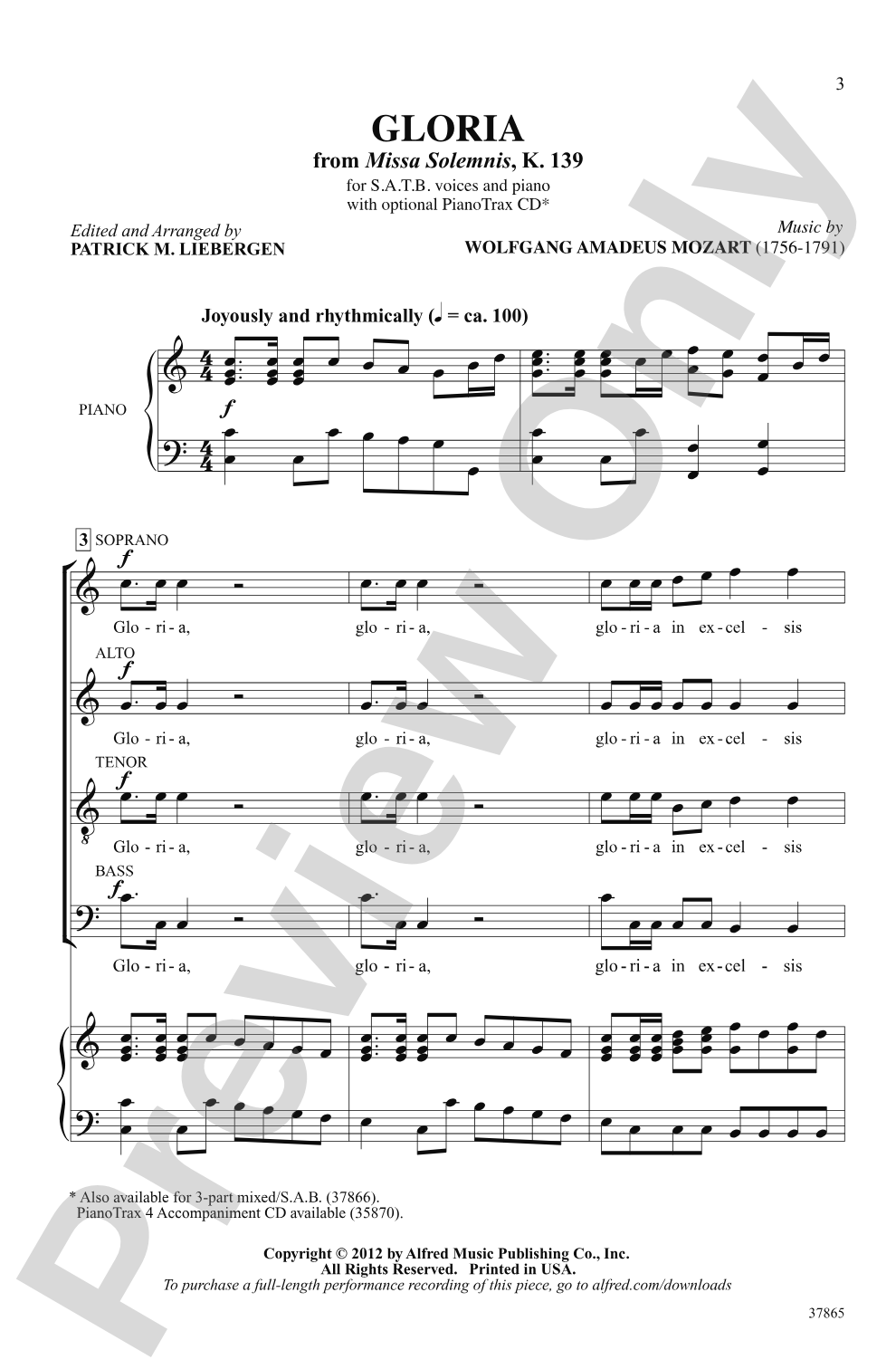

Gloria (from Missa Solemnis, K. 139): SATB Choral Octavo
From Missa Solemnis, K. 139
Music by Wolfgang Amadeus Mozart / ed. and arr. Patrick M. Liebergen
Item: 00-PO-0001233
$2.05
Minimum order quantity: 20 copies
Pickup currently not available
Description
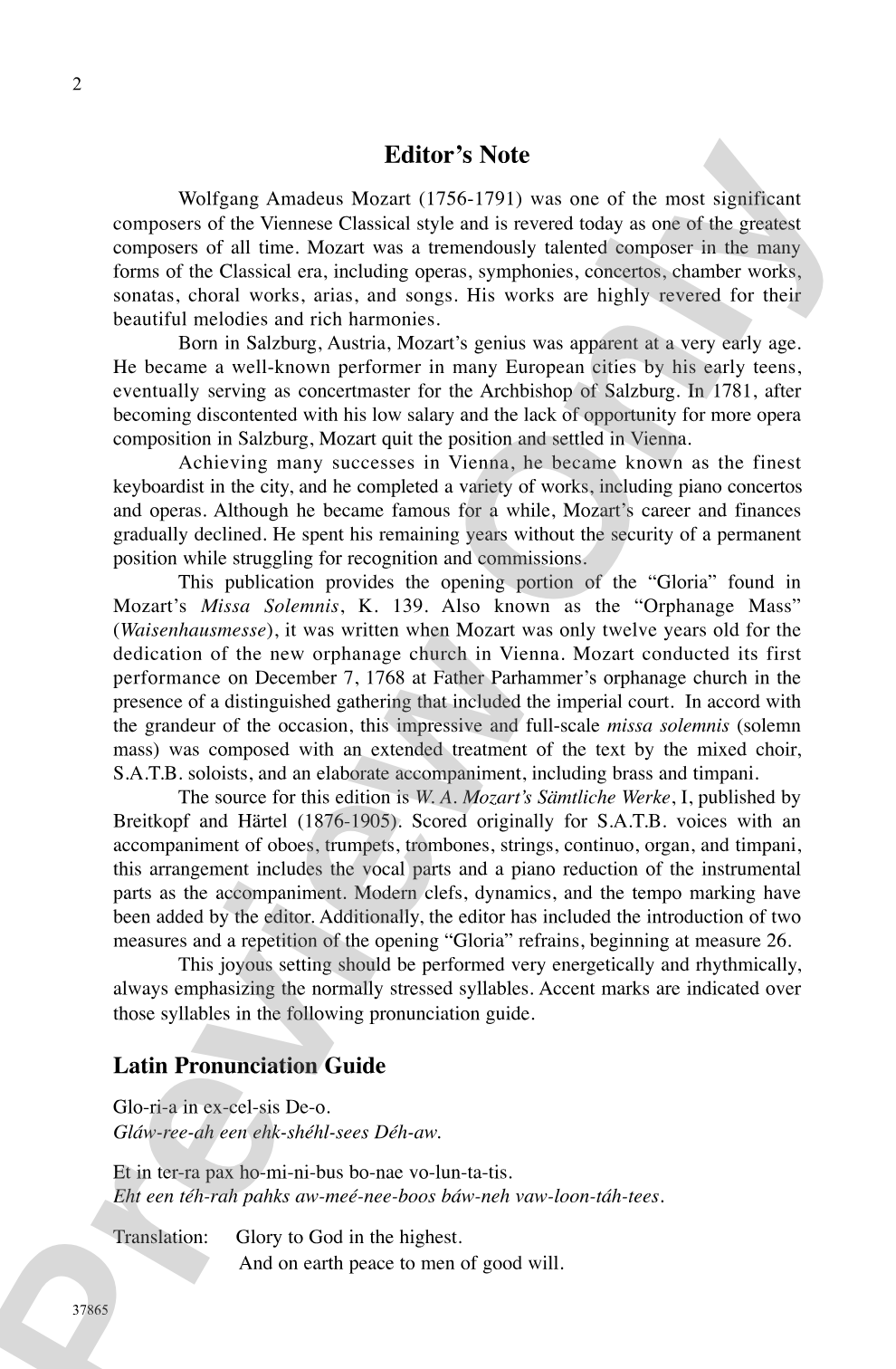
Talk about a child prodigy; Mozart composed and conducted the premiere of this piece when he was only 12 years old. It's less than two minutes long, but calls for solid choral singing from start to finish. Accompaniment available on PianoTrax 4 CD (00-35870).


Gloria (from Missa Solemnis, K. 139): SATB Choral Octavo isn't in MakeMusic Cloud just yet...but it could be. Let us know you'd like to see it, and you'll help shape what comes next. In the meantime, start a free trial and dive into thousands of interactive titles your students can play along with today.
Request This Title
Tell us you want it.
Start Your Free Trial
Explore everything that's ready to play right now.
Sample Audio
1
Audio File
--:--
0:00
0:00
Sample Video
No sample videos found.
Additional Details
Series:
Alfred Choral Designs
Publisher:
Alfred Music
Page Count:
8
SKU:
00-PO-0001233
More about this title
About the Composer: Wolfgang Amadeus Mozart
Mozart wrote this mass at an age when most students are still learning their fundamentals. Born in Salzburg in 1756, he received rigorous training from his father Leopold and was performing professionally across Europe by his early teens. His facility with counterpoint, harmonic language, and vocal writing was already fully formed, making works like the Missa Solemnis K. 139 not juvenile exercises but genuine contributions to the sacred choral repertoire.
What makes Mozart essential for music educators is how his music demonstrates structural clarity without sacrificing emotional depth. Even in works composed during his childhood and adolescence, you hear the hallmarks that define his maturity: balanced phrases, singable melodies that still challenge the voice, and orchestration that serves rather than overwhelms.
Why we love this
A genuine masterwork scaled to rehearsal reality. Mozart packed serious compositional craft into a piece that won't demand weeks of preparation, yet offers far more musical substance than the typical warm-up or filler selection. The Gloria moves quickly enough to maintain energy while requiring real attention to balance, text clarity, and ensemble blend.
What to expect
Bright and purposeful. The piece carries the ceremonial weight of sacred music while maintaining an almost conversational warmth in its dialogue between voice parts. At less than two minutes, it feels concentrated and vital rather than sprawling.
Who it's for
Choirs with solid fundamentals in four-part writing and enough rehearsal time to address ensemble intonation. This is ideal for groups moving beyond simple repertoire but not yet tackling Baroque counterpoint or Romantic chromaticism.
How to get the most out of it
- Emphasize the text without sacrificing Mozart's phrase architecture. These lines want to sing, so resist the urge to chop them into syllabic fragments; instead, let the words ride on the melody.
- Listen carefully to harmonic movement between sections. The classical voice-leading is transparent, which means tuning issues and balance problems become immediately audible.
- Work dynamics conservatively at first. Mozart indicates his intentions clearly on the page; adding extra contrast often muddies the classical texture rather than clarifying it.
How to use it
Pair this with other classical sacred works for a focused program, or use it as an opener that establishes musicianship standards for your audience. The brevity makes it valuable as a palate cleanser between larger works.
Skills your students will build
- Classical voice-leading and harmonic progression
- Balancing individual lines within homophonic texture
- Singing Latin text with clear diction at a brisk tempo
- Listening for tuning across four parts with minimal accompaniment support