
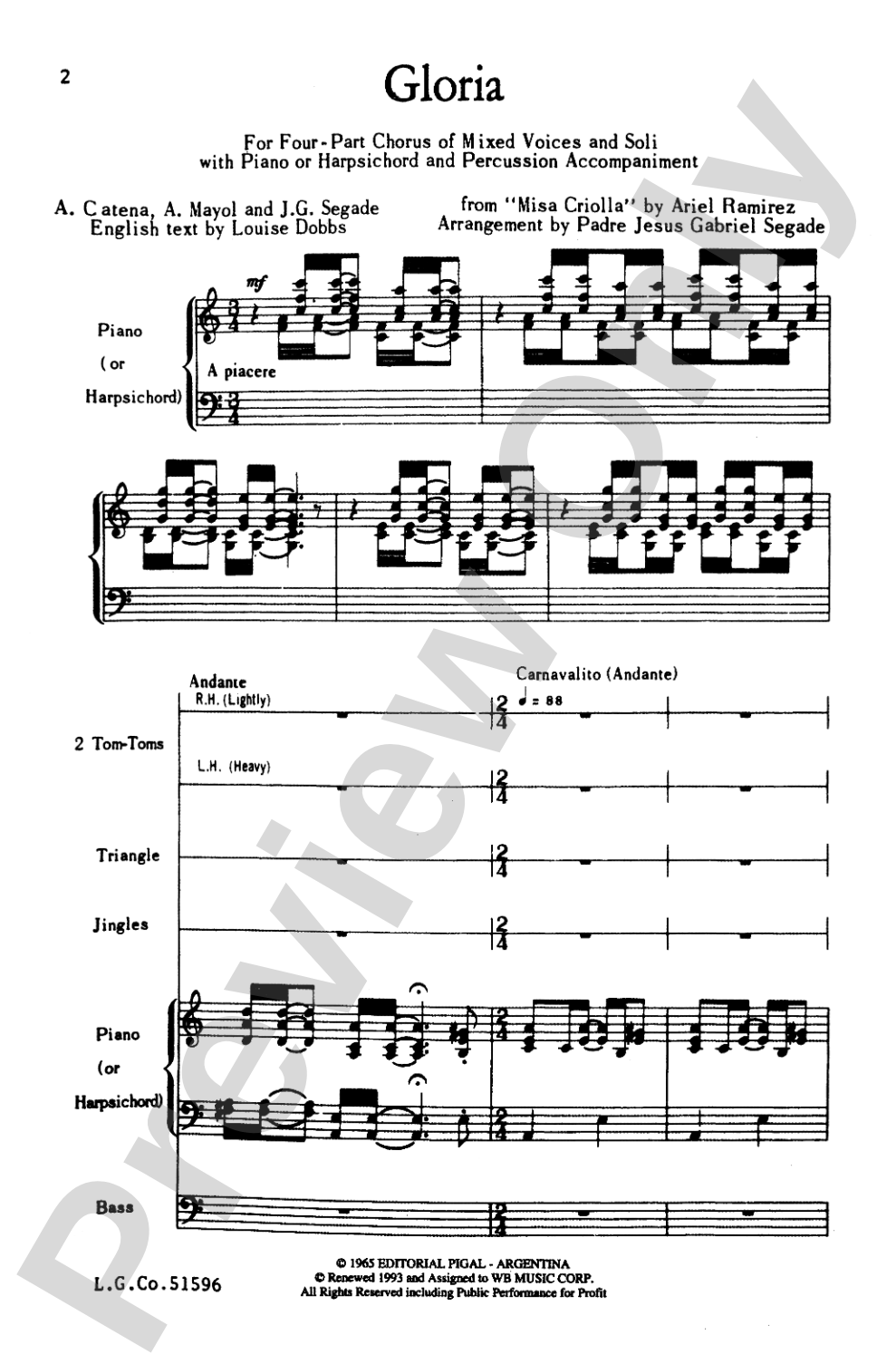
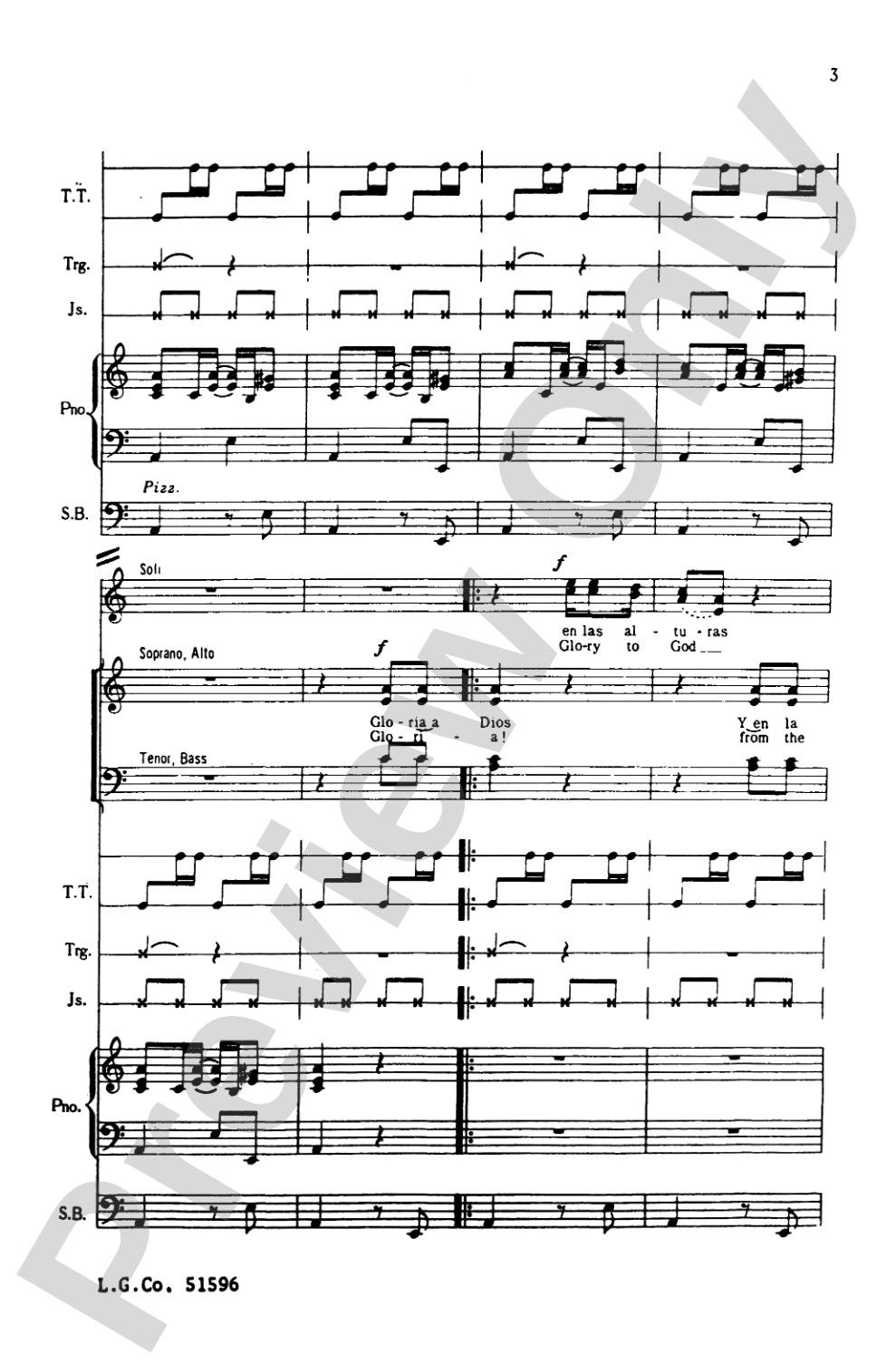
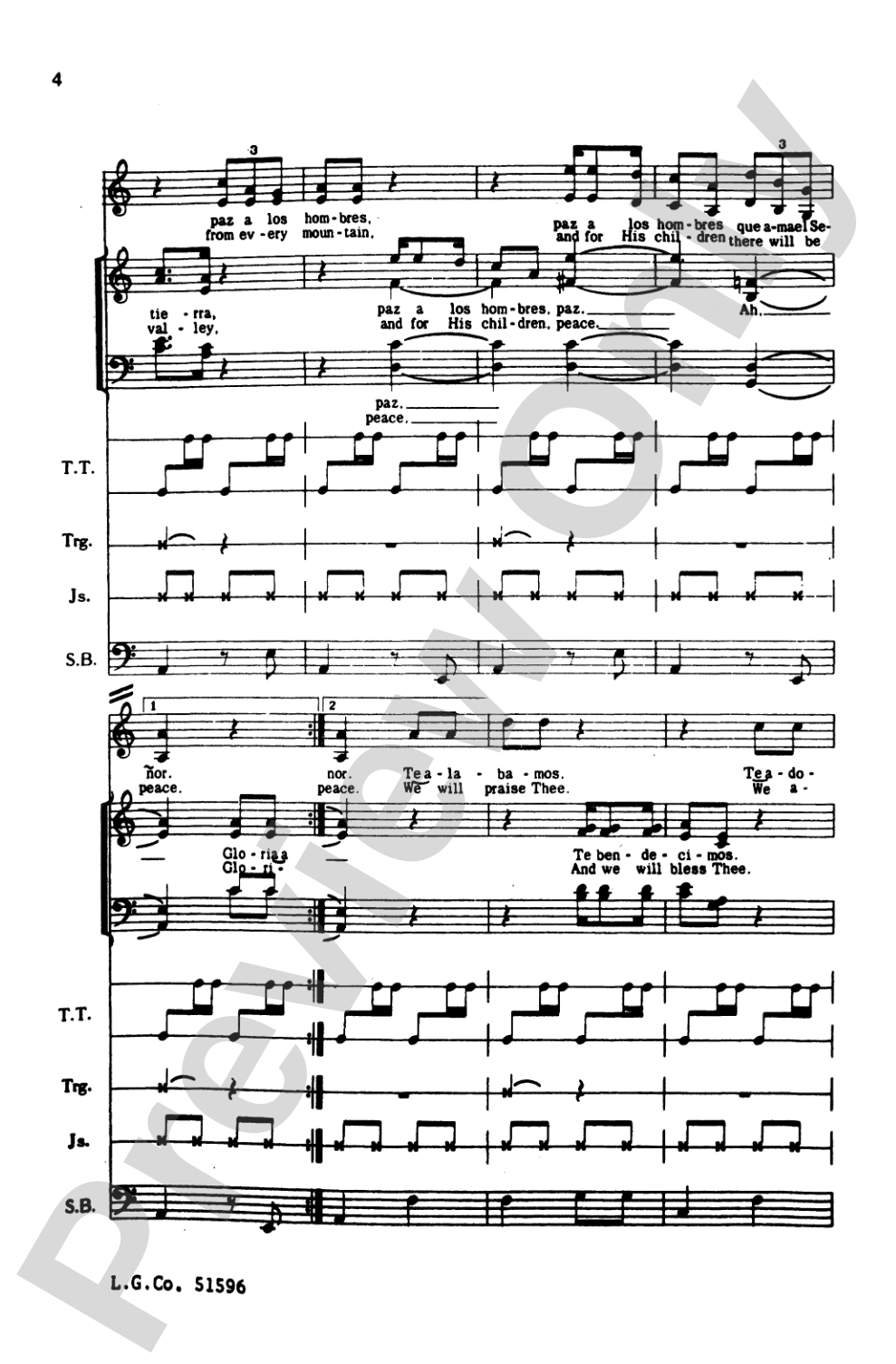

Gloria (from Misa Criolla): SATB Choral Octavo
From Misa Criolla
By Ariel Ramirez / arr. Jesus Gabriel Segade
Item: 00-PO-0002665
$2.95
Minimum order quantity: 20 copies
Pickup currently not available
Related Items
Gloria: SATB Choral Octavo |
$2.95
|
View |
Description
Misa Criolla by Argentinian composer Ariel Ramirez is a mass written in Spanish (with English subtext) for mixed choir, soloists, piano or harpsichord, string bass, and traditional Latin American percussion instruments. Inspired by a visit to Germany after the Holocaust, this work has been performed by countless musicians around the globe. The Gloria movement has become a favorite for honor choirs and festivals.


Gloria (from Misa Criolla): SATB Choral Octavo isn't in MakeMusic Cloud just yet...but it could be. Let us know you'd like to see it, and you'll help shape what comes next. In the meantime, start a free trial and dive into thousands of interactive titles your students can play along with today.
Request This Title
Tell us you want it.
Start Your Free Trial
Explore everything that's ready to play right now.
Sample Audio
No sample audio found.
Sample Video
No sample videos found.
Additional Details
Series:
Alfred Archive Edition: Lawson-Gould Music Publishers
Publisher:
Alfred Music
Page Count:
16
SKU:
00-PO-0002665
More about this title
About the Composer: Ariel Ramirez
Ariel Ramirez (1921-2010) was an Argentinian composer and pianist whose work bridged classical composition with Latin American folk traditions. His most celebrated work, Misa Criolla, emerged from a profound artistic experience following a 1959 visit to Germany, where he confronted the historical weight of the Holocaust and felt compelled to create a spiritual work that honored both Christian liturgy and his own cultural heritage.
Ramirez's gift was his ability to embed authentic Latin American rhythms, melodies, and instrumental colors into the structure of the Latin mass without reducing either tradition. His compositions have reached choirs worldwide and remain central to the repertoire of ensembles seeking to expand beyond European classical forms.
Why we love this
This Gloria sits at the intersection of accessibility and artistic substance. The Spanish text with English subtext makes it inviting for diverse choirs, while the rhythmic vitality and uncomplicated harmonic language allow singers at multiple levels to contribute meaningfully. Directors return to this piece because it generates genuine joy in rehearsal and translates that energy directly to audiences.
What to expect
Warm, rhythmically buoyant, and infused with joy that feels earned rather than imposed. The harmonic language is transparent and grounded in tonal traditions, yet the Latin American colors give it a timeless quality that feels simultaneously rooted and universal. Singers report feeling energized by the combination of sacred text and infectious rhythmic momentum.
Who it's for
Honor choirs, festival ensembles, and SATB groups seeking repertoire that combines spiritual depth with celebratory energy. This octavo works equally well for experienced singers and developing ensembles because the writing is grateful without being simplistic.
How to get the most out of it
- Anchor the rhythmic drive through consistent Latin percussion patterns. Even without traditional instruments, percussive syllables or body percussion in rehearsal will clarify the pulse and free singers from over-thinking meter.
- Treat the Spanish text with natural speech rhythm rather than artificial articulation. The language should feel conversational and celebratory, not precious.
- Balance the choral sections against any soloists carefully. The piece gains impact when ensemble and soloists inhabit the same acoustic space without one overwhelming the other.
- Rehearse the text in both Spanish and English separately at first, then layer them together. This dual-language approach solidifies vowel consistency and prevents singers from code-switching mid-phrase.
How to use it
This Gloria anchors programs celebrating world spirituality or cultural diversity. It pairs naturally with other Latin American sacred works or with Renaissance masses to show how liturgical form transcends geography. Consider programming it as a second-half opener to reset audience energy after a contrasting set.
Skills your students will build
- Singing Spanish text with authentic vowel quality and conversational phrasing
- Maintaining consistent Latin American rhythmic patterns (especially syncopation across voice parts)
- Balancing harmonic transparency in four-part writing
- Coordinating ensemble singing with soloists and optional percussion accompaniment
- Understanding how cultural tradition and classical form coexist in sacred music