
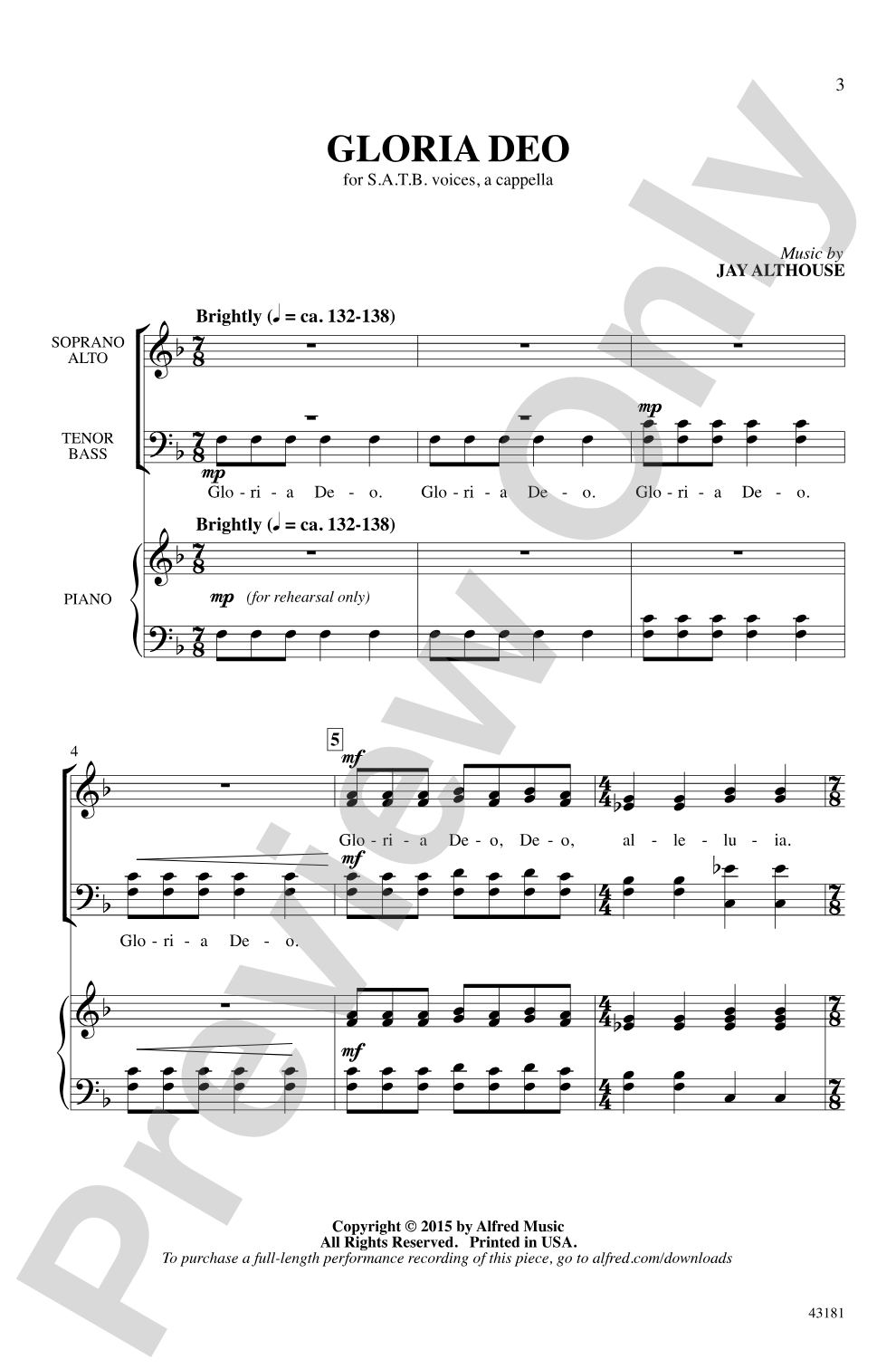
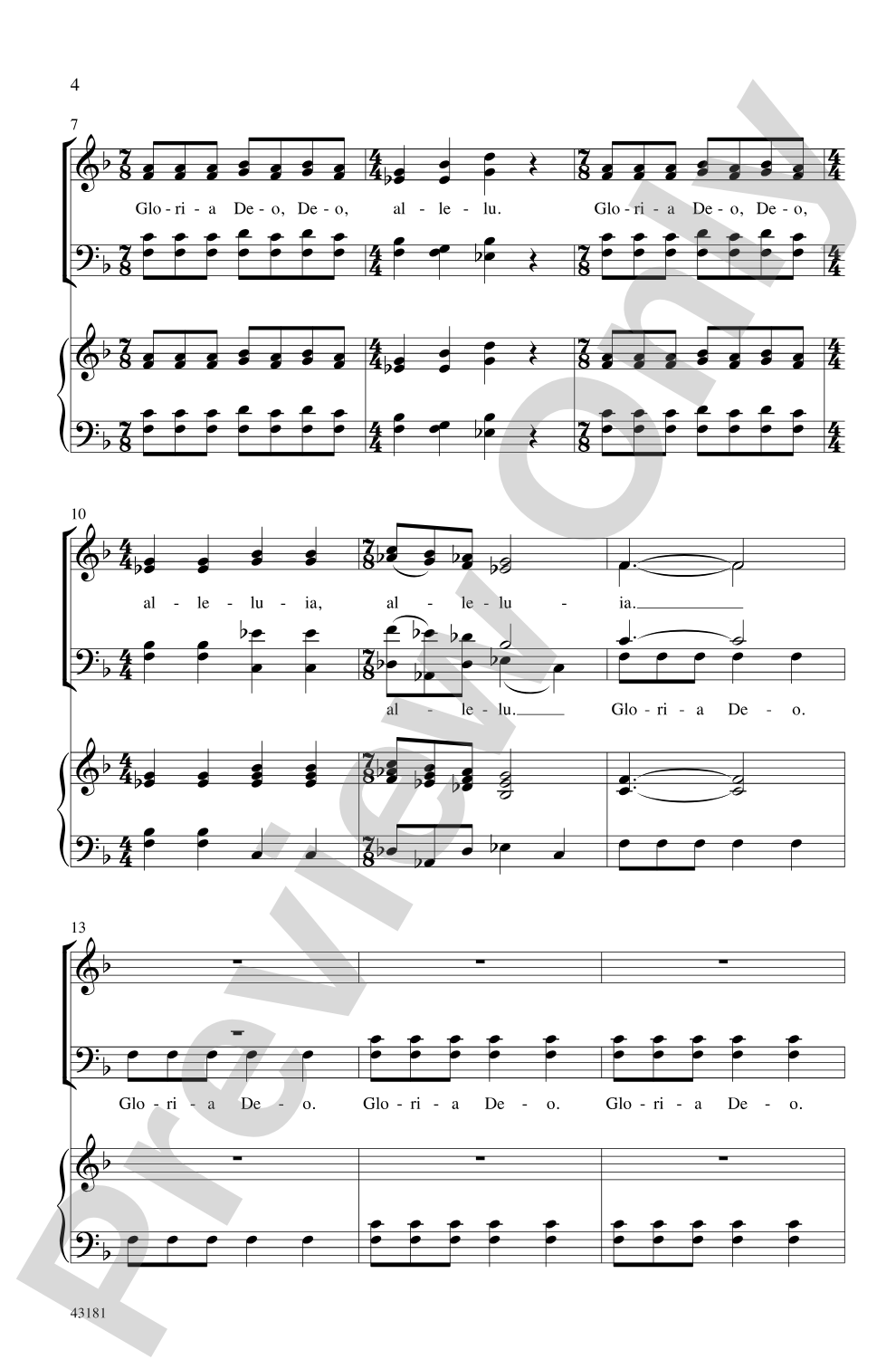

Gloria Deo: SATB, a cappella Choral Octavo
By Jay Althouse
Item: 00-PO-0003182
$2.05
Minimum order quantity: 20 copies
Pickup currently not available
Related Items
Gloria Deo: SATB, a cappella Choral Octavo |
$2.05
|
View |
Description
This exuberant choral fanfare offers a fresh approach for a cappella mixed groups. Constructed with mixed and changing meters, and with a touch of divisi for the women's voices at the end, this glorious work will be a standout on concerts year round.


Gloria Deo: SATB, a cappella Choral Octavo isn't in MakeMusic Cloud just yet...but it could be. Let us know you'd like to see it, and you'll help shape what comes next. In the meantime, start a free trial and dive into thousands of interactive titles your students can play along with today.
Request This Title
Tell us you want it.
Start Your Free Trial
Explore everything that's ready to play right now.
Sample Audio
1
Audio File
--:--
0:00
0:00
Sample Video
No sample videos found.
Additional Details
Series:
Alfred Choral Designs
Publisher:
Alfred Music
Page Count:
12
SKU:
00-PO-0003182
More about this title
About the Composer: Jay Althouse

Jay Althouse holds degrees in Music Education and Music from Indiana University of Pennsylvania, where he was later honored with the Distinguished Alumni award. His career spans both the publishing industry (where he spent eight years managing rights and licenses and served on the Executive Board of the Music Publishers Association of America) and composition, resulting in more than 800 published choral works performed across the English-speaking world.
Althouse's contributions to music education extend well beyond his compositions. He is a writer member of ASCAP and a regular recipient of the ASCAP Special Award for his standard music compositions. His collaborative work with his wife, Sally K. Albrecht, includes children's musicals and widely-adopted pedagogical texts such as The Complete Choral Warm-up Book and Accent on Composers. He has also compiled vocal solo collections, written reproducible classroom resources, and co-created I Hear America Singing, performed by the San Francisco Girls and Boys Choirs at President Barack Obama's inauguration in 2009. Althouse resides in North Carolina, where he serves on the National Advisory Board of the Folk Art Society of America.
Why we love this
The mixed and changing meters give this piece real rhythmic interest while remaining singable for SATB groups at intermediate levels and above. Althouse crafts the fanfare with structural clarity, so the metric shifts feel intentional rather than confusing, and the final moment of divisi writing for women's voices provides a satisfying textural payoff without demanding extreme technical range.
What to expect
Gloria Deo radiates exuberance and celebratory energy, with the changing meters creating momentum rather than hesitation. The writing feels contemporary yet accessible, offering enough rhythmic complexity to keep singers engaged without sacrificing the piece's bright, triumphant character.
Who it's for
Mixed SATB choirs at the intermediate level and above will find this piece well-suited to their abilities. The a cappella voicing works beautifully for concert choirs, festival performances, and groups that have achieved solid blend and intonation skills.
How to get the most out of it
- Lock the internal pulse during meter changes by conducting the eighth note or quarter note consistently, depending on where the metric emphasis falls. This steadies the ensemble and prevents the shifting time signatures from feeling scattered.
- Isolate the divisi passage at the end in rehearsal with the sopranos and altos separately, then layer the parts back in. The independence required at that moment deserves focused attention before full group run-throughs.
- Emphasize the fanfare quality through crisp articulation and controlled dynamics. This piece thrives on rhythmic precision and forward energy rather than legit sustain.
- Balance the parts carefully during moments of metric overlap; the changing meters can obscure inner voice lines if you're not deliberate about mix and projection.
How to use it
This is a strong opener for any concert, where it can set an energetic tone and immediately engage your audience. Its sacred text also makes it suitable for liturgical settings, worship services, or interfaith concert programming alongside other works of praise.
Skills your students will build
- Reading and maintaining pulse through mixed and changing meters (including transitions between signatures)
- Balancing divisi voicing and blending independent melodic lines
- Sustaining intonation and ensemble cohesion without instrumental support
- Executing rhythmically precise articulation within fanfare-style writing