
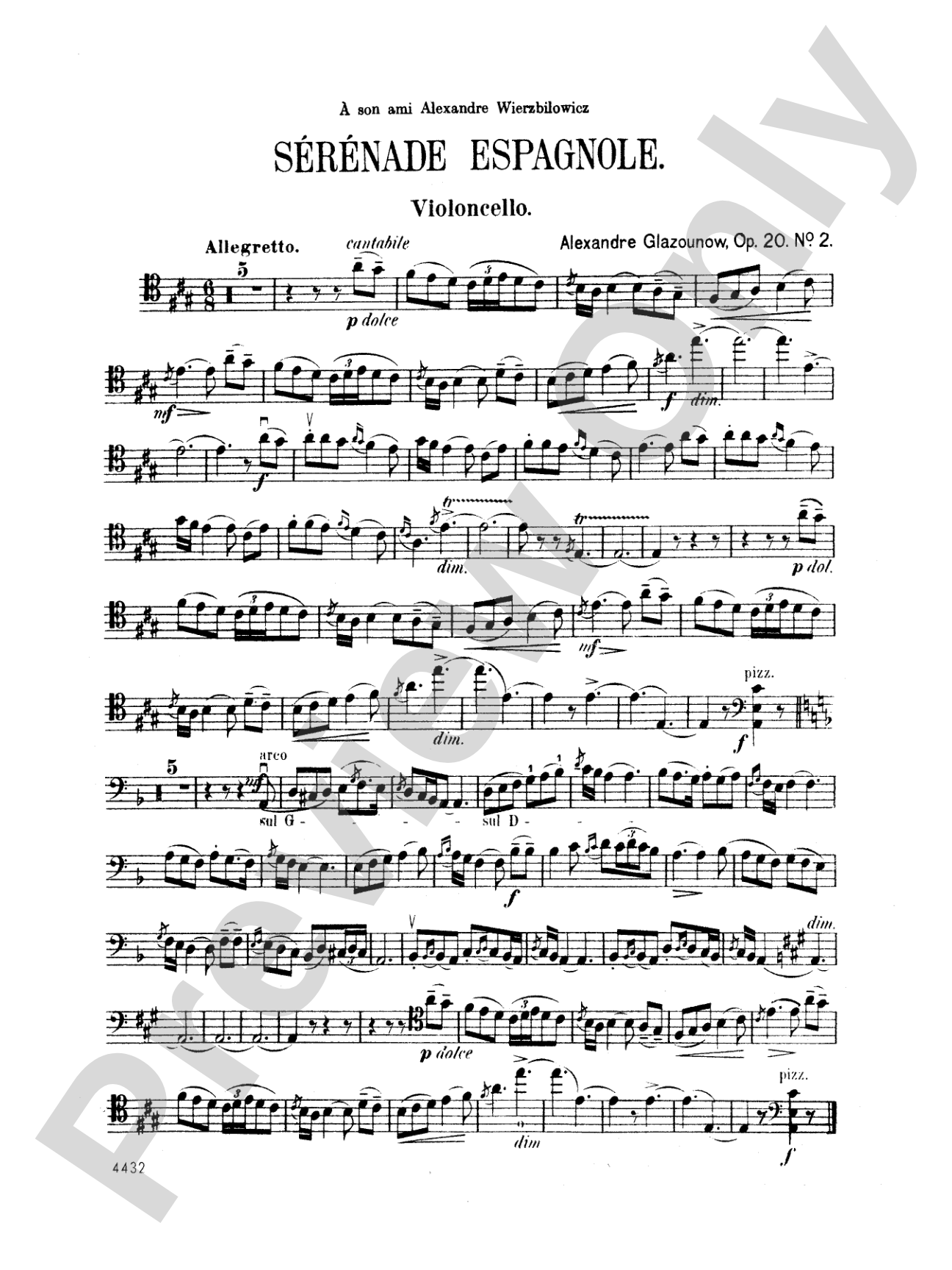

Glazunov: Serenade Espagnole, Op. 20, No. 2: Cello Book
By Alexander Glazunov
Item: 00-PK-0003509

$8.99
Pickup currently not available
Buy Extra Parts (Digital PDF Download)
| Product | Price | Quantity |
|---|---|---|
| Glazunov: Serenade Espagnole, Op. 20, No. 2 | $3.99 | |
| Glazunov: Serenade Espagnole, Op. 20, No. 2 | $3.99 |
Parts Added to Cart!
Related Items
Serenade Espagnole: Cello Book |
$8.95
|
View |
Description
A Cello solo with Piano Accompaniment composed by Alexander Glazunov.


Don't just read it, hear it, play along with it, and watch your students grow with it. In MakeMusic Cloud, Glazunov: Serenade Espagnole, Op. 20, No. 2: Cello Book comes alive with professional accompaniment, adjustable tempo, and built-in practice tools that turn solo practice into real progress.
Open in the Player
Jump straight in and assign it today.
Start Your Free Trial
Open this title and explore the full library in minutes.
Sample Audio
No sample audio found.
Sample Video
No sample videos found.
Additional Details
Series:
Kalmus Edition
Publisher:
Alfred Music
Page Count:
12
SKU:
00-PK-0003509
More about this title
About the Composer: Alexander Glazunov
Alexander Glazunov (1865-1936) was a Russian composer whose gift for melody and orchestration made him a bridge between Romantic grandeur and early modernism. A student of Rimsky-Korsakov, he composed prolifically across all genres and became a dominant force in late 19th-century Russian musical life, serving as director of the St. Petersburg Conservatory.
Glazunov's chamber and solo works remain staples of the classical repertoire. His cello writing demonstrates deep understanding of the instrument's lyrical possibilities, combining rich harmonic language with vocal, singing lines that suit both concert and competition settings.
Why we love this
The Serenade Espagnole sits in that rare territory where technical display and genuine musical substance coexist. Cellists value it for its combination of singing passages that demand real tone control and rhythmic flourishes that sound brilliant without requiring circus technique. It's a piece that rewards careful practice and speaks equally well in a recital or competition setting.
What to expect
Passionate and overtly romantic, with Spanish inflections lending color to an essentially songful work. The music moves easily between intimate, singing passages and moments of virtuosic sparkle, creating a sense of both confidence and lyrical warmth.
Who it's for
Intermediate to advanced cellists preparing for recitals, competitions, or festival performances. The piece works well for players developing confidence with extended melodic lines and who are ready to handle Romantic-era harmonic language and technical decoration.
How to get the most out of it
- Shape the melody with vocal phrasing rather than treating passage work as separate from thematic material. Every sixteenth note serves the larger musical line.
- Balance the cello's presence against the piano part. This is a true duet, not a concerto; listen to the accompaniment and let it inform your tempo flexibility and rubato.
- Establish a clear harmonic anchor in the opening phrases. The Spanish flavor comes through most convincingly when the harmony feels grounded beneath the melodic material.
- Work the trickier rhythmic passages with the piano from the start. Glazunov's syncopations can feel awkward if the cello and keyboard aren't locked in ensemble.
How to use it
Pair this with other Romantic cello works to create a coherent recital segment, or program it as a contrasting companion to works from the 20th-century avant-garde. It functions equally well as a festival or competition piece, where its combination of musicality and technical interest appeals to adjudicators.
Skills your students will build
- Cantabile phrasing across longer melodic lines
- Tone control and balance in duet texture with piano
- Rhythmic precision in syncopated and ornamented passages
- Romantic-era harmonic language and tonal interpretation
- Pedal and rubato coordination with an accompanist