

Gladiator (arr. Will Rapp John Wasson) Part 3: Marching Band Conductor Score & Parts
By Hans Zimmer / Arranged by Will Rapp / Arranged by John Wasson
Grade: 3-4
Item: 35-PK01757114
$65.00
Pickup currently not available
Buy Extra Parts (Digital PDF Download)
Parts Added to Cart!
Description
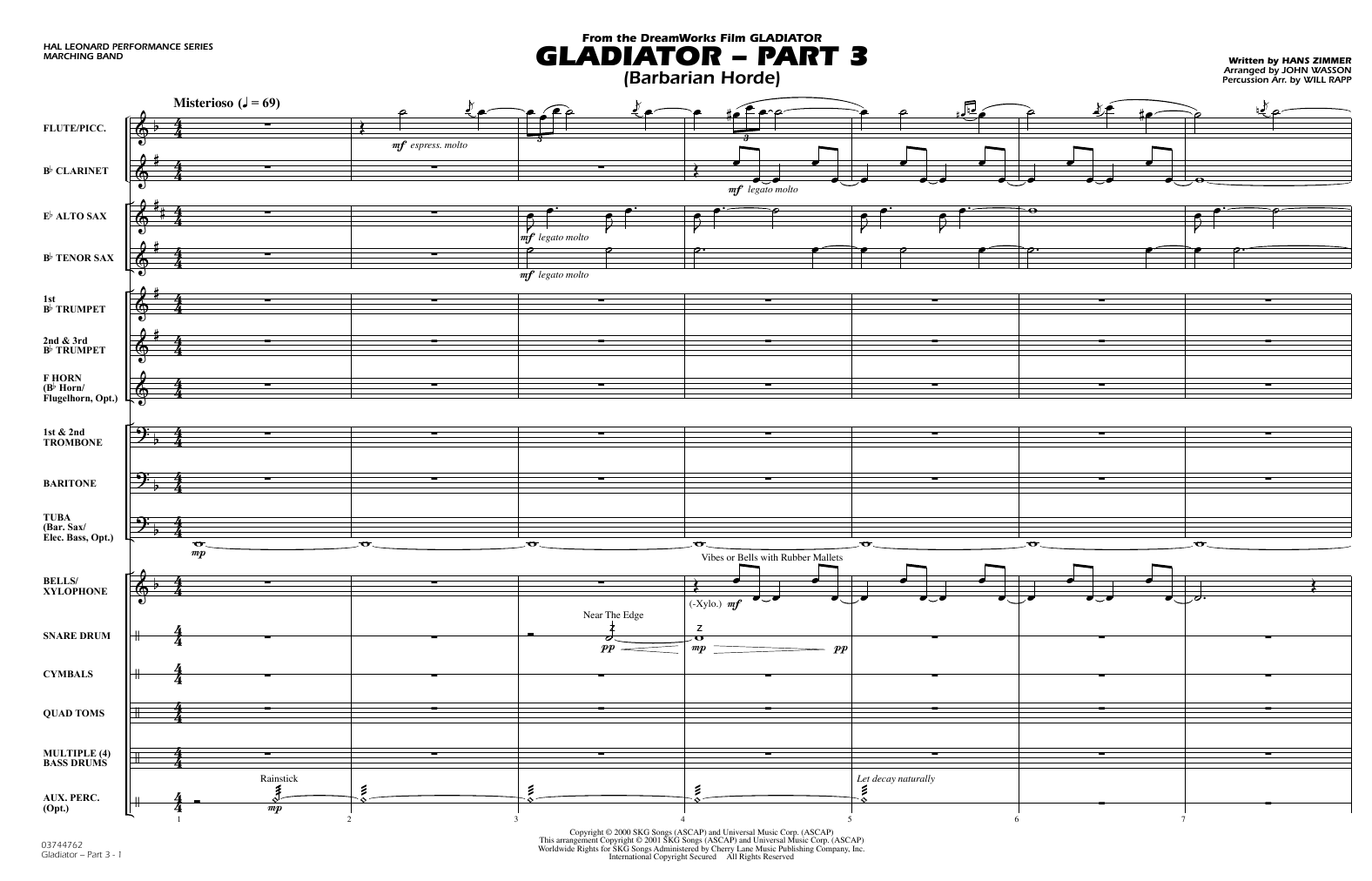
The dramatic and powerful themes of Hans Zimmer helped define the action in this Academy Award-winning movie blockbuster. Skillfully adapted for the marching field by John Wasson and Will Rapp, here is a complete show based on this emotional music. This closing production number is built on Barbarian Horde. A quiet introduction featuring the woodwinds sets the mood. The pace picks up with an ominous low brass statement which leads to the dramatic full band finish.


Gladiator (arr. Will Rapp John Wasson) Part 3: Marching Band Conductor Score & Parts isn't in MakeMusic Cloud just yet...but it could be. Let us know you'd like to see it, and you'll help shape what comes next. In the meantime, start a free trial and dive into thousands of interactive titles your students can play along with today.
Request This Title
Tell us you want it.
Start Your Free Trial
Explore everything that's ready to play right now.
Sample Audio
No sample audio found.
Sample Video
No sample videos found.
Additional Details
Publisher:
Hal Leonard
SKU:
35-PK01757114
More about this title
About the Composer: Hans Zimmer
Hans Zimmer stands among the most influential film composers of the last three decades, with a career defined by his ability to distill complex emotional narratives into memorable, orchestrally powerful themes. His work across action films, dramatic epics, and intimate character studies demonstrates a sophisticated understanding of how music shapes audience perception. For music educators, his compositions offer rich material for teaching orchestration, harmonic language, and the relationship between thematic development and dramatic pacing.
Why we love this
This arrangement captures the visceral energy of Zimmer's score while remaining accessible to Grade 3-4 ensembles. The structural arc is compelling: a woodwind introduction that draws listeners in, followed by a low brass swell that builds genuine dramatic tension before the full band delivers the payoff. You get a complete show moment that feels cinematic without requiring advanced technique from every section.
What to expect
This piece channels the raw force of ancient conflict without losing emotional depth. A hushed, watchful opening gives way to mounting dread as the low brass moves beneath the texture, building toward a climactic moment where the entire ensemble crashes forward. The effect is both thrilling and cinematic.
Who it's for
Marching bands ready to tackle a show finale with real dramatic stakes. The Grade 3-4 range means most groups have the technical foundation to execute this cleanly, while still needing focused rehearsal on ensemble balance and sustained intensity.
How to get the most out of it
- Shape the opening woodwind passage with dynamic restraint; let the soft introduction feel deliberate and ominous rather than tentative. The contrast will make the brass entrance hit harder.
- Lock the low brass statement (tuba and baritone) to a steady pulse before adding the layered voices on top. This section carries the weight of the dramatic build and needs rhythmic cohesion.
- Balance the full band finish carefully so that individual themes remain audible within the texture. Avoid the temptation to simply play loud; clarity of line matters more than volume.
- Treat the transition from the low brass statement into the full ensemble as a natural swell rather than an abrupt gear shift. The momentum should feel inevitable.
How to use it
This works perfectly as the closing number of a show centered on power, conflict, or historical drama. The three-part structure also means you can program the complete Gladiator suite as a suite, or use this movement as a standalone closer that sends the audience out with impact. It pairs well with other action-oriented repertoire and provides a natural finale that requires no additional transition music.
Skills your students will build
- Building and controlling dramatic tension over an extended musical arc
- Balancing sectional lines within a dense full band texture
- Dynamic contrast between soft introductions and powerful climactic moments
- Rhythmic precision in the low brass foundation while upper voices add complexity
- Sustaining intensity through repeated or varied thematic statements