
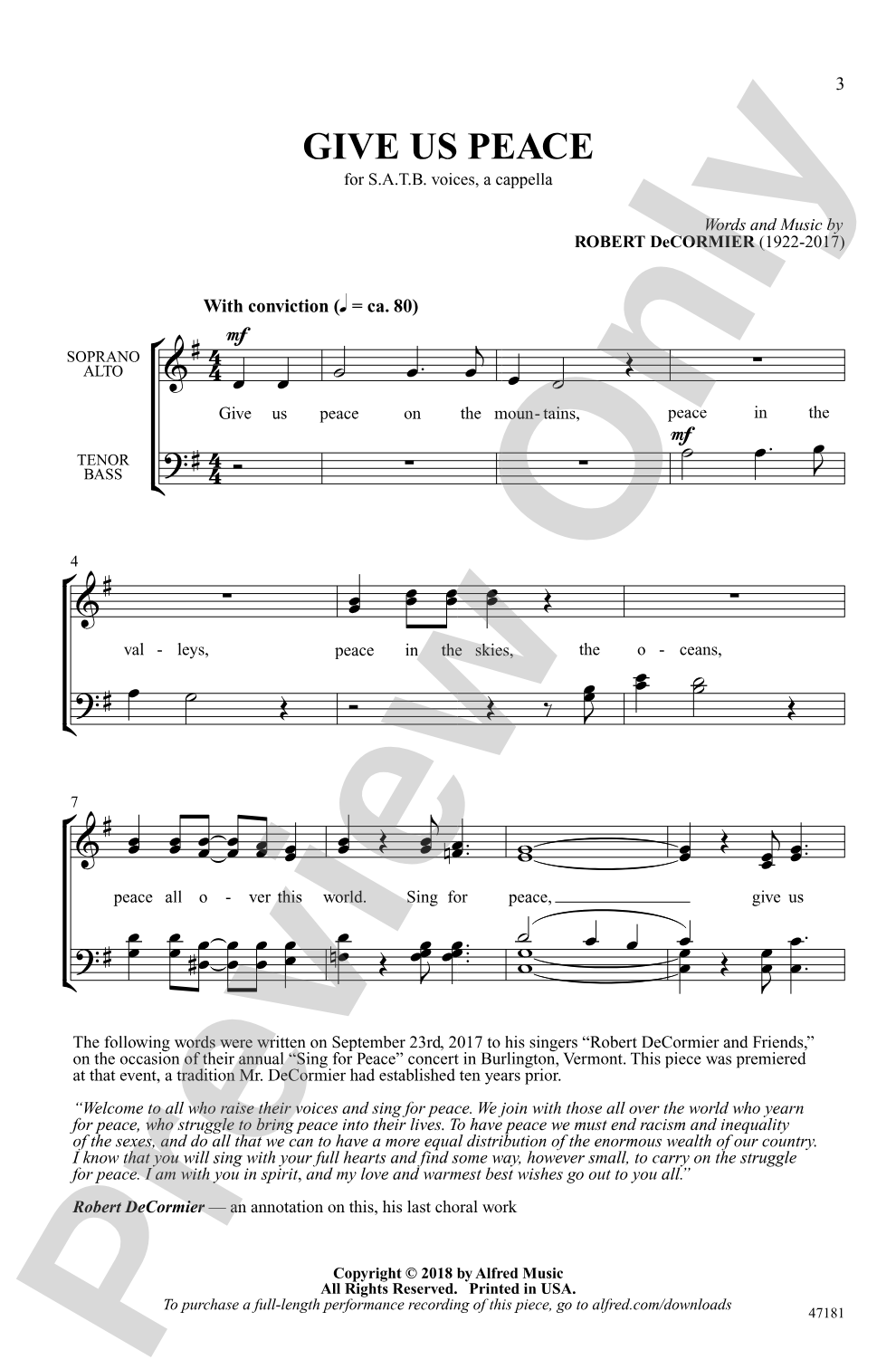

Give Us Peace: SATB, a cappella Choral Octavo
Words and music by Robert DeCormier
Item: 00-PO-0005898
$2.05
Minimum order quantity: 20 copies
Pickup currently not available
Related Items
Give Us Peace: SATB, a cappella Choral Octavo |
$2.05
|
View |
Description
Premiered by Robert DeCormier and Friends on the occasion of their tenth annual "Sing for Peace" concert in Burlington, Vermont, this powerful anthem is the last piece written by the prolific American arranger, composer, and conductor---just one month prior to his passing. Strong a cappella scoring reveals Mr. DeCormier's love of folk music, and striking original words impart a prayer for peace.


Give Us Peace: SATB, a cappella Choral Octavo isn't in MakeMusic Cloud just yet...but it could be. Let us know you'd like to see it, and you'll help shape what comes next. In the meantime, start a free trial and dive into thousands of interactive titles your students can play along with today.
Request This Title
Tell us you want it.
Start Your Free Trial
Explore everything that's ready to play right now.
Sample Audio
1
Audio File
--:--
0:00
0:00
Sample Video
Additional Details
Series:
Lawson-Gould
Publisher:
Alfred Music
Page Count:
8
SKU:
00-PO-0005898
More about this title
About the Composer: Robert DeCormier
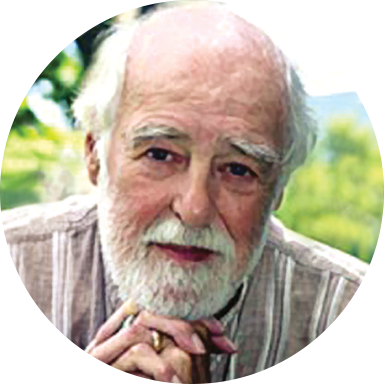
Robert DeCormier trained at the Juilliard School and built a career spanning classical, Broadway, and folk music traditions. He served as music director of the New York Choral Society for seventeen years, worked closely with Harry Belafonte as conductor and arranger, and from 1978 to 2010 held the position of music director for Peter, Paul and Mary. He also taught conducting and ensembles at the Eastman School of Music and helped establish the Vermont Symphony Orchestra Chorus in 1993.
In 2000, DeCormier founded Counterpoint, a professional vocal ensemble based in Vermont that performed regionally and offered workshops to high school choirs across New England. Throughout his career, he composed and arranged extensively, drawing from African-American spirituals, American folk songs, and international repertoire. His work earned him the Vermont Governor's Award for Excellence in the Arts in 2002 and a Lifetime Achievement Award from the New England Choral Arts Foundation in 2006. Give Us Peace stands as his final composition, written one month before his death.
Why we love this
This piece arrives weighted with historical significance: it is DeCormier's last work, premiered at a "Sing for Peace" concert he helped nurture in his Vermont community. The a cappella scoring reflects his deep command of folk idiom and choral sound, making it both musically rewarding and emotionally grounded. Directors will find it speaks powerfully in concert settings precisely because it balances accessibility with artistic substance.
What to expect
Warm, contemplative, and quietly dignified. The a cappella texture creates an intimacy that draws listeners inward, while the folk-influenced harmonies ground the piece in something recognizable and human. This is a work that asks singers to listen to one another and to mean every word.
Who it's for
Choirs at the high school level and above with solid fundamental blend and ability to balance multiple lines will find this octavo within reach. It works equally well for community choruses, church choirs seeking concert repertoire, and collegiate singers looking for repertoire with genuine artistic and historical weight.
How to get the most out of it
- Attend to the folk-song roots in the melodic writing; these melodies are built to resonate, not to disappear in overly lush harmonies. Clarity of line will serve the text better than thickness of sound.
- Use the eight-page length to build interpretive momentum; this is a prayer, not a recitation. Shape the arc across the entire piece rather than treating phrases in isolation.
- Balance the voices so that the original words land distinctly. DeCormier's text carries weight equal to his music, and muddied diction will weaken the message.
How to use it
Program this as a thoughtful closer to a concert themed around hope, community, or social values. Its brevity and emotional clarity also make it a natural fit alongside other peace-focused or spiritually grounded repertoire. Many choirs will find it serves as a meaningful anchor in a mixed program, giving audiences a moment of genuine reflection.
Skills your students will build
- Balancing independent melodic lines in a cappella texture
- Sustaining intonation across harmonic changes without instrumental support
- Interpreting text with musical intention and emotional authenticity
- Understanding folk music idioms and their harmonic conventions
- Listening actively to surrounding voices to achieve blend