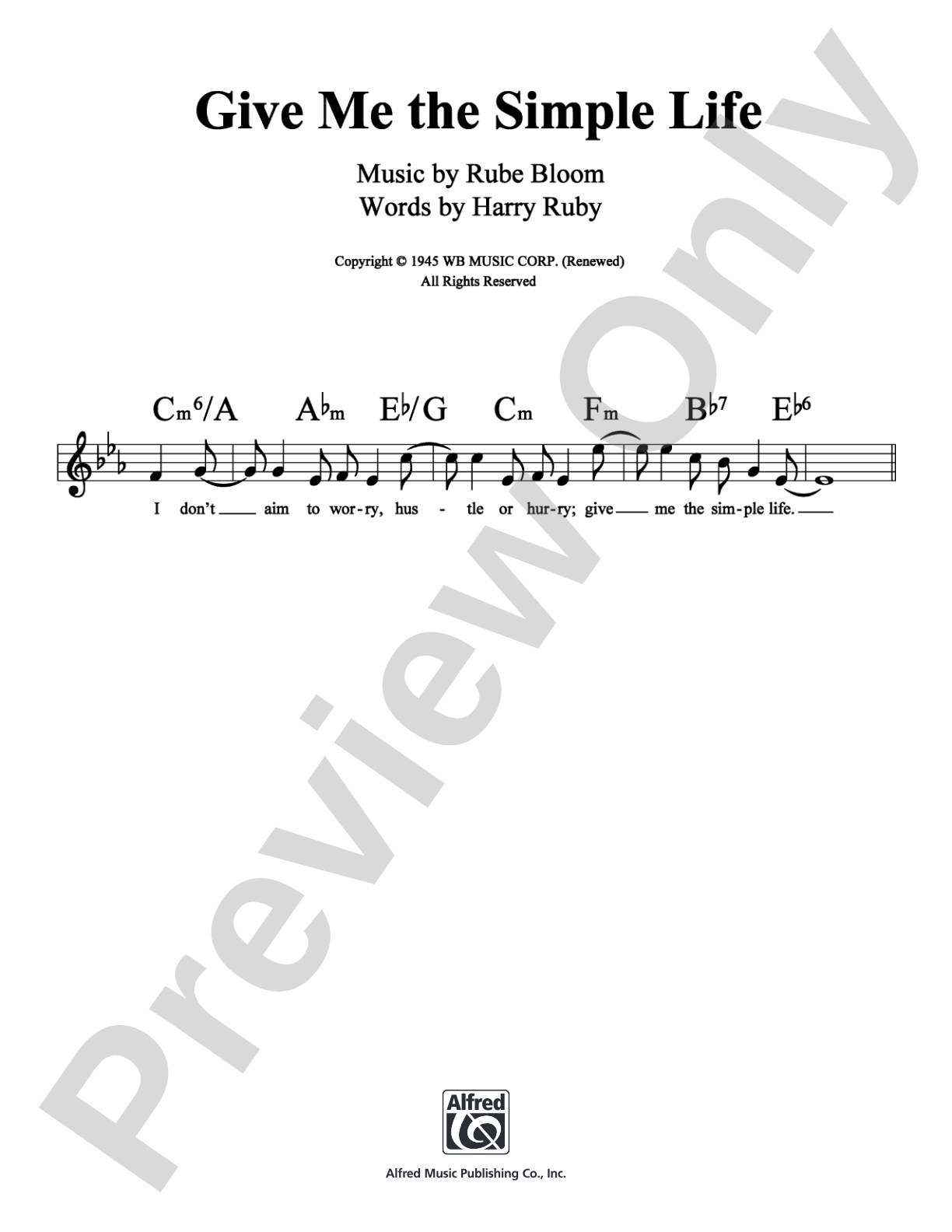
Give Me the Simple Life: Lead Sheet Digital Sheet Music

Give Me the Simple Life: Lead Sheet Digital Sheet Music

Bing Crosby, Benny Goodman, Rube Bloom, Jimmy Dorsey

Item: 00-PS-0006936

Digital Download
$1.99
Description

Give Me the Simple Life: Lead Sheet Digital Sheet Music isn't in MakeMusic Cloud just yet...but it could be. Let us know you'd like to see it, and you'll help shape what comes next. In the meantime, start a free trial and dive into thousands of interactive titles your students can play along with today.

Sample Audio
No sample audio found.
Sample Video
Additional Details
SKU: 00-PS-0006936

More about this title

About the Artist: Bing Crosby

Bing Crosby (1903-1977) defined the sound of American popular music across five decades. His warm baritone and conversational phrasing influenced countless singers and shaped how standards became embedded in the cultural repertoire. Crosby's recordings of jazz and swing era material remain essential listening for understanding vocal interpretation and the art of accompaniment.

As a bandleader, film star, and recording artist, Crosby bridged classical training with vernacular music in ways that made sophisticated harmony and swung phrasing accessible to mass audiences. For music educators, his recorded interpretations offer masterclass examples of how to serve a melody while improvising tastefully within harmonic structures.

Why we love this

This standard captures one of the most recorded songs of the swing era, and Crosby's association with it makes this lead sheet instantly recognizable to singers and audiences alike. The melody sits comfortably for voices across multiple ranges, and the harmonic language rewards both straight reading and creative reharmonization. It's equally at home in a jazz combo setting, a vocalist recital, or as the foundation for student arrangements.

What to expect

Warm and nostalgic, with an almost conversational melody that invites relaxation rather than display. The tune floats above gentle swing rhythms, evoking lazy afternoons and a deliberately unpretentious approach to happiness. There's a conversational ease in the phrasing that makes it feel intimate even in larger ensemble settings.

Who it's for

Singers preparing jazz or standards repertoire, whether for competitions, recitals, or ensemble work. Jazz pianists and guitarists building a foundation in lead sheet reading and chord vocabulary. Educators seeking accessible, historically significant material for teaching song form, harmonic function, and the relationship between written melody and recorded interpretation.

How to get the most out of it

  • Shape the melody by pulling back slightly on the highest notes; let them breathe rather than sitting on them. This approach mirrors Crosby's own restrained phrasing.
  • Determine whether you'll follow the recorded version's tempo or establish your own. A moderate swing feel around 140 BPM allows room for lyrical interpretation without dragging.
  • Explore the implied chord changes for comping opportunities if you're working with a rhythm section. The harmonic structure invites gentle reharmonization without losing the tune's identity.
  • Ground the lyric content in storytelling. The song's simplicity is deceptive; connecting to the nostalgia beneath the words adds dimension to any interpretation.

How to use it

Program this alongside other standards to create a historical survey of American song or to showcase different arranging approaches at a single concert. It works beautifully as a bridge between a jazz combo set and more formal vocal music. For applied studios, use the lead sheet as a vehicle for teaching singers how to listen critically to recorded interpretations and then make independent choices about phrasing and tempo.

Skills your students will build

  • Reading and interpreting lead sheet notation
  • Understanding song form and harmonic progression in standards
  • Applying swing phrasing and rhythmic interpretation to written melody
  • Balancing literal melodic reading with stylistic choices and flexibility
  • Analyzing recorded arrangements to inform solo performance decisions

You May Also Like