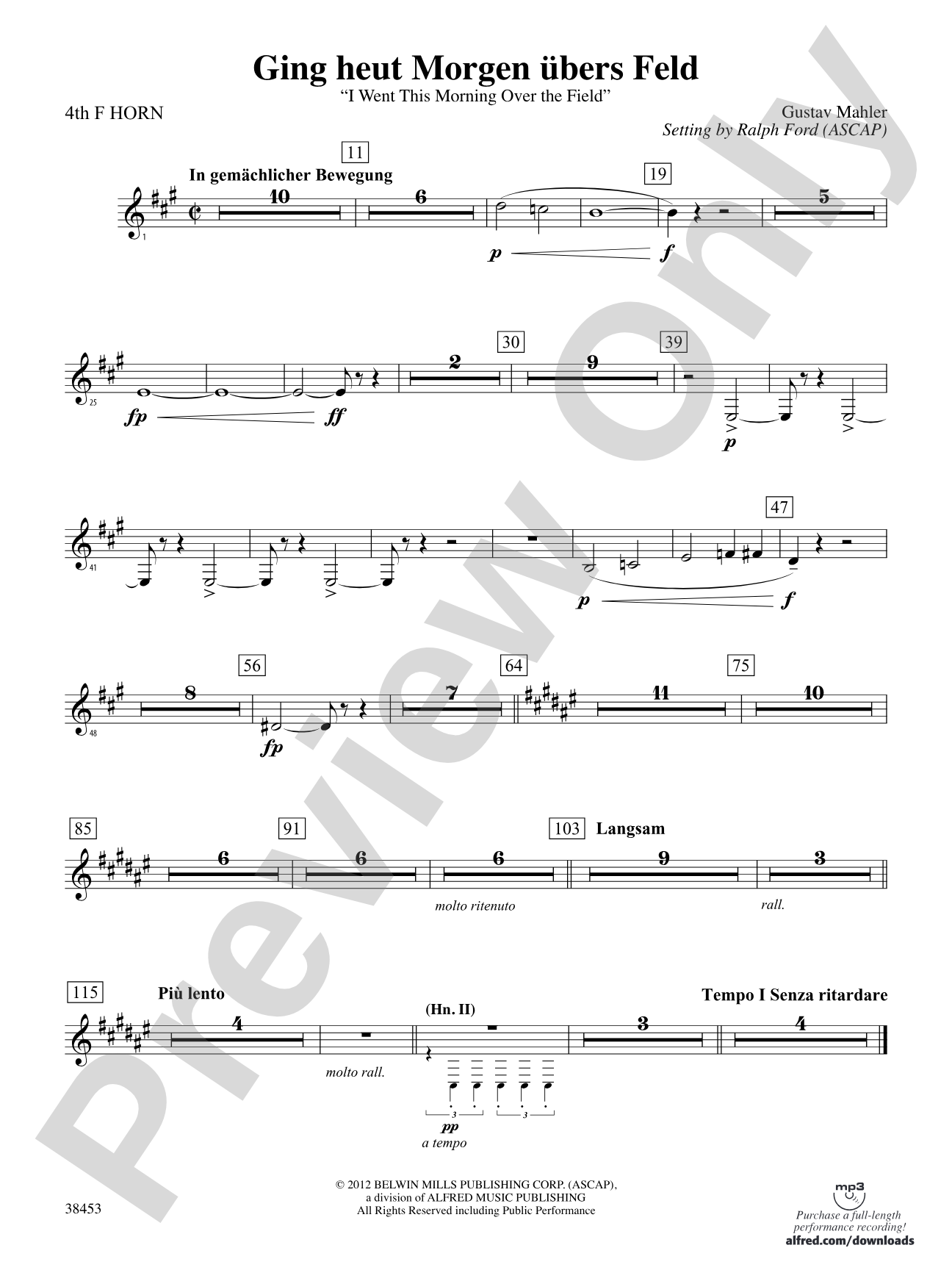
Ging heut Morgen übers Feld: 4th F Horn Sheet Music Preview

Ging heut Morgen übers Feld: 4th F Horn

"I Went This Morning Over the Field"

By Gustav Mahler / setting by Ralph Ford

Grade: 4

Item: 00-PC-0015509_H4

Digital Download
$3.00
Description
The happiest song from this great work, now arranged with a choice of soloist! In this expanded setting, the transparency of the original is maintained, providing the perfect place to add the soloist. Vocal, B-flat, F, or B.C. solo parts are provided, or the piece can be played without a soloist. The harp part is integral to the arrangement but can be performed on synth.

Don't just read it, hear it, play along with it, and watch your students grow with it. In MakeMusic Cloud, Ging heut Morgen übers Feld: 4th F Horn comes alive with professional accompaniment, adjustable tempo, and built-in practice tools that turn solo practice into real progress.

Sample Audio
0:00
0:00
Sample Video
Additional Details
Series: Belwin Concert Full Orchestra
Publisher: Alfred Music
Page Count: 206
SKU: 00-PC-0015509_H4

More about this title

About the Composer: Gustav Mahler

Gustav Mahler (1860-1911) was an Austrian composer and conductor whose ten symphonies and song cycles reshaped the symphony's expressive range in the late Romantic period. His works weave together folk melodies, intricate orchestration, and profound emotional depth, bridging the 19th-century symphonic tradition and early modernism. Mahler's influence on orchestration and his integration of vocal and instrumental forces remain central to the repertoire that music educators teach and students encounter.

Why we love this

Ralph Ford's orchestration keeps the song's folk simplicity and radiant melody intact while providing the technical clarity that makes it teachable and rewarding at Grade 4. The flexible soloist options mean you can feature a strong vocalist, showcase a section principal, or perform it purely instrumentally depending on your ensemble's needs. This is Mahler made accessible without compromise.

What to expect

Sunlight and walking through a field on a spring morning. The melody sits in the upper voices with the ease of folk song, supported by warm harmonic motion and the shimmer of harp. There's joy here without sentimentality, brightness without brittleness.

Who it's for

Orchestra directors seeking a masterwork arrangement that combines musical substance with Grade 4 accessibility. This works equally well for ensembles with strong soloists and those who prefer an instrumental reading, making it flexible for diverse student groups.

How to get the most out of it

  • Balance the harp part carefully to support the harmony without overwhelming the soloist or melody section. The part is integral to the arrangement's warmth, so avoid treating it as background texture.
  • If using the synth option for harp, commit to a consistent touch and voicing in rehearsals before performance. The synthetic timbre will carry differently than acoustic harp, so adjust dynamic balance accordingly.
  • Let the soloist's phrasing lead the orchestra slightly rather than locking to a metronomic pulse. The original folk character thrives when the ensemble breathes together, following the singer's natural rubato.
  • Emphasize the transparency Ford built into this scoring. Resist the urge to swell; the piece radiates through clarity and lightness, not volume.

How to use it

Program this as a concert opener to establish warmth and draw the audience in before more dramatic works. It also pairs beautifully on a spring or end-of-year concert alongside lighter fare or as a palate-cleansing moment between heavier romantic repertoire.

Skills your students will build

  • Balancing a solo line against full orchestra texture
  • Playing transparently at moderate to soft dynamics
  • Responding to rubato and flexible phrasing from a soloist
  • Reading harp or synthesizer accompaniment parts and coordinating rhythm section support

You May Also Like