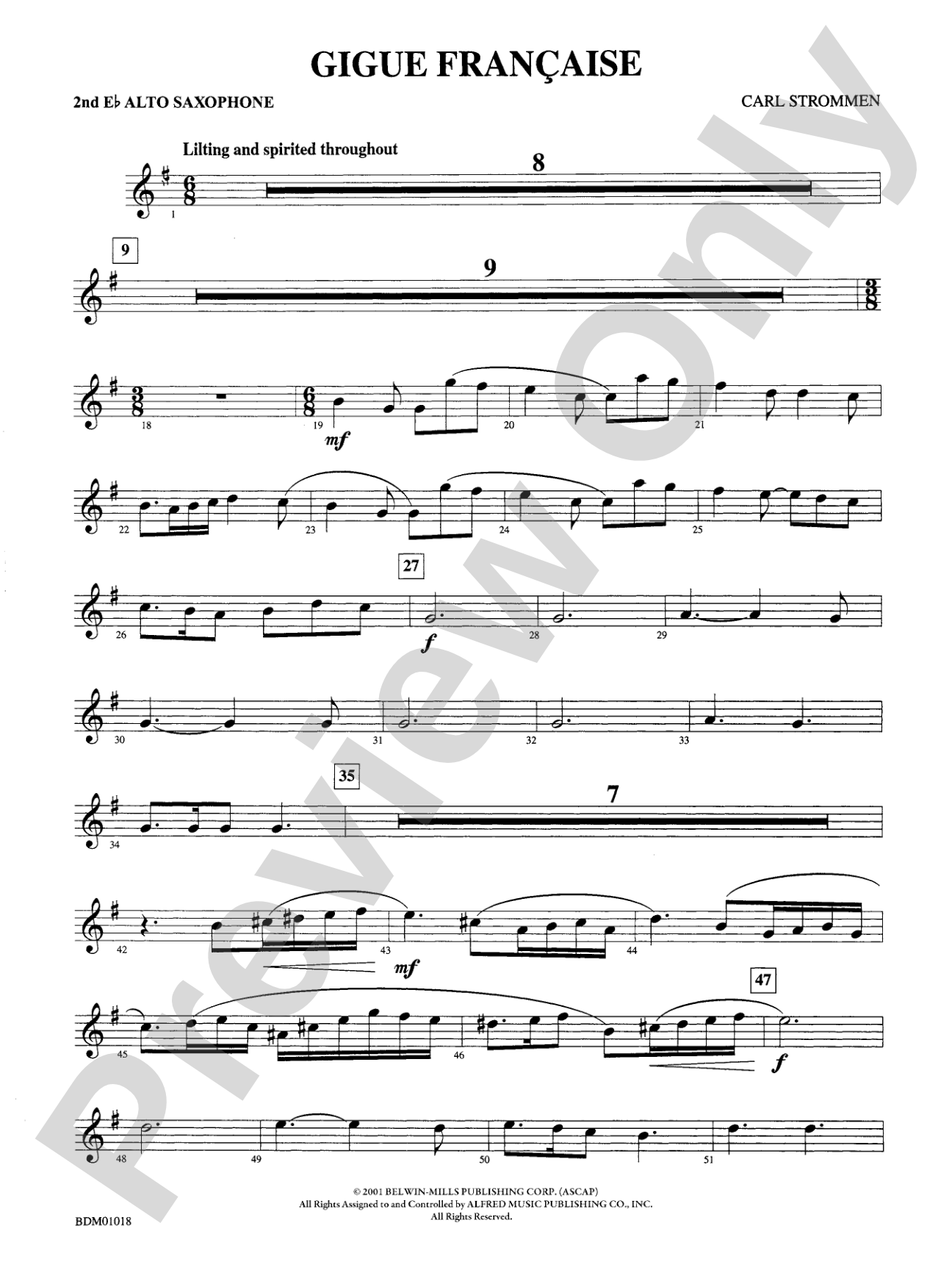
Gigue Française: 2nd E-flat Alto Saxophone Sheet Music Preview

Gigue Française: 2nd E-flat Alto Saxophone

By Carl Strommen

Grade: 3 (Medium Easy)

Item: 00-PC-0016047_AX2

Digital Download
$3.00
Description
Cast in triple meter, this original composition begins with a delightful melody in the clarinet section. Although the tune sounds intricate, it falls well in the fingers - once mastered it will delight your students. A serious composition that is enjoyable to rehearse. Dance-like in nature, this composition brings the essence of France into your ensemble. A delight to rehearse and perform. Your audience will be dancing in the aisles. This title is available in MakeMusic Cloud.

Don't just read it, hear it, play along with it, and watch your students grow with it. In MakeMusic Cloud, Gigue Française: 2nd E-flat Alto Saxophone comes alive with professional accompaniment, adjustable tempo, and built-in practice tools that turn solo practice into real progress.

Sample Audio
0:00
0:00
Sample Video
Additional Details
Series: Belwin Concert Band
Publisher: Alfred Music
Page Count: 160
SKU: 00-PC-0016047_AX2

More about this title

About the Composer: Carl Strommen

Carl Strommen

Carl Strommen's prolific output spans band, orchestra, jazz ensemble, and vocal music, establishing him as one of the most frequently performed composer-arrangers internationally. His work appears regularly in concert halls, broadcast media, and film soundtracks, and he maintains an active schedule as both a clinician and commissioned composer, earning the ASCAP Standard Writers Award annually for his contributions to the field.

A graduate of City College of New York, Strommen currently serves as an adjunct professor of orchestration and composition at C.W. Post Campus of Long Island University in Brookville, New York. He resides on Long Island and divides extended family time between Colorado and the Northeast.

Why we love this

Strommen writes with clarity about what works for bands at this level: the clarinet melody sounds sophisticated in its construction but sits naturally under the fingers, which means your students experience the reward of playing something genuinely musical without getting bogged down in technical frustration. The dance-like energy and French character give it real personality, making rehearsals engaging rather than obligatory.

What to expect

Delicate and bright, with the rhythmic swagger of a French court dance translated into modern ensemble color. The clarinet line dances forward while the band provides responsive support, creating an intimate yet energetic conversation that feels both refined and approachable.

Who it's for

Grade 3 concert bands looking for a piece that sounds more sophisticated than it plays. Directors preparing for contest or festival season will appreciate repertoire that builds student confidence while maintaining genuine musical interest for both performers and audiences.

How to get the most out of it

  • Balance the clarinet melody prominently in the opening passages so the intricate writing shines; younger players tend to bury expressive lines, but this one deserves to sing.
  • Emphasize the triple meter's lilt rather than marching through it mechanically; the gigue style calls for a gentle swing that makes the ensemble sound alive.
  • Let the band find the dance character in their bodies before they find it in the notes; humming or counting with a light bounce helps everyone catch the intended spirit.
  • Mark the harmonic shifts with slight color changes in dynamics, not large ones; subtlety at this grade level shows maturity and keeps the French aesthetic intact.

How to use it

Perfect as a contrasting midconcert selection between heavier or more serious works, or as a strong closer that leaves audiences smiling. The Grade 3 difficulty and contest-appropriate length make it ideal for early-season programming when ensembles are rebuilding their fundamentals but still need musically rewarding material.

Skills your students will build

  • Phrasing and line-shaping in triple meter
  • Articulation clarity in fast scalar passages (clarinet section)
  • Sectional balance and blend with featured melodic voices
  • Stylistic interpretation of dance forms and French character
  • Ensemble coordination across changing harmonic textures

You May Also Like