
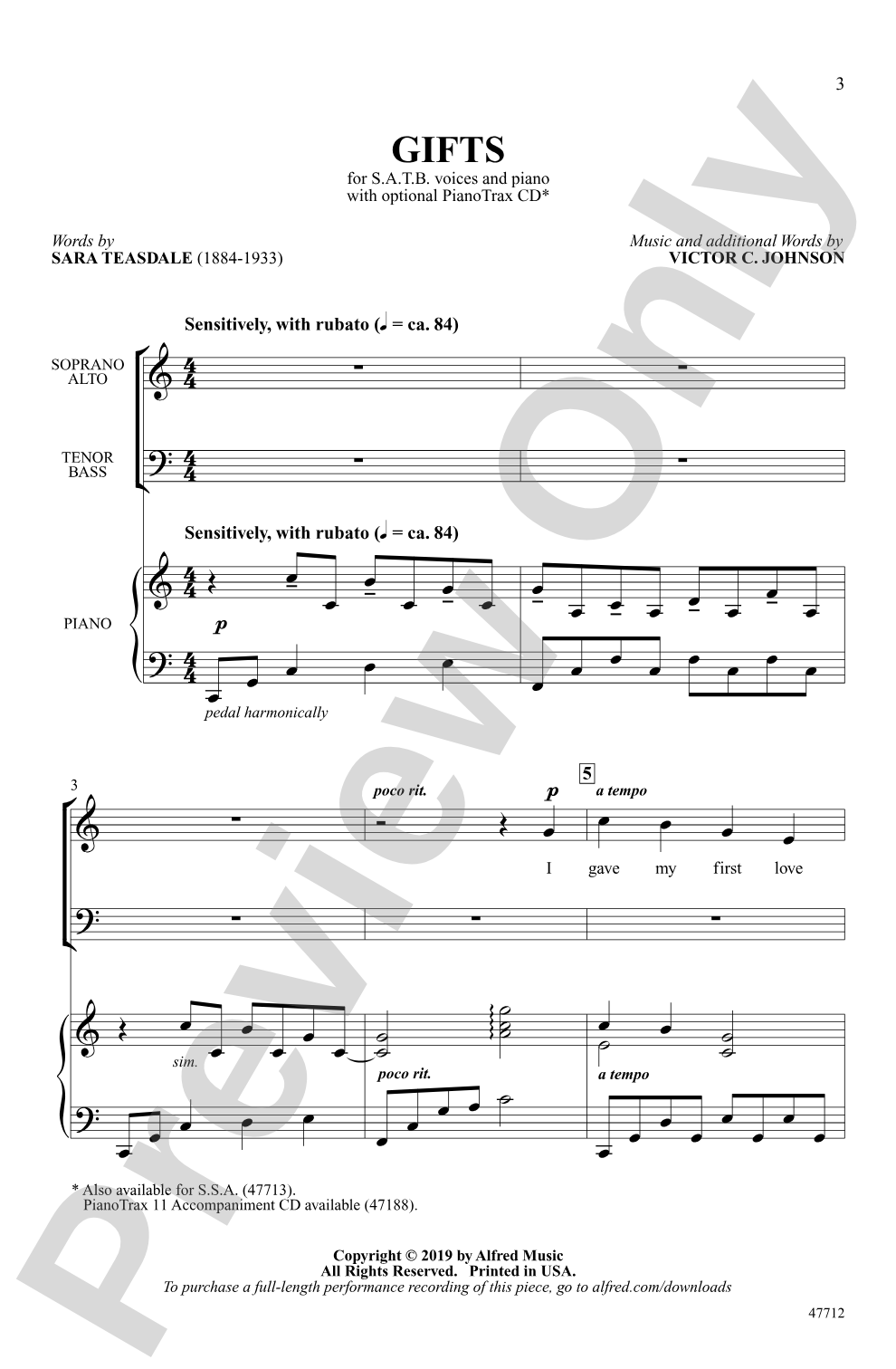

Gifts: SATB Choral Octavo
Words by Sara Teasdale, music and additional words by Victor C. Johnson
Item: 00-PO-0006002
$2.05
Minimum order quantity: 20 copies
Pickup currently not available
Description
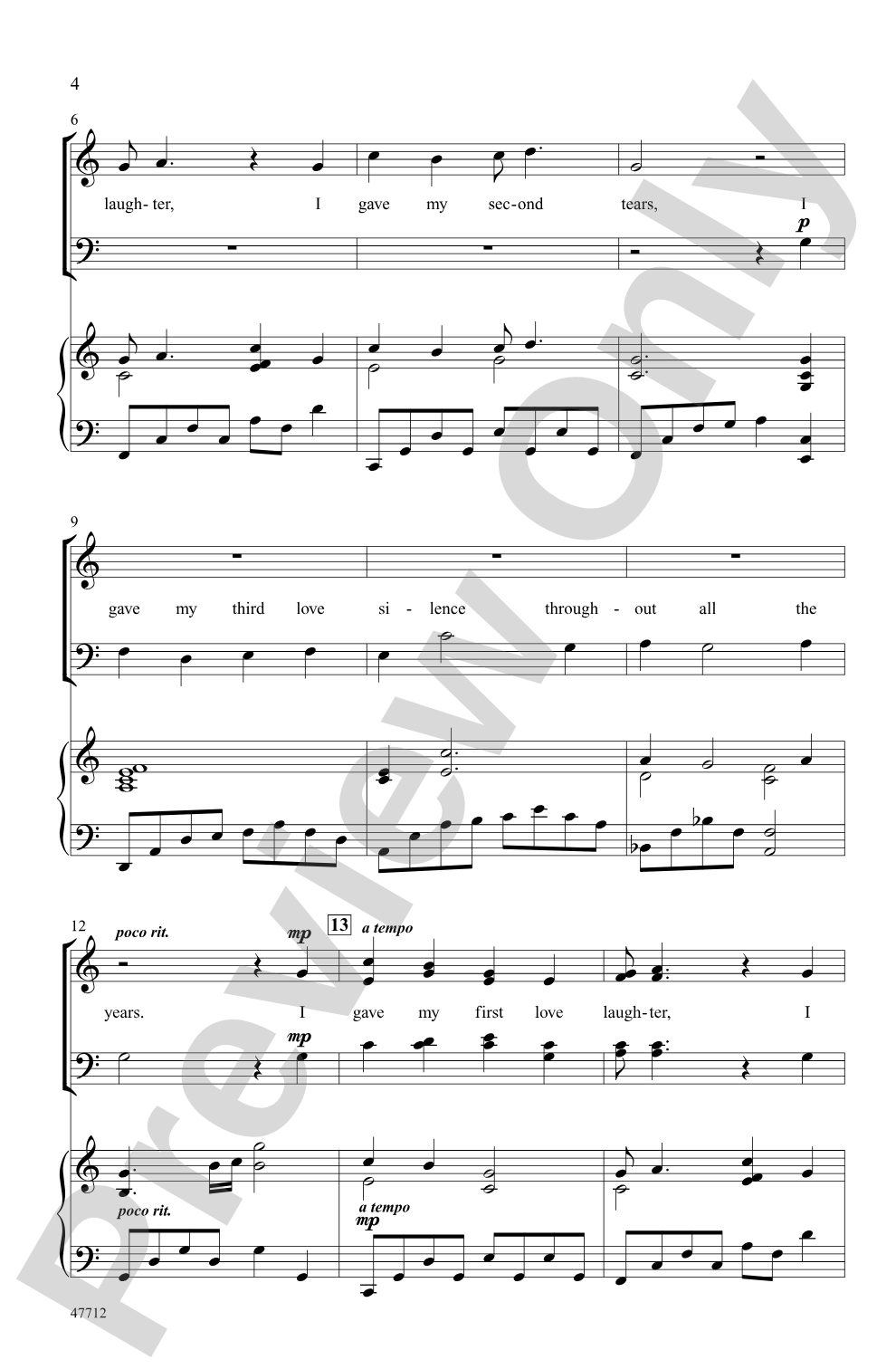
Sara Teasdale's poignant commentary on the challenges and rewards of love is the foundation of this sensitive choral setting. Strong homophonic writing puts a focus on the words, while scattered harmonic suspensions and gentle ebbs and flows of tempo invite a deep understanding of the text. “These are the gifts of love.”


Gifts: SATB Choral Octavo isn't in MakeMusic Cloud just yet...but it could be. Let us know you'd like to see it, and you'll help shape what comes next. In the meantime, start a free trial and dive into thousands of interactive titles your students can play along with today.
Request This Title
Tell us you want it.
Start Your Free Trial
Explore everything that's ready to play right now.
Sample Audio
1
Audio File
--:--
0:00
0:00
Sample Video
Additional Details
Series:
Alfred Choral Designs
Publisher:
Alfred Music
Page Count:
12
SKU:
00-PO-0006002
More about this title
About the Composer: Victor C. Johnson

Victor C. Johnson brings deep roots in Texas choral music as both a composer and educator. Currently serving as School Choral Editor for Sing!, the educational publishing division of Choristers Guild, he has established himself as a prolific voice in choral literature with over 500 works across choral octavos, vocal solos, and keyboard collections. His experience directing at the Fort Worth Academy of Fine Arts from 2000 to 2018 shaped his understanding of what student singers need to grow, and he has continued that mission through his appointment in 2022 as conductor of the Dallas Symphony Children's Chorus Mixed Ensemble (grades 9-12).
Johnson's professional involvement spans the American Choral Directors Association, American Guild of Organists, Texas Music Educators Association, National Association for Music Education, and other leading music education organizations. His dual focus on publishing and conducting positions him uniquely to write music that directors can actually teach and singers can genuinely connect with.
Why we love this
Johnson's setting trusts the poetry first. The homophonic writing keeps Teasdale's words front and center, yet the carefully placed harmonic suspensions and flexible pacing prevent the piece from feeling plain or safe. This is the kind of literature that deepens a choir's sensitivity to text without requiring advanced harmonic analysis or complex rhythmic reading.
What to expect
The piece settles into a reflective, almost intimate space. Johnson's writing creates moments of genuine harmonic richness that emerge organically from the text, making the choir feel like it's discovering something vulnerable about love rather than performing a predetermined message.
Who it's for
This octavo suits choirs seeking literary depth without excessive harmonic or rhythmic complexity. It works well for treble-heavy or balanced SATB ensembles at the high school through adult community level who want to program something meaningful for a concert or festival setting.
How to get the most out of it
- Let the suspended chords breathe. Rather than moving through them quickly, give singers time to feel the tension and resolution, which mirrors the emotional arc of Teasdale's reflection on love.
- Shape the dynamics around the text's meaning, not arbitrary volume changes. Notice where love feels full and where it feels tentative, and let the choir's collective voice follow that journey.
- Work vowel unification during the homophonic sections to maximize clarity of the words while keeping the sound warm and connected.
- Use the recorded accompaniment to lock the gentle tempo shifts in place during early rehearsals, then gradually reduce reliance on it so the choir learns to listen to itself.
How to use it
Pair this with other text-driven works of similar length for a concert exploring themes of human connection, or program it alone as a concert centerpiece that stands on its own. Its contemplative character makes it particularly effective in the second half of a program, where audiences have settled in and are ready for introspection.
Skills your students will build
- Sustaining focused vowel sound in homophonic passages
- Reading and performing harmonic suspensions with sensitivity
- Following and executing flexible tempo changes through textual interpretation
- Balancing clarity of diction with unified vocal blend