
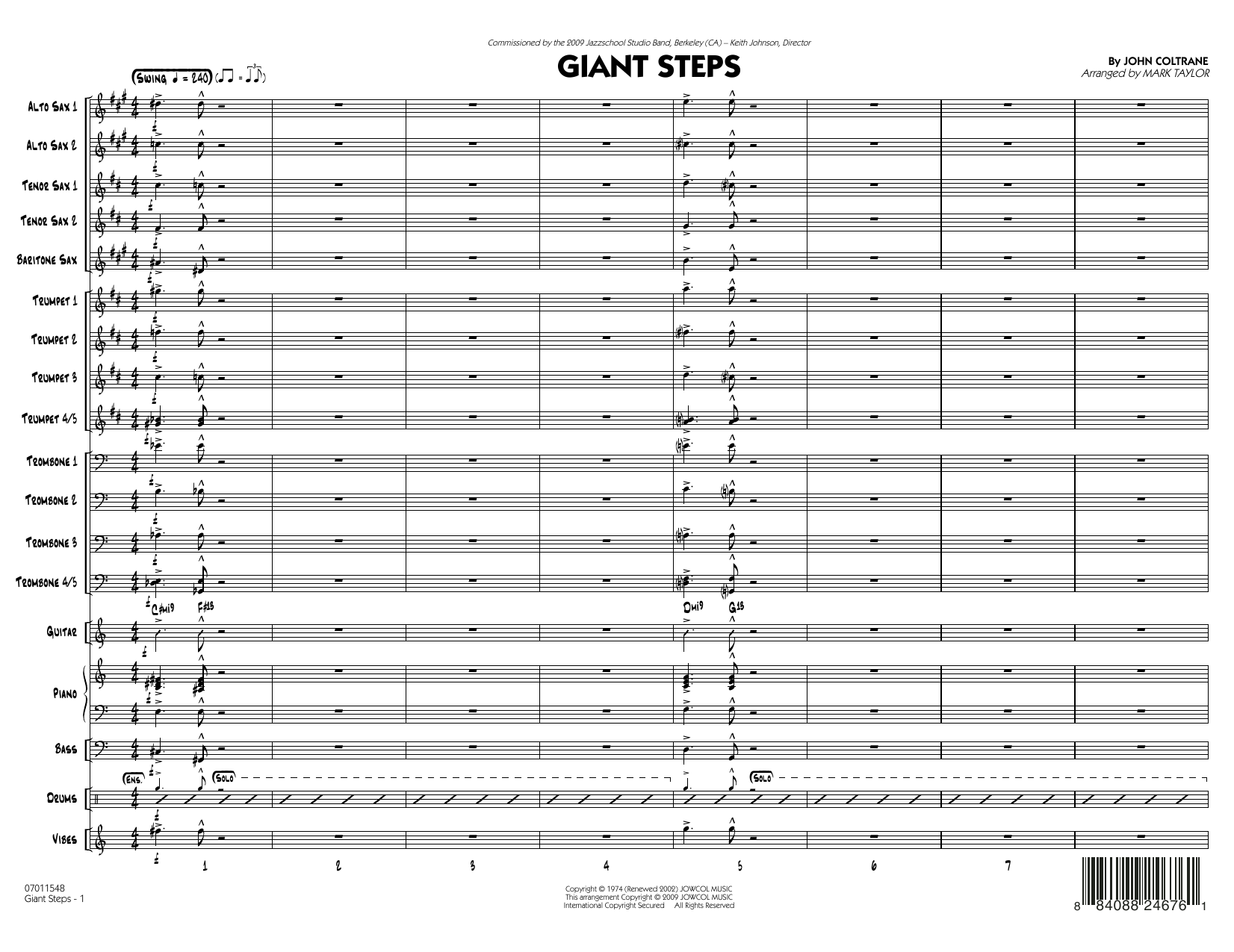

Giant Steps (arr. Mark Taylor): Jazz Ensemble Conductor Score & Parts
By John Coltrane / Arranged by Mark Taylor
Grade: 5
Item: 35-PK01215316
$65.00
Pickup currently not available
Buy Extra Parts (Digital PDF Download)
Parts Added to Cart!
Description
Here's a fresh new take on a traditional jazz standard. The style is still uptempo swing, and the saxes maintain a fair share of the spotlight along with ensemble hits and solo spots for drums. However, there is a brief excursion into 5/4 and a few other meter surprises that help give this outstanding chart a contemporary edge.


Giant Steps (arr. Mark Taylor): Jazz Ensemble Conductor Score & Parts isn't in MakeMusic Cloud just yet...but it could be. Let us know you'd like to see it, and you'll help shape what comes next. In the meantime, start a free trial and dive into thousands of interactive titles your students can play along with today.
Request This Title
Tell us you want it.
Start Your Free Trial
Explore everything that's ready to play right now.
Sample Audio
No sample audio found.
Sample Video
No sample videos found.
Additional Details
Publisher:
Hal Leonard
SKU:
35-PK01215316
More about this title
About the Composer: John Coltrane
John Coltrane transformed jazz through his fearless harmonic exploration and relentless work ethic. His 1960 composition Giant Steps became a watershed moment in jazz history, presenting chord changes so complex and fast-moving that the tune immediately challenged musicians and remains a proving ground for serious improvisers today.
Coltrane's impact on music education extends far beyond this single composition. His commitment to continuous improvement and his willingness to push against established boundaries exemplify the mindset that music teachers hope to instill in their students. Giant Steps continues to appear in jazz curricula worldwide as both a listening example and a performance vehicle for advanced ensembles.
Why we love this
Mark Taylor's arrangement preserves what makes Giant Steps essential repertoire for jazz ensembles while giving it room to breathe in the modern classroom. The addition of metric variety and contemporary compositional touches means your students encounter a chart that respects the tradition but refuses to be bound by it, which is exactly the spirit Coltrane himself embodied.
What to expect
The energy is relentless and sophisticated. You get the propulsive swing groove that defined Coltrane's original, but the meter shifts and contemporary touches keep listeners and players alert, creating moments of surprise that make the piece feel both timeless and urgent.
Who it's for
Grade 5 jazz ensembles ready to tackle a standard that demands precision, rhythmic flexibility, and serious musicianship. This works equally well for groups pursuing a competitive jazz festival set or bands looking to program something that challenges students without requiring years of jazz experience.
How to get the most out of it
- Build the saxophone section's confidence with the main melody before rehearsing sections; the signature changes move quickly, and having everyone nail the opening theme creates momentum for the trickier passages that follow.
- Prepare the rhythm section early in the rehearsal process for the 5/4 excursion. That meter shift catches many groups off guard, so isolating it with drums and bass first prevents it from derailing the full ensemble later.
- Use the dynamic range between the uptempo swing sections and the metric surprises as a storytelling tool. The contrast works best when the ensemble fully commits to the character of each section rather than treating them as obstacles to overcome.
- Feature your strongest soloists on the designated solo sections and ensemble hits. The chart gives drummers, saxes, and rhythm section players room to shine, so casting matters just as much as preparation.
How to use it
Pair this with other Grade 5 jazz standards to showcase your ensemble's versatility, or use it as the centerpiece of a concert focused on how jazz tradition continues to evolve. The contemporary arranging choices make it an excellent teaching moment about how a composer's legacy can inspire fresh interpretations rather than mere repetition.
Skills your students will build
- Reading and performing complex chord changes at faster tempos
- Transitioning between standard time signatures and uncommon meters (5/4) within a single piece
- Balancing ensemble precision with the flexibility required in jazz interpretation
- Supporting featured soloists while maintaining rhythmic integrity
- Understanding how arrangement choices can honor a composition's history while expanding its possibilities