
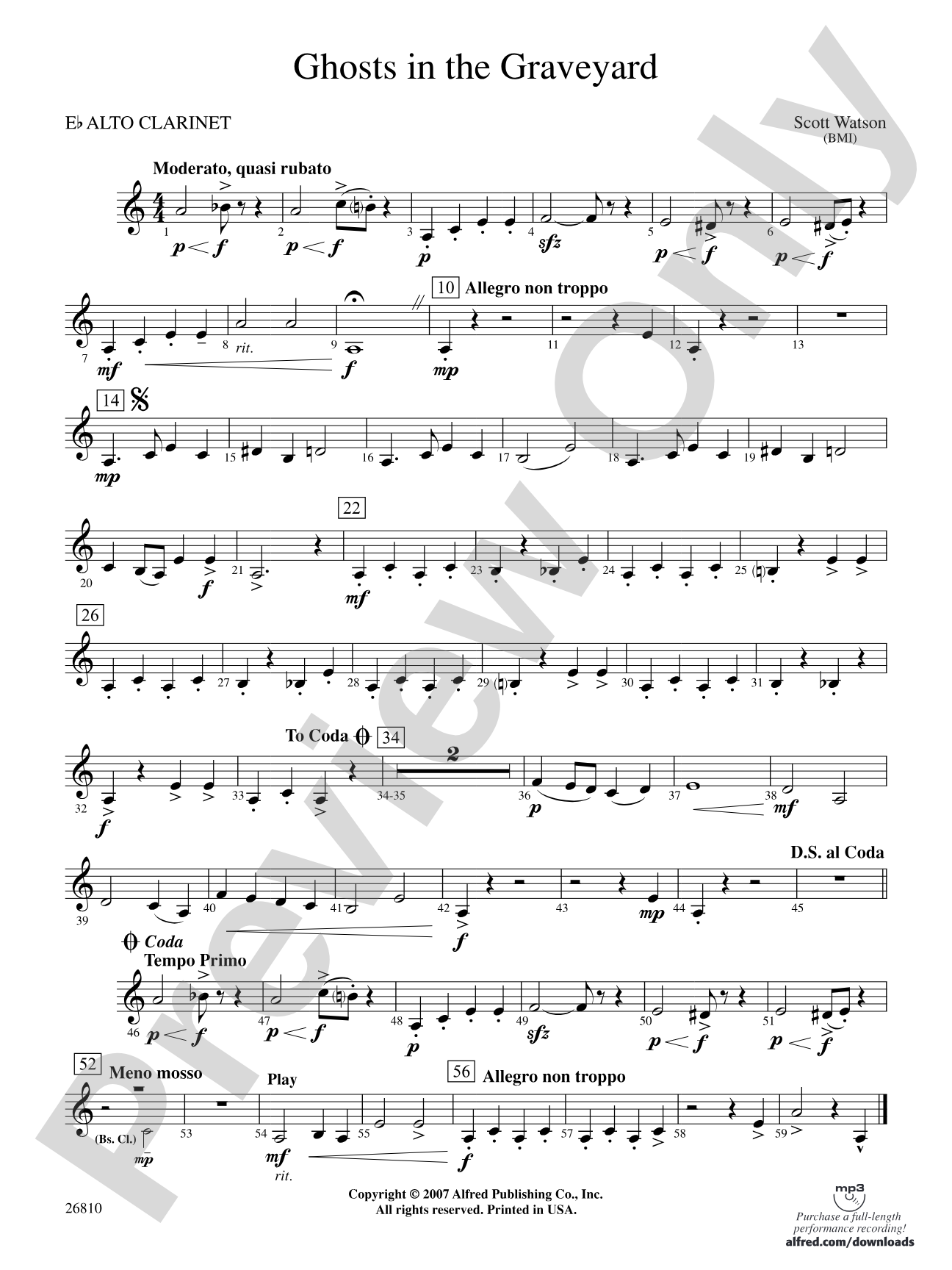

Ghosts in the Graveyard: E-flat Alto Clarinet
By Scott Watson
Grade: 1.5 (Easy)
Item: 00-PC-0001248_AC1
$5.99
Pickup currently not available
Description
Named after a well-loved children's Halloween game, this wonderful selection for young band brings the spooky sounds of haunted houses and Halloween to life. Whether you program it in the fall, winter, or spring it's sure to be a favorite. The piece gives your low brass and woodwinds some prominent melodic material, makes clever use of novel percussion, and even includes a flute section "scream!" (3:00) This title is available in MakeMusic Cloud.


Don't just read it, hear it, play along with it, and watch your students grow with it. In MakeMusic Cloud, Ghosts in the Graveyard: E-flat Alto Clarinet comes alive with professional accompaniment, adjustable tempo, and built-in practice tools that turn solo practice into real progress.
Open in the Player
Jump straight in and assign it today.
Start Your Free Trial
Open this title and explore the full library in minutes.
Sample Audio
1
Audio File
--:--
0:00
0:00
Sample Video
Additional Details
Series:
Alfred Debut Series
Publisher:
Alfred Music
Page Count:
61
SKU:
00-PC-0001248_AC1
More about this title
About the Composer: Scott Watson

Scott Watson has spent his entire career bridging the worlds of contemporary composition and practical music education. As Associate Professor of Music at Cairn University, he draws on 35 years of experience as an instrumental music teacher and high school band director in the Parkland School District, where he also coordinated the elementary band and strings program across multiple schools.
Watson's compositional voice reflects this dual expertise. His more than 120 published works for concert band, string orchestra, and chamber ensembles span all performance levels and have been performed at venues including the Academy of Music in Philadelphia, the Midwest Clinic, and the White House. Beyond composing, he contributes regularly to Alfred Publications' Sound Innovations series, leads clinics and guest conducting engagements for honor bands and festivals, and authored "Using Technology to Unlock Musical Creativity" (Oxford University Press, 2011), a text widely respected in music education circles.
Why we love this
Watson's gift for writing accessible concert band music without sacrificing personality shows brilliantly here. The piece gives your low brass and woodwinds genuine melodic spotlight rather than relegating them to accompaniment roles, which energizes young players and builds section pride. The flute section "scream" and creative percussion writing prove that Grade 1.5 music can be inventive and entertaining for both musicians and audiences.
What to expect
Playful and theatrical in the best sense, with genuinely spooky moments that emerge from clever orchestration rather than cheap tricks. The low brass and woodwind melodies feel warm and slightly mischievous, while the percussion and flute effects create a creeping sense of fun haunting.
Who it's for
Young concert bands at the Grade 1.5 level who are ready for music with personality and some structural sophistication. This works equally well for schools programming a fall concert or those looking for a memorable closer at any time of year.
How to get the most out of it
- Balance the prominent low brass and woodwind melodies by checking that your trumpet and clarinet parts don't overshadow the feature passages; bring the tuba and baritone sax forward without pushing tempo.
- Prepare the flute section "scream" at 3:00 as a moment of humor and release rather than a technical display; brief rehearsal with the group beforehand keeps the effect effective and prevents self-consciousness.
- Explore the novel percussion writing with your players during sectional time; creative instrument choices and unconventional techniques are central to the piece's character, so understanding the intent behind each effect deepens performance.
- Set a consistent tempo framework early in rehearsals so that the spooky atmosphere lands without dragging; Grade 1.5 ensembles often slow down instinctively in novelty pieces, so lock in the pulse with your rhythm section first.
How to use it
Program this as a festival opener or concert closer when you want to shift the emotional temperature and remind audiences that band music can be entertaining and character-driven. It pairs well with more traditional selections on the same program and gives young musicians a piece they'll remember and want to play again.
Skills your students will build
- Balancing sectional melody and accompaniment across different instrument families
- Playing with stylistic nuance and character in a novelty context
- Extended and creative percussion techniques for small ensembles
- Ensemble listening and responding to dynamic changes and tempo shaping