
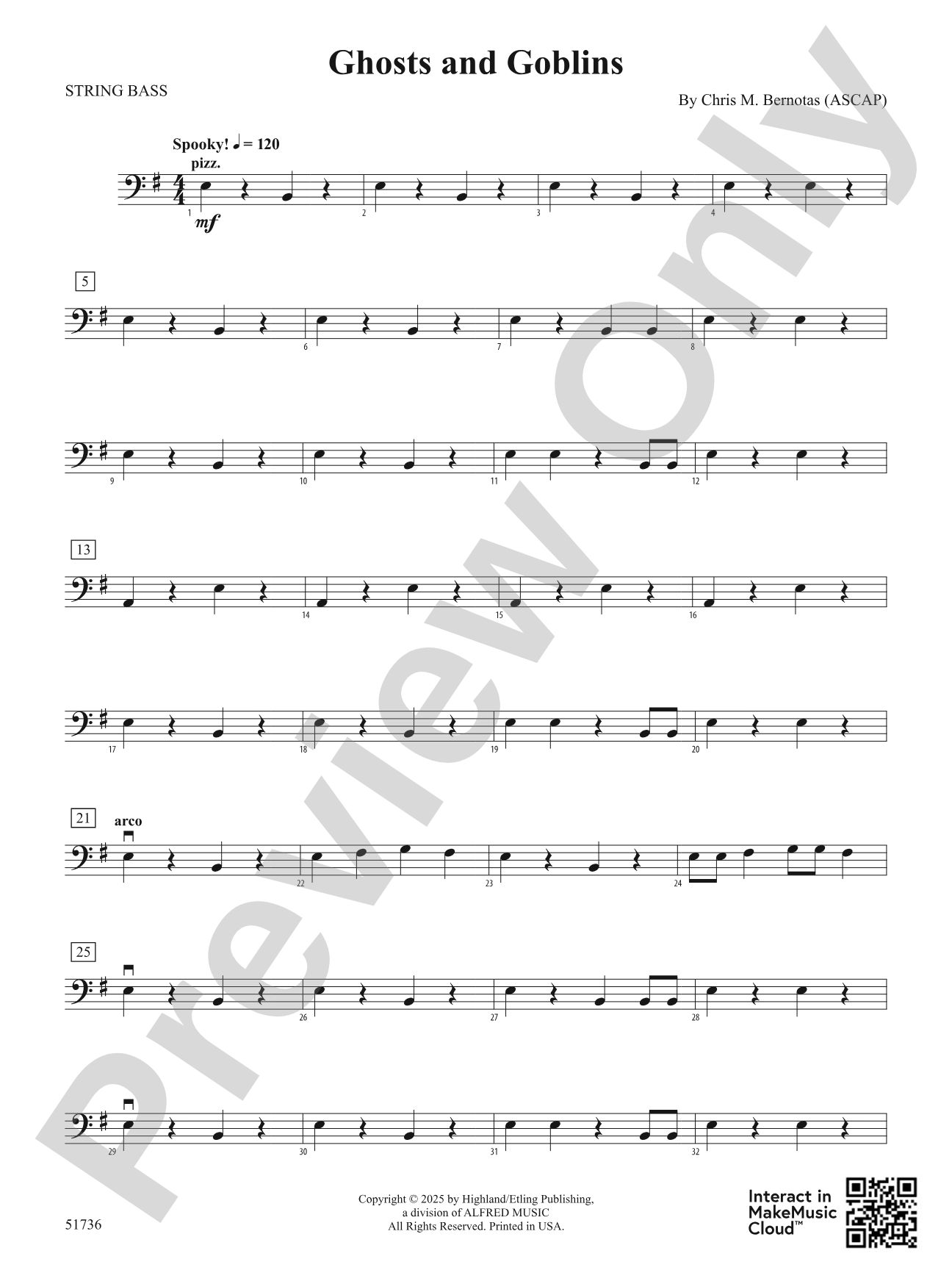

Ghosts and Goblins: String Bass
By Chris M. Bernotas
Level:.5
Item: 00-PC-0019484_SB
$3.00
Pickup currently not available
Description
Creepy, crawly, spooky, and scary -- this fun piece has it all! Ghosts and Goblins, by Chris M. Bernotas, is based on the first 6 notes of the D major scale, but in the Dorian mode. Perfect for your students first concert. Violin 2 and viola are doubled, as are cello and string bass. Simple but engaging, with pizzicato, arco, and just a few dynamics so students can focus on getting the finger patterns and rhythms correct. This is a great addition to the very beginning string orchestra library. (2:15) Correlates to Sound Innovations Book 1, Level 4.


Don't just read it, hear it, play along with it, and watch your students grow with it. In MakeMusic Cloud, Ghosts and Goblins: String Bass comes alive with professional accompaniment, adjustable tempo, and built-in practice tools that turn solo practice into real progress.
Open in the Player
Jump straight in and assign it today.
Start Your Free Trial
Open this title and explore the full library in minutes.
Sample Audio
1
Audio File
--:--
0:00
0:00
Sample Video
No sample videos found.
Additional Details
Series:
Sound Innovations Series for Strings
Publisher:
Alfred Music
SKU:
00-PC-0019484_SB
More about this title
About the Composer: Chris M. Bernotas

Chris M. Bernotas brings over 25 years of music education experience to his work as a composer and Director of Instrumental Publications for Alfred Music. His compositions balance accessibility with musicality, making them staple repertoire in concert programs from beginner ensembles through advanced groups. His deep classroom experience allows him to write music that addresses real pedagogical challenges while keeping students engaged.
Beyond composition, Bernotas serves as a guest conductor and clinician, leading honor groups and workshops for music educators. He has co-authored multiple educational series including Sound Innovations Ensemble Development, Sound Artistry, and Sound Performance. Through his work at Alfred Music and his continued advocacy for music education, he remains focused on creating resources that help teachers inspire young musicians at every developmental level.
Why we love this
This piece solves a real programming need for early string orchestra without sacrificing musical substance. The Dorian modal sound is distinctive enough to hold an audience's attention while the doubled sections (Violin 2/viola and cello/bass) ensure that even smaller ensembles sound full. Starting an ensemble's concert year with something fun and thematically engaging sets a positive tone before moving into more challenging repertoire.
What to expect
Atmospheric and mischievous, with a playful creepiness that appeals to students without being genuinely scary. The sparse dynamics and straightforward rhythms let the modal Dorian sound take center stage, creating an eerie but approachable mood that holds listeners' attention for just over two minutes.
Who it's for
String orchestras in their first concert, particularly those working at Level 4 of Sound Innovations Book 1. The piece works well for ensembles made up primarily of first and second-year string players who have basic bow control and simple finger patterns but need accessible, engaging repertoire that keeps everyone invested.
How to get the most out of it
- Establish the Dorian sound in rehearsal by isolating the opening 6-note figure and having students recognize how the raised 6th scale degree creates the modal color before adding articulation.
- Balance the doubled voices by assigning half of each section to melody and half to harmony, then blend them together gradually so no one part overwhelms the texture.
- Mark the transitions between pizzicato and arco passages clearly in all parts; students first learning these articulations benefit from seeing exactly where the shift occurs rather than discovering it by ear.
- Keep the pulse steady and slightly deliberate through the spooky sections; rushing drains the atmospheric effect and makes rhythmic coordination harder for younger players.
How to use it
Open a fall or Halloween concert with this piece to set an entertaining tone before moving into more substantial selections. The short duration (2:15) and modest difficulty make it an ideal opener that builds confidence in young players and immediately signals to the audience that the evening will be engaging and fun.
Skills your students will build
- Understanding and performing in Dorian mode, specifically the raised 6th degree that distinguishes it from natural minor
- Clean transitions between pizzicato and arco articulation
- Reading and executing two-part texture within section doublings
- Maintaining steady pulse and intonation during sparse harmonic moments
- Playing with clear dynamic control across a limited dynamic range