
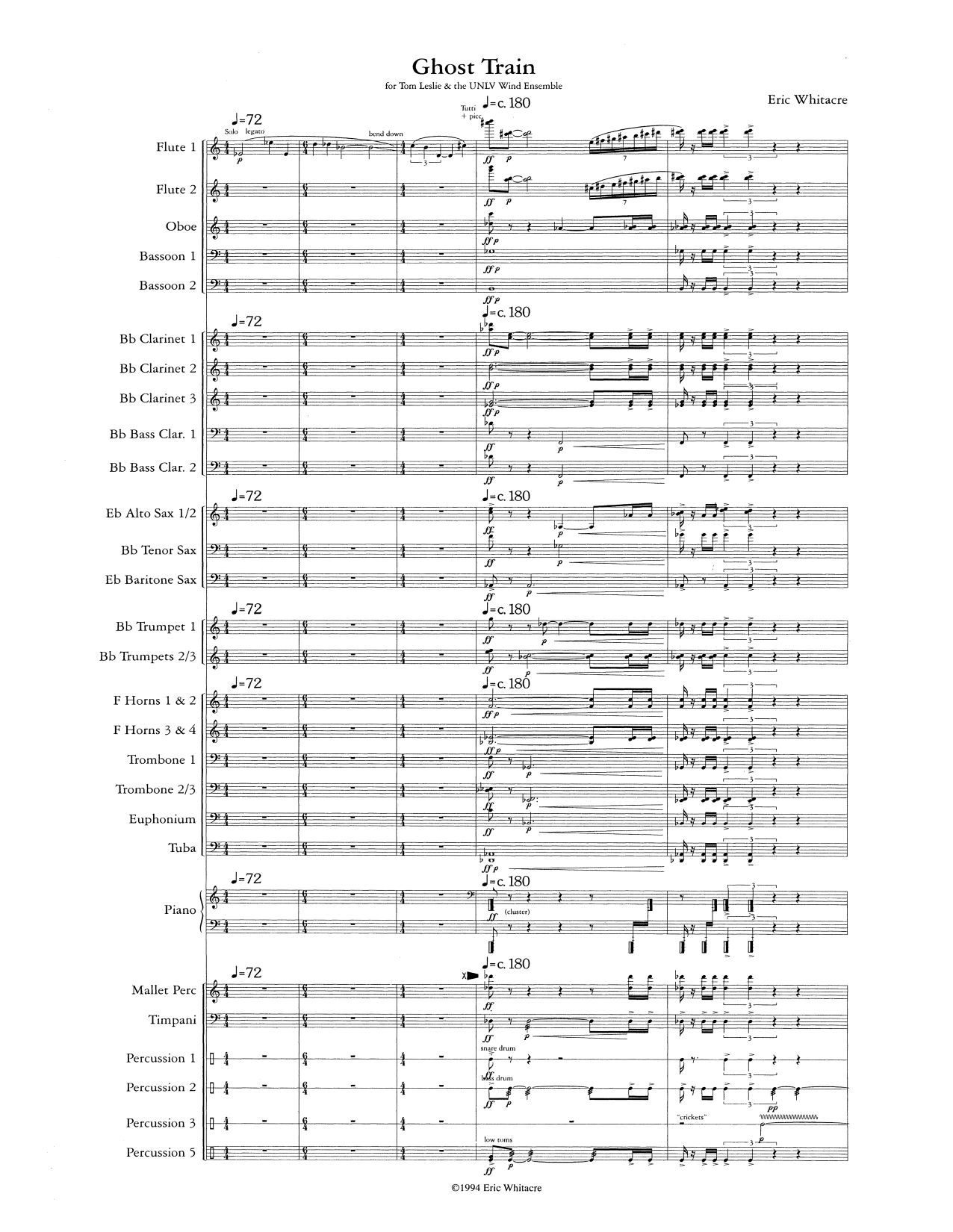

Ghost Train - Movement 1 (from Ghost Train Trilogy): Concert Band Conductor Score & Parts
By Eric Whitacre
Item: 35-PK01105880
$175.00
Pickup currently not available
Buy Extra Parts (Digital PDF Download)
Parts Added to Cart!
Description
The piece that helped launch Eric Whitacre's career in wind band composing! In this highly programmatic work, Eric transforms a story from American folklore of a supernatural locomotive that roars throughout the Western U.S. Rich in special effects and unique compositional techniques, this dynamic piece creates vivid aural images as the train leaves the station and passes through a varied landscape.


Ghost Train - Movement 1 (from Ghost Train Trilogy): Concert Band Conductor Score & Parts isn't in MakeMusic Cloud just yet...but it could be. Let us know you'd like to see it, and you'll help shape what comes next. In the meantime, start a free trial and dive into thousands of interactive titles your students can play along with today.
Request This Title
Tell us you want it.
Start Your Free Trial
Explore everything that's ready to play right now.
Sample Audio
No sample audio found.
Sample Video
No sample videos found.
Additional Details
Publisher:
Hal Leonard
SKU:
35-PK01105880
More about this title
About the Composer: Eric Whitacre
Eric Whitacre stands among the most performed living composers, with a catalog that spans choral works, film scores, and increasingly significant contributions to the wind band repertoire. His ability to craft deeply communicative music that speaks to both musicians and listeners has made him a transformative figure in contemporary classical music, particularly in bringing accessible yet sophisticated compositional language to school and community ensembles.
Why we love this
This is the work that proved Whitacre's mastery of wind band writing extends far beyond his legendary choral output. Ghost Train marries visceral storytelling with compositional craft, delivering genuine programmatic drama without sacrificing musical substance or accessibility. Your band gets to inhabit a complete narrative arc while executing techniques that feel like real composing challenges rather than mere novelties.
What to expect
You're riding the rails through the American West as darkness gathers. The piece crackles with supernatural energy, building from mechanical precision into something wild and untamed. Whitacre's orchestration gives wind band the texture and color usually associated with much larger forces, creating moments of genuine awe alongside passages of driving, elemental power.
Who it's for
Bands at the upper intermediate to advanced level who are ready to tackle graphic scoring and theatrical musical storytelling. This work rewards ensembles with secure fundamentals and the maturity to commit fully to programmatic interpretation without losing sight of musical structure.
How to get the most out of it
- Establish a steady, relentless pulse for the opening station section before the train begins its journey; this foundation makes the subsequent accelerations and textural layering land with maximum impact.
- Balance the special effects against the underlying harmonic progression so that sonic color enhances rather than masks the musical architecture.
- Work the landscape transitions as genuine tempo and texture changes, not just sudden dynamic shifts; each section should breathe distinctly from the one before it.
- Let the ensemble hear recordings of actual trains early in rehearsal so the imitative passages sound informed by real sound rather than generic locomotive effects.
How to use it
Open a concert with this work to establish immediate engagement and energy; audiences will stay attentive through your entire program after such a gripping opener. Alternatively, use it as a statement piece during a contemporary music showcase or film-music themed concert, where its dramatic arc and innovative scoring will feel right at home.
Skills your students will build
- Reading and executing special effects notation (col legno, flutter tonguing, mallet choices)
- Sustaining rhythmic precision while maintaining expressive phrasing across extended sections
- Balancing independent ensemble lines to create layered textural effects
- Responding to rapid tempo and character shifts without losing musical coherence
- Connecting programmatic intent to physical sound production and articulation choices