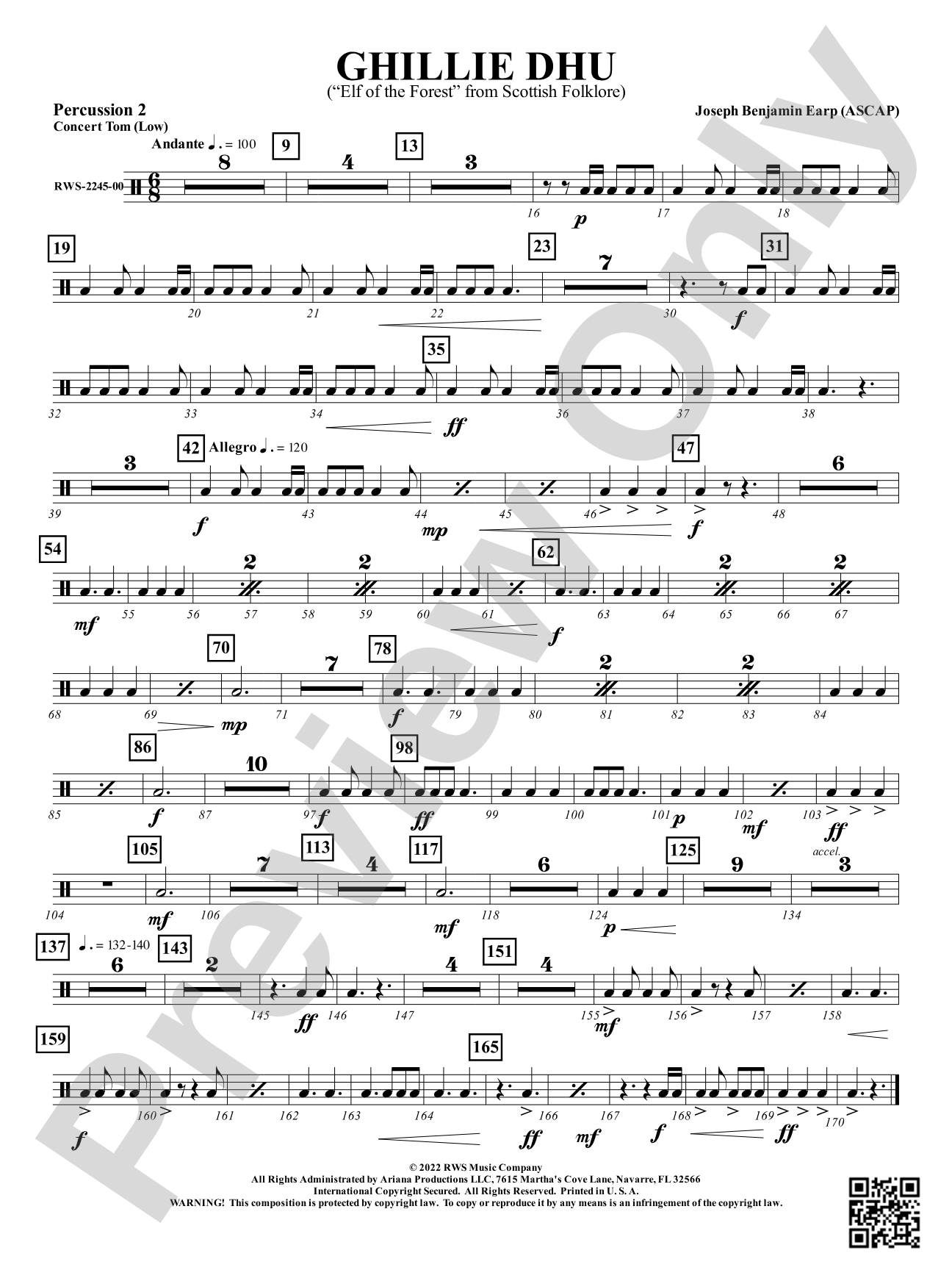
Ghillie Dhu - "Elf of the Forest" from Scottish Folklore: 2nd Percussion Sheet Music Preview

Ghillie Dhu - "Elf of the Forest" from Scottish Folklore: 2nd Percussion

"Elf of the Forest" from Scottish Folklore

By Joseph Benjamin Earp

Grade: 3.5

Item: 98-PC-RWS2245_PC2

Digital Download
$3.99
Description
"Ghillie Dhu" (Gill-e Dew) Elf of the Forest is inspired by a friendly but often wild creature from Scottish Folklore. This mythical being is given life through the captivating writing of Joseph Benjamin Earp. Scored for flexible instrumentation, "Ghillie Dhu" is a wonderful teaching tool for instrumental ensembles focused on polyrhythms and compound time signatures. Appropriate for any concert or festival performance.

Original Item#: RWS-2245-00

Ghillie Dhu - "Elf of the Forest" from Scottish Folklore: 2nd Percussion isn't in MakeMusic Cloud just yet...but it could be. Let us know you'd like to see it, and you'll help shape what comes next. In the meantime, start a free trial and dive into thousands of interactive titles your students can play along with today.

Sample Audio
0:00
0:00
Sample Video
Additional Details
Series: RWS - Custom Concert Band
Publisher: RWS Music Company
SKU: 98-PC-RWS2245_PC2

More about this title

Why we love this

Earp's orchestration brings Scottish folklore to vivid life without sacrificing pedagogical clarity. The flexible instrumentation means you can program this regardless of your ensemble's configuration, while the polyrhythmic and compound meter content gives your students material with real harmonic and rhythmic substance at Grade 3.5.

What to expect

A forest creature caught between mischief and grace. The writing darts and circles with folkloric energy, combining Scottish harmonic color with restless rhythmic motion that feels both playful and slightly unpredictable.

Who it's for

Conductors building intermediate ensembles ready to tackle polyrhythms and compound signatures with musical context. This works equally well for concert band directors wanting performance-quality repertoire and contest/festival directors seeking an engaging piece that develops sophisticated rhythmic skills.

How to get the most out of it

  • Establish the compound meter pulse early in rehearsal before layering the polyrhythmic figures; ask students to conduct in 6/8 or 9/8 depending on the section to lock the underlying beat.
  • Balance the interweaving melodic lines by rotating which section holds the primary voice through different phrases, preventing any one instrument family from dominating the texture.
  • Let the flexible instrumentation work for you by doubling thinner passages with auxiliary instruments if your ensemble is undersized, ensuring harmonic fullness without compromising clarity.
  • Record rehearsals and listen back with the band; polyrhythmic passages reveal themselves more clearly on playback than in real time, and students hear their own rhythmic precision more objectively.

How to use it

Place this mid-concert where its rhythmic complexity and folkloric character create a distinctive moment between more straightforward fare. It pairs well with traditional folk arrangements or contemporary concert works, and its educational content makes it ideal for a festival program where adjudication feedback matters.

Skills your students will build

  • Reading and performing polyrhythms in concert band texture
  • Maintaining pulse in compound meters (6/8, 9/8) across multiple instrumental parts
  • Balancing independent melodic lines within a unified ensemble sound
  • Adapting to flexible instrumentation and doubling strategies

You May Also Like