
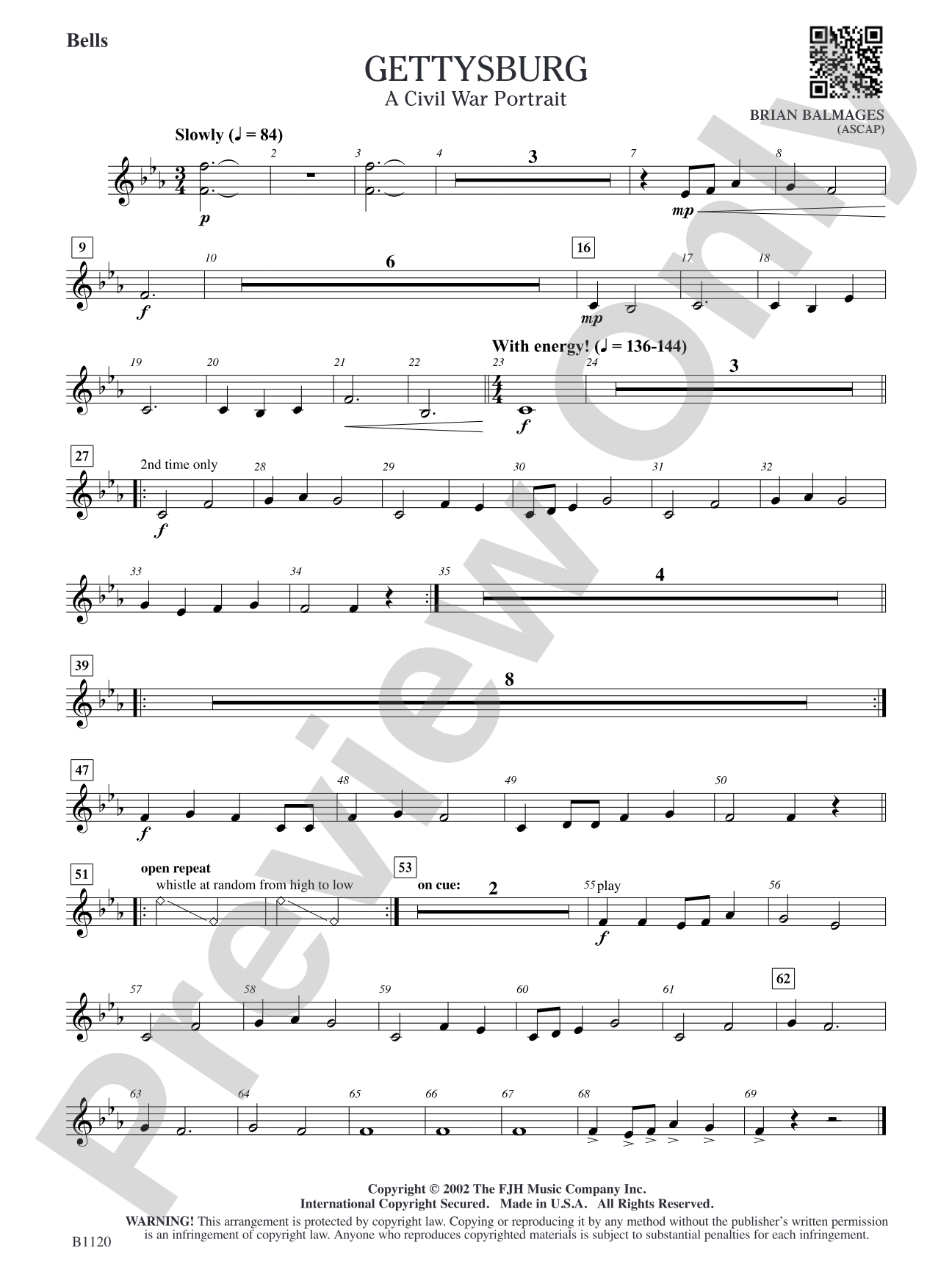

Gettysburg (A Civil War Portrait): Bells
A Civil War Portrait
By Brian Balmages
Grade: 1
Item: 98-PC-DB1120_B
$7.00
Pickup currently not available
Description
Using many effects to recreate the events at the Battle of Gettysburg, this piece is perfect for discussing historical perspective (included in the notes). A slow, mysterious opening leads into a depiction of the battle. A short, aleatoric section simulates a huge cannon bombardment with drums and whistling. A great way to utilize percussion while providing many opportunities for the rest of the band as well. Consider this strongly for your programming needs. (2:45)


Gettysburg (A Civil War Portrait): Bells isn't in MakeMusic Cloud just yet...but it could be. Let us know you'd like to see it, and you'll help shape what comes next. In the meantime, start a free trial and dive into thousands of interactive titles your students can play along with today.
Request This Title
Tell us you want it.
Start Your Free Trial
Explore everything that's ready to play right now.
Sample Audio
1
Audio File
--:--
0:00
0:00
Sample Video
No sample videos found.
Additional Details
Series:
FJH Beginning Band
Publisher:
The FJH Music Company, Inc.
SKU:
98-PC-DB1120_B
More about this title
About the Composer: Brian Balmages

Brian Balmages has established himself as a composer and conductor working across orchestral, band, and chamber idioms. His works have been heard in some of the world's most prestigious venues, including Carnegie Hall, the Kennedy Center, and the Sydney Opera House, performed by ensembles spanning from professional orchestras to elementary school bands. He received the A. Austin Harding Award from the American School Band Directors Association and won the 2020 NBA William D. Revelli Composition Contest. Balmages was also inducted into the American Bandmasters Association.
As a guest conductor, Balmages regularly appears with all-state and regional ensembles, university orchestras, and professional groups internationally. His conducting schedule includes appearances at the Midwest Clinic, Western International Band Clinic, and numerous state and national conferences. He holds the position of Director of MakeMusic Publications and Digital Education for Alfred and MakeMusic, and has received the inaugural Distinguished Alumni Award from James Madison University's School of Visual and Performing Arts.
Why we love this
Balmages gives you a Grade 1 piece with real musical substance and compositional variety. The structure moves logically from atmospheric opening through kinetic battle depiction, and the aleatoric cannon section genuinely engages your entire ensemble while staying accessible. It's also a smart curricular tool: you get historical content built into the score notes, percussion that gets to do meaningful work, and a legitimate concert piece rather than a teaching exercise masquerading as music.
What to expect
The piece opens in shadow and mystery, drawing listeners into an intimate, uncertain space before erupting into visceral battle imagery. The percussion-driven cannon section feels chaotic and overwhelming in the best way, creating genuine sensory drama without sacrificing ensemble control.
Who it's for
Beginning concert bands and middle school ensembles looking for Grade 1 repertoire that offers musical substance beyond simple warm-ups or exercises. Directors seeking pieces that engage percussion meaningfully while keeping the full band accessible will find this especially valuable. This works equally well for festival programs or educational concerts where historical context adds depth to the listening experience.
How to get the most out of it
- Shape the mysterious opening with a clear sense of direction despite the minimal texture; avoid letting it feel static by maintaining gentle dynamic momentum through the sustained lines.
- Ensure your percussion section understands the aleatoric section as a collective sound mass rather than individual entrances; rehearse the general energy and intensity level with clear conducting gestures that show where the section builds and releases.
- Balance the pitched percussion and whistling effects in the cannon bombardment so the texture remains clear rather than muddled; individual rehearsals with those sections ensure they hear their specific roles within the larger soundscape.
- Build the transition from battle noise back into pitched material deliberately, allowing the audience to recognize the shift from chaos to coherence.
How to use it
Include this in a concert exploring American history or patriotic themes, where the included historical notes enrich audience understanding before the performance. The compact length (2:45) makes it suitable as a standalone festival entry or as a complementary piece alongside other Grade 1 concert band works. Consider programming it as a bridge between a quieter opening work and something more uplifting, using its narrative arc to shape the emotional contour of your set.
Skills your students will build
- Sustaining soft dynamics and long lines without losing focus or pitch quality
- Reading and responding to aleatoric notation in a group context
- Coordinate ensemble balance when percussion and pitched instruments occupy the same textural space
- Historical listening and understanding music as narrative