
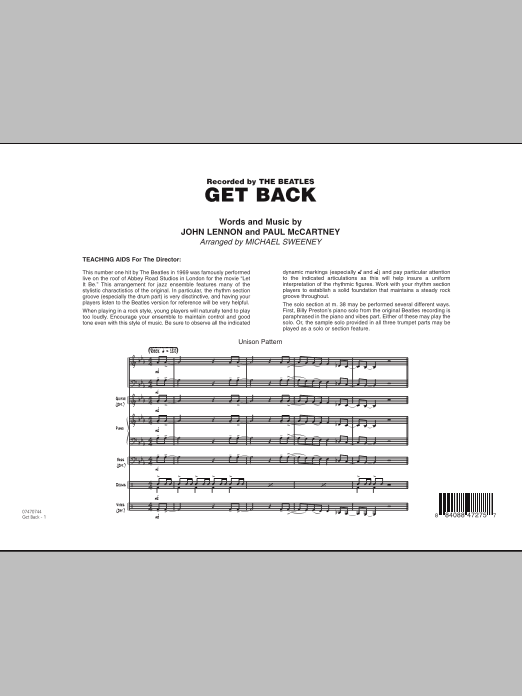

Get Back: Jazz Ensemble Conductor Score & Parts
By John Lennon / By Paul McCartney / As performed by The Beatles / Arranged by Michael Sweeney
Grade: 1
Item: 35-PK00142196
$45.00
Pickup currently not available
Buy Extra Parts (Digital PDF Download)
| Product | Price | Quantity |
|---|---|---|
| Get Back - Full Score | $7.50 | |
| Get Back - Alto Sax 1 | $6.00 | |
| Get Back - Alto Sax 2 | $6.00 | |
| Get Back - Tenor Sax 1 | $6.00 | |
| Get Back - Tenor Sax 2 | $6.00 | |
| Get Back - Baritone Sax | $6.00 | |
| Get Back - Trumpet 1 | $6.00 | |
| Get Back - Trumpet 2 | $6.00 | |
| Get Back - Trumpet 3 | $6.00 | |
| Get Back - Trombone 1 | $6.00 | |
| Get Back - Trombone 2 | $6.00 | |
| Get Back - Trombone 3 | $6.00 | |
| Get Back - Guitar | $6.00 | |
| Get Back - Piano | $6.00 | |
| Get Back - Bass | $6.00 | |
| Get Back - Drums | $6.00 | |
| Get Back - Vibes | $6.00 | |
| Get Back - Flute | $6.00 | |
| Get Back - Bb Clarinet 1 | $6.00 | |
| Get Back - Bb Clarinet 2 | $6.00 | |
| Get Back - F Horn | $6.00 | |
| Get Back - Tuba | $6.00 |
Parts Added to Cart!
Description
Recorded by the Beatles on :Let It Be," and notably performed on the roof of Apple Studios in London, here is a rockin' version for very young jazz bands.


Get Back: Jazz Ensemble Conductor Score & Parts isn't in MakeMusic Cloud just yet...but it could be. Let us know you'd like to see it, and you'll help shape what comes next. In the meantime, start a free trial and dive into thousands of interactive titles your students can play along with today.
Request This Title
Tell us you want it.
Start Your Free Trial
Explore everything that's ready to play right now.
Sample Audio
No sample audio found.
Sample Video
No sample videos found.
Additional Details
Publisher:
Hal Leonard
SKU:
35-PK00142196
More about this title
About the Composer: John Lennon
John Lennon shaped modern popular music as a songwriter, guitarist, and vocalist for the Beatles. His compositions spanned rock, pop, and experimental styles, often blending memorable melodies with unconventional recording techniques that influenced generations of musicians and producers.
For music educators, Lennon's catalog offers accessible entry points into contemporary songwriting and arrangement. His melodies sit naturally in young voices and ensembles, making his work invaluable for teaching song structure, harmonic progression, and the relationship between lyrics and musical phrasing.
Why we love this
Michael Sweeney has distilled one of the Beatles' most iconic rockers into a Grade 1 arrangement that preserves the song's energy and swagger without overwhelming young players. The chart captures that roof-performance spirit in something your ensemble can actually play and feel proud of.
What to expect
Stripped down but swinging, this version channels the raw energy of that famous rooftop concert. The arrangement breathes with groove and attitude, delivering the defiant spirit of the original in a form that young musicians can inhabit and make their own.
Who it's for
This arrangement works for Grade 1 jazz ensembles ready to tackle a recognizable tune with real character. Young players benefit from the immediate payoff of playing a song everyone knows, and directors get an engaging vehicle for teaching basic jazz vocabulary and ensemble cohesion.
How to get the most out of it
- Nail the rhythmic precision in the head. Even at Grade 1, the groove only locks when players commit to the written articulations and stick placements together.
- Let the melody sing out front without drowning the rhythm section. The soloists need room to breathe, and that happens when accompaniment players voice dynamics with intention.
- Anchor the backbeat with your snare and bass drum. This tune lives in its pocket; a tight rhythm section makes everything else sound twice as good.
- Use the recorded accompaniment to establish feel before rehearsal. Hearing the original groove first gives younger players a sonic reference they can't get from the page alone.
How to use it
Feature this early in the year when you're building ensemble chemistry and introducing your group to jazz idioms. It's an ideal warm-up tune for a concert featuring a mix of jazz and contemporary repertoire, or a standalone moment that reminds audiences why this song endures.
Skills your students will build
- Reading slash chord notation and basic jazz voicings
- Playing with a defined groove and consistent feel across the ensemble
- Listening to rhythm section placement and locking into the pocket
- Interpreting stylistic articulation marks in a rock-influenced context
- Balancing solo and ensemble textures in an arrangement