
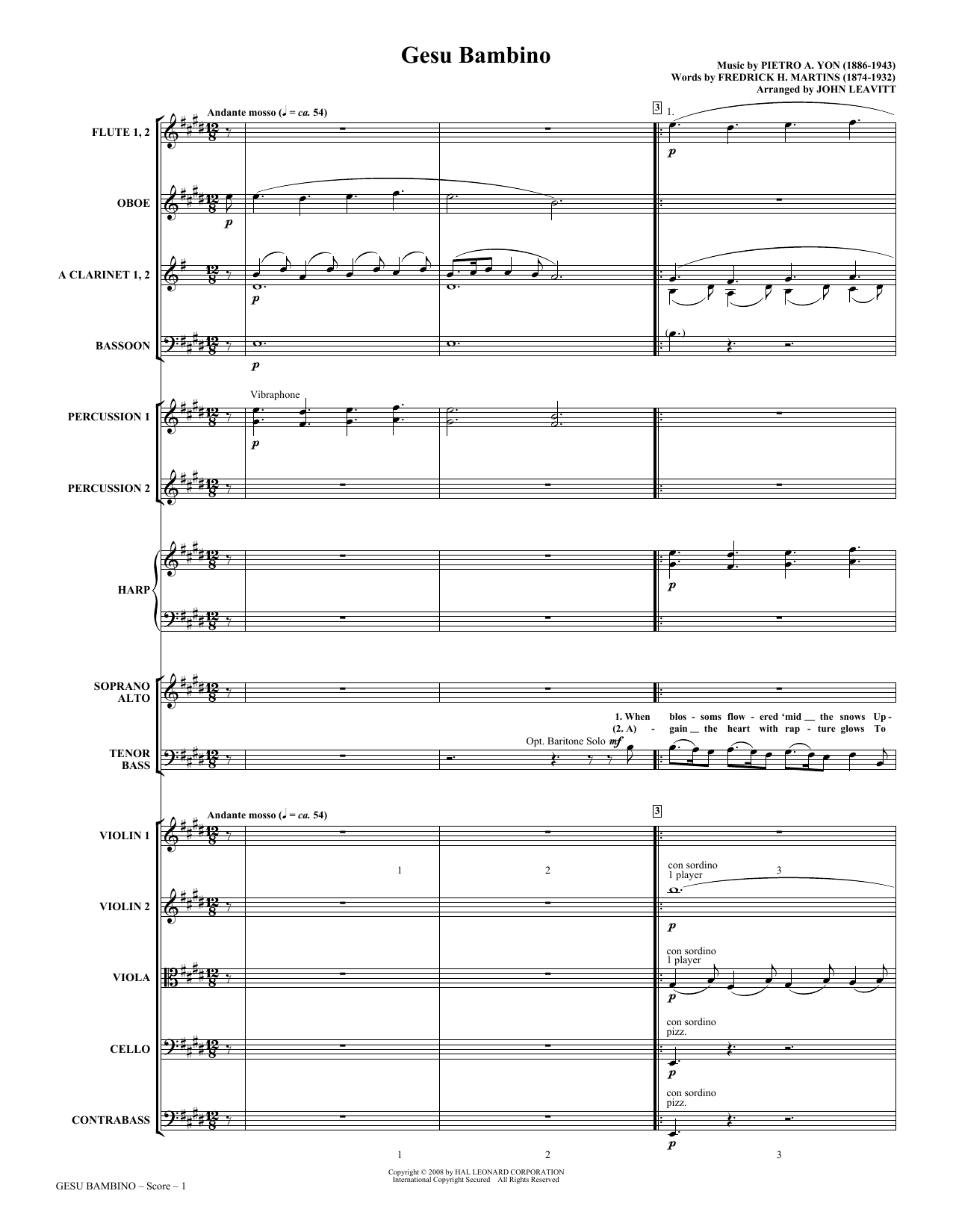

Gesú Bambino (arr. John Leavitt): Choral Instrumental Pak
By Pietro A. Yon / Arranged by John Leavitt
Item: 35-PK01306620
$60.00
Pickup currently not available
Buy Extra Parts (Digital PDF Download)
Parts Added to Cart!
Description
A quintessential Christmas classic! This arrangement is "on point" at every turn with stellar part writing and a creative accompaniment. Respectful to the source material, this octavo is equally at home in concert halls and sanctuaries. Score and Parts (fl 1-2, ob, cl 1-2, bn, perc 1-2, hp, vn 1-2, va, vc, db) available as a digital download.


Gesú Bambino (arr. John Leavitt): Choral Instrumental Pak isn't in MakeMusic Cloud just yet...but it could be. Let us know you'd like to see it, and you'll help shape what comes next. In the meantime, start a free trial and dive into thousands of interactive titles your students can play along with today.
Request This Title
Tell us you want it.
Start Your Free Trial
Explore everything that's ready to play right now.
Sample Audio
No sample audio found.
Sample Video
No sample videos found.
Additional Details
Publisher:
Hal Leonard
SKU:
35-PK01306620
More about this title
About the Composer: Pietro A. Yon
Pietro A. Yon (1886–1943) was an Italian organist and composer whose output ranged from sacred choral works to organ pieces and orchestral compositions. He spent much of his career in the United States, serving as organist at St. Peter's Church in New York City, where he built a reputation for both his improvisational gifts and his facility with liturgical music.
Yon's compositional voice bridged European tradition and American musical sensibilities. His sacred works, particularly those for Christmas and Easter, found their way into churches and concert halls across North America, where they remain staples of holiday programming. Gesú Bambino stands as his most enduring creation, beloved for its melodic directness and spiritual warmth.
Why we love this
John Leavitt's hand here is unmistakable. The orchestration honors Yon's gift for melody while adding textural sophistication that keeps the ensemble engaged from the opening measures through the final resolution. This isn't a bare-bones transcription; it's a reimagining that breathes fresh life into a beloved carol without losing the intimacy that makes audiences return to it year after year.
What to expect
Reverent without being heavy. The arrangement unfolds with a kind of quiet majesty, with the melody floating over gently shifting harmonies that feel both timeless and thoughtfully modern. There's genuine tenderness woven through the orchestration; moments of brightness give way to introspective passages that invite the listener to sit with the carol's devotional essence.
Who it's for
Choirs seeking a sophisticated yet accessible Christmas offering, particularly those with resources for a full instrumental complement or access to capable community musicians. This works equally well in secular concert settings and liturgical contexts, making it a versatile choice for directors programming across different venues.
How to get the most out of it
- Balance the harp and strings carefully in the opening; they establish the arrangement's harmonic foundation, so they should be present but never overshadow the choir's entrance.
- Conduct with a clear, unhurried pulse. This music benefits from generosity of tempo and space between phrases rather than rhythmic urgency.
- Shape the woodwind doublings (flute, oboe, clarinet) as a unified color rather than independent voices. They support the harmonic foundation, not compete for attention.
- Use the timpani and percussion judiciously in the climactic sections. These moments are powerful enough without excessive layering; sometimes restraint in the accompaniment makes the choir's moment land harder.
How to use it
Anchor this as the centerpiece of a Christmas concert rather than tucking it into a longer medley. Its fullness of orchestration and emotional maturity command programming space of their own. Pair it with lighter seasonal fare earlier in the concert, then let this arrangement close the first half or serve as a bridge into your program's final section.
Skills your students will build
- Balancing choral tone with instrumental accompaniment across diverse instrumental colors
- Sustained, connected phrasing over shifting harmonic movement
- Ensemble cohesion when coordinating with multiple instrumental parts
- Sensitivity to dynamic gradation and textural transparency
- Interpretation of rubato and expressive timing within a notated score