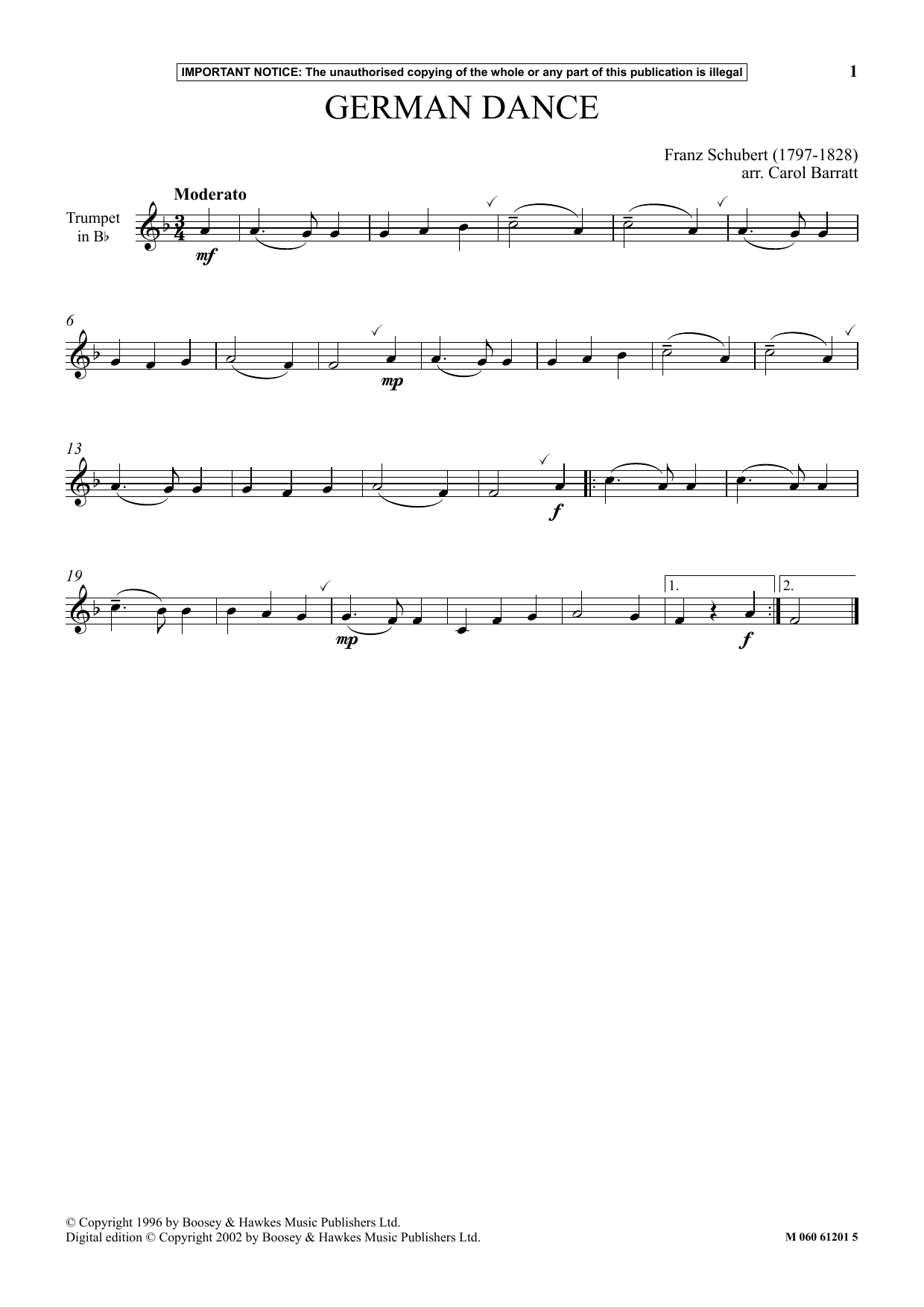
German Dance Sheet Music Preview

German Dance: Instrumental Solo

As performed by Franz Schubert

Item: 35-DS00239272

Digital Download
$3.99
One moment…
Description

Discover MakeMusic Cloud: thousands of interactive titles your students can play along with today.

Sample Audio
No sample audio found.
Sample Video
Additional Details
Publisher: Hal Leonard
Page Count: 2
SKU: 35-DS00239272

More about this title

About the Artist: Franz Schubert

Schubert composed across every major genre during his short life, leaving behind nine symphonies, over 600 songs, and countless chamber works that shaped Romantic music. His gift for melody was unmatched; he could spin a simple folk-like tune into something profound without losing its essential character. Among his prolific output are dozens of dances for piano, written largely for social occasions and dance halls, yet each one bears the hallmark of his harmonic sophistication and gift for phrasing.

Why we love this

This dance captures what makes Schubert's social music so enduring: it's elegant without being precious, singable without being simple. The piece works equally well as a teaching tool for phrase architecture and as a delightful concert opener that audiences recognize as genuinely Schubert, not a textbook exercise.

What to expect

Graceful and unpretentious, with the natural lilt of Austrian folk dance refined through Schubert's harmonic lens. There's warmth in the melody and an easy charm that makes it feel both intimate and suitable for an audience.

Who it's for

Intermediate pianists working on Romantic-era repertoire and students who need accessible yet musically rewarding pieces for recitals or studio performances. It's also ideal for music history classes studying Schubert's compositional range or the social role of dance music in 19th-century Vienna.

How to get the most out of it

  • Shape the melody with gentle weight on the downbeats; let the accompaniment stay light and conversational rather than heavy-handed
  • Maintain steady forward motion without rushing; these dances were meant for actual dancing, so rhythmic integrity matters more than expressive dragging
  • Balance the left hand carefully so harmonic progressions sing without overwhelming the right hand line

How to use it

Pair it with other Schubert dances or shorter character pieces to create a themed recital section that showcases his lighter side. It works particularly well as a second or third piece on a program, offering a moment of clarity and straightforwardness after something more dramatic.

Skills your students will build

  • Phrasing in eight-bar and 16-bar units
  • Balancing melody and accompaniment textures
  • Reading and interpreting classical dance forms
  • Maintaining steady tempo while shaping expression
  • Understanding harmonic function in tonal contexts

You May Also Like