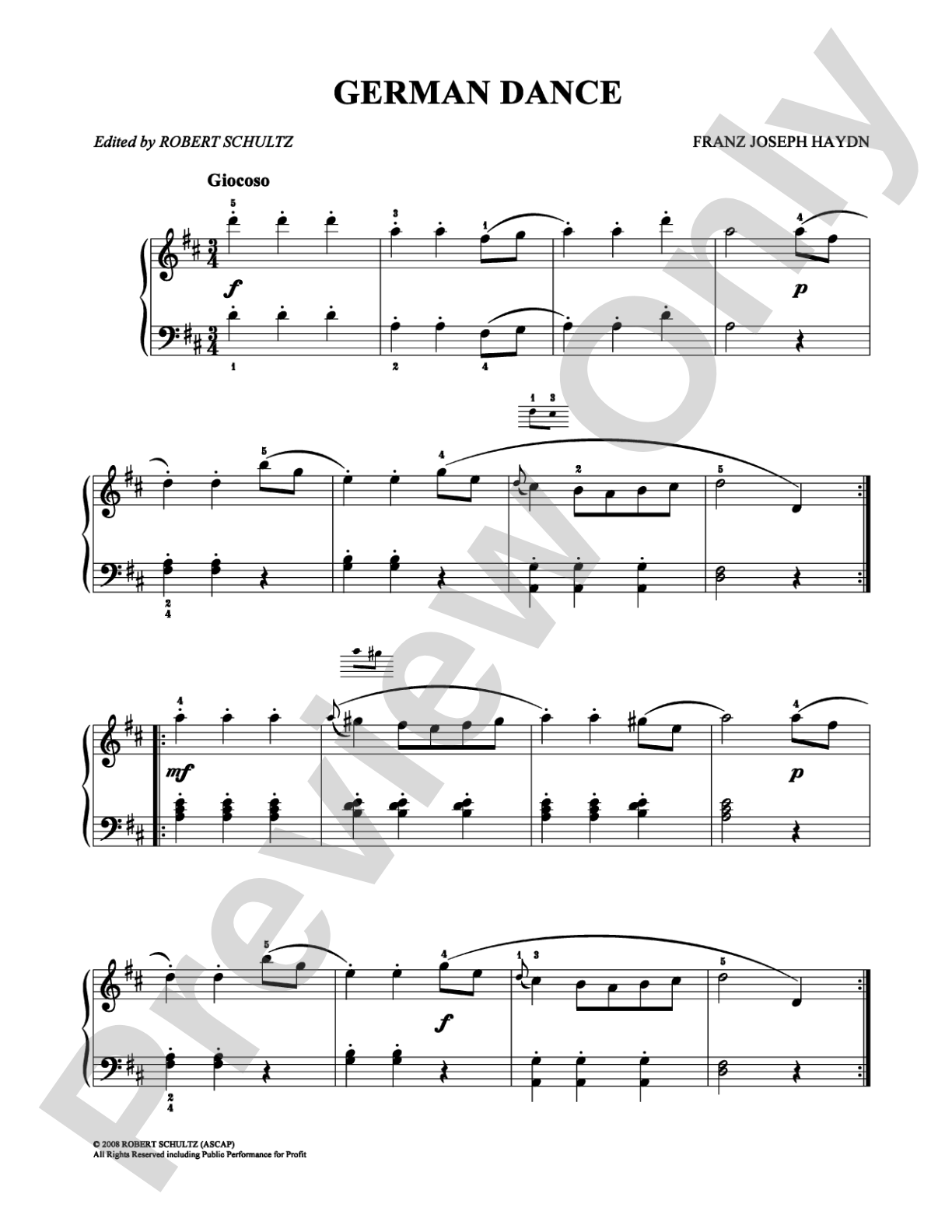
Franz Joseph Haydn (1732-1809) spent most of his career as the court composer and conductor at Eszterháza, the Hungarian estate of Prince Nikolaus Esterházy, where he wrote hundreds of symphonies, string quartets, and vocal works that defined the Classical era. His prolific output and inventive approach to form and orchestration influenced virtually every major composer who followed him, from Mozart to Beethoven.
Beyond his large-scale works, Haydn wrote abundantly for keyboard and domestic music-making. His dances and smaller character pieces reveal his gift for melodic invention and rhythmic clarity, making his music immediately accessible to students while maintaining the harmonic sophistication that earned him the title "Father of the Symphony."