
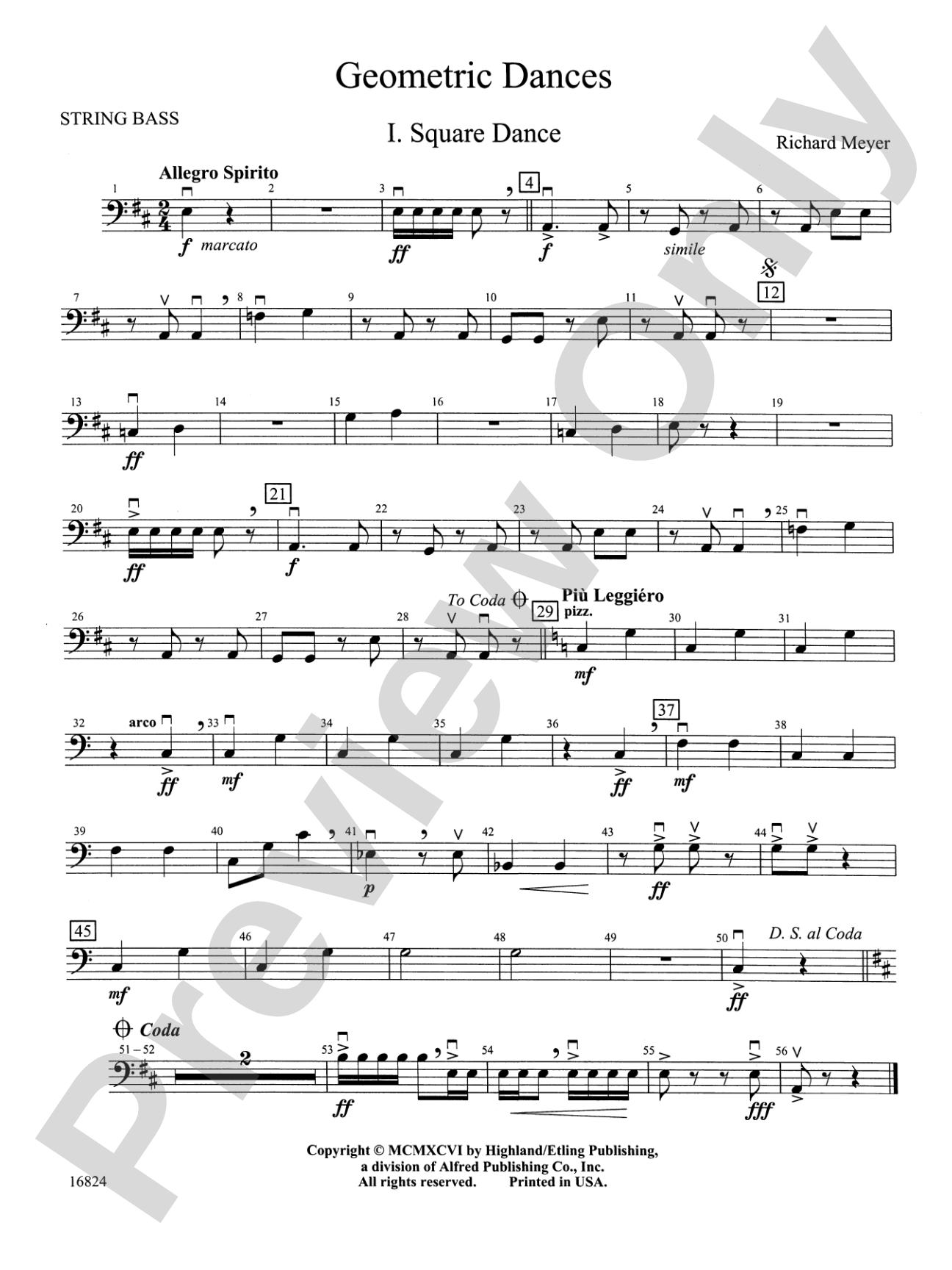

Geometric Dances: String Bass
1. Square-Dance, 2. Round-Dance, 3. Triangle Dance
By Richard Meyer
Grade: 3
Item: 00-PC-0000198_SB
$5.99
Pickup currently not available
Description
Winner of the Texas Orchestra Directors Composition Contest, this superb three-movement work is an excellent showcase for your orchestra. Titled "Square-Dance," "Round-Dance" and "Triangle Dance," the variety of styles and playing techniques will leave your students incredibly enriched. (Grade 3) This title is available in MakeMusic Cloud.


Don't just read it, hear it, play along with it, and watch your students grow with it. In MakeMusic Cloud, Geometric Dances: String Bass comes alive with professional accompaniment, adjustable tempo, and built-in practice tools that turn solo practice into real progress.
Open in the Player
Jump straight in and assign it today.
Start Your Free Trial
Open this title and explore the full library in minutes.
Sample Audio
1
Audio File
--:--
0:00
0:00
Sample Video
No sample videos found.
Additional Details
Series:
Highland/Etling String Orchestra
Publisher:
Alfred Music
Page Count:
128
SKU:
00-PC-0000198_SB
More about this title
About the Composer: Richard Meyer

Richard Meyer spent 35 years teaching strings across elementary, middle, and high school classrooms in California public schools. At Oak Avenue Intermediate School in Temple City, he expanded the orchestra program from 29 students to 200 over two decades while simultaneously directing the city's elementary string initiative. His work caught national attention in 2009 when he created the "Giving Bach" program, which uses interactive concerts to reach special needs and underserved students throughout Southern California.
Beyond the classroom, Meyer has shaped orchestras as the music director of the Pasadena Youth Symphony Orchestra for 16 years, leading ensembles on international tours to Vienna, Australia, and Canada. He brings deep expertise as a clinician at major conferences including the A.S.T.A. National Conference and the Texas Orchestra Directors' Association Conference, and has guest-conducted All-State orchestras in multiple states. Meyer is also a prolific composer with nearly 200 works in print and served as string editor for Alfred Publishing Company, where he co-authored the String Explorer Series and other widely-used string resources.
Why we love this
Meyer wrote this piece specifically to deliver what string orchestras at this level need: varied textures and style contrasts that hold student attention while building technical vocabulary. The geometric titles signal clever compositional thinking that connects shape and movement in ways students can understand and visualize, making rehearsal conversations about character and intent feel natural and purposeful.
What to expect
Each movement carries its own personality. The square-dance pulses with driving energy and straightforward rhythmic patterns, the round-dance brings lyrical sweep and fluid phrasing, and the triangle-dance sparkles with angular rhythms and unexpected harmonic colors. Together they create a mini-journey that feels complete without ever becoming heavy or overly complex.
Who it's for
This work fits string orchestras with solid fundamentals and growing confidence in shifting positions and mixed textures. Grade 3 ensembles that have spent time on unison playing and basic two-part writing will find these three movements accessible yet satisfying.
How to get the most out of it
- Emphasize the rhythmic clarity in each movement's opening gesture; Meyer's titles reward directors who help students hear and feel the geometric logic beneath the music.
- Balance the ensemble voicing carefully in passages where melody and accompaniment roles shift, especially within the "Round-Dance" movement where parts weave in and out.
- Let your strongest section leaders anchor the sustained tones while other parts move; this relieves intonation pressure and keeps the texture transparent.
- Use the stylistic variety across movements as an opportunity to revisit vibrato control and bow weight; each dance calls for distinct character.
How to use it
Program this as a centerpiece for a winter or spring concert where you want to show off your orchestra's range and engagement. The three-movement structure and contest-winning pedigree make it a natural capstone to a program celebrating what students have accomplished by mid-year, and its approachable Grade 3 level means rehearsal time stays efficient.
Skills your students will build
- Position shifting within scalar passages
- Sustaining steady tempo across textural changes
- Balancing melody against rhythmic accompaniment figures
- Executing contrasting articulation styles across three distinct musical characters
- Reading and responding to conductorial cues in multi-movement form