
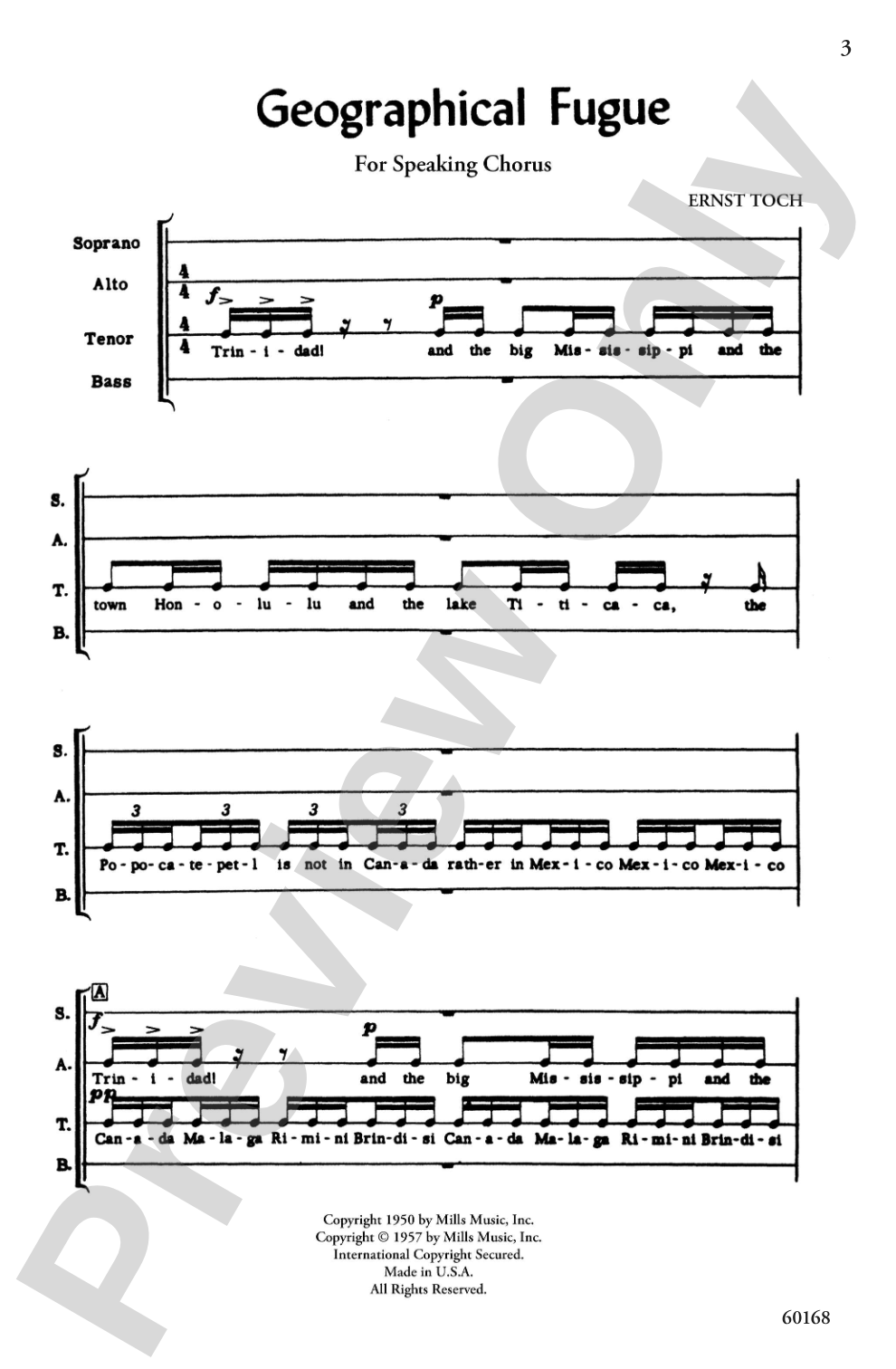
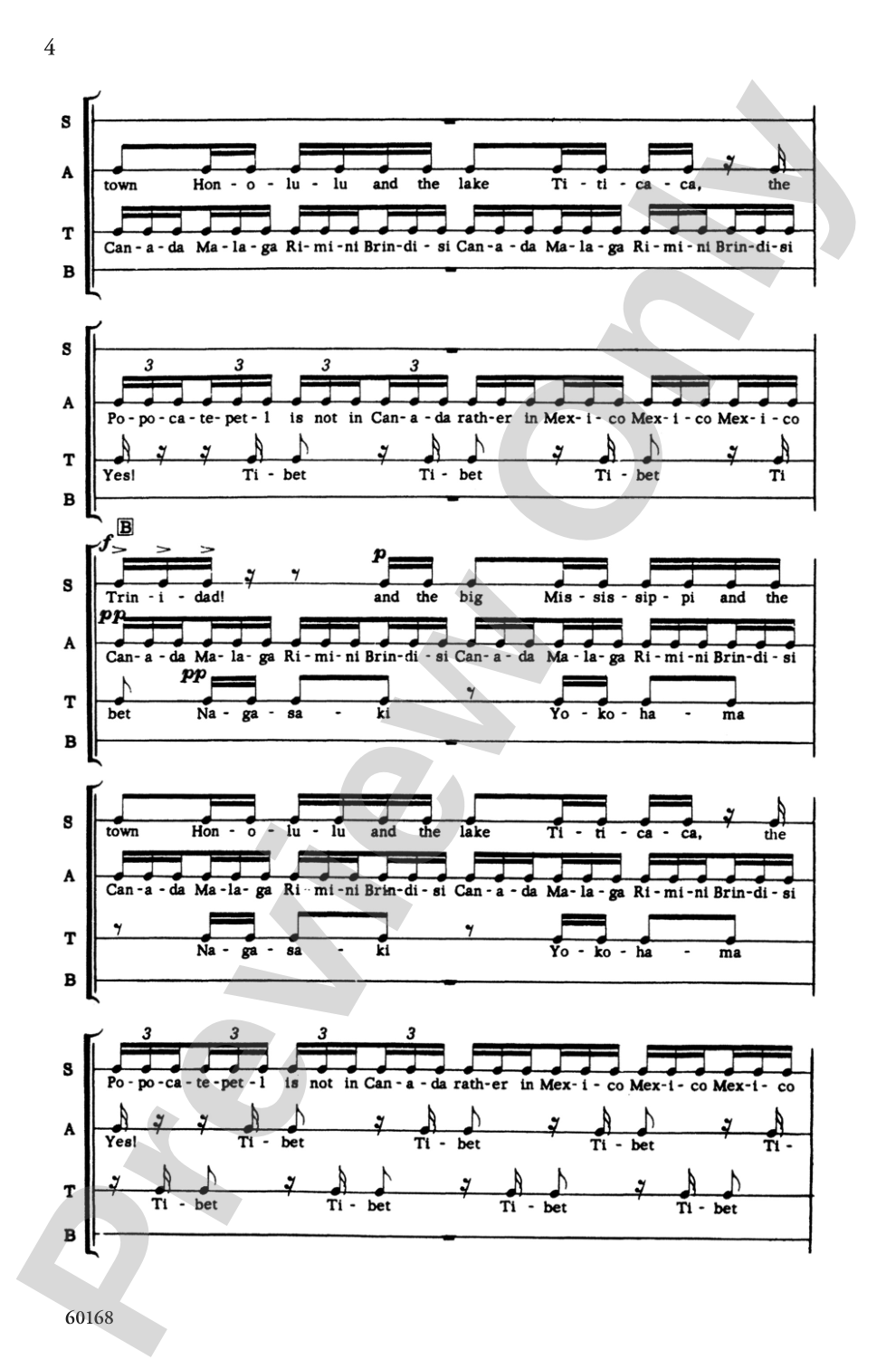
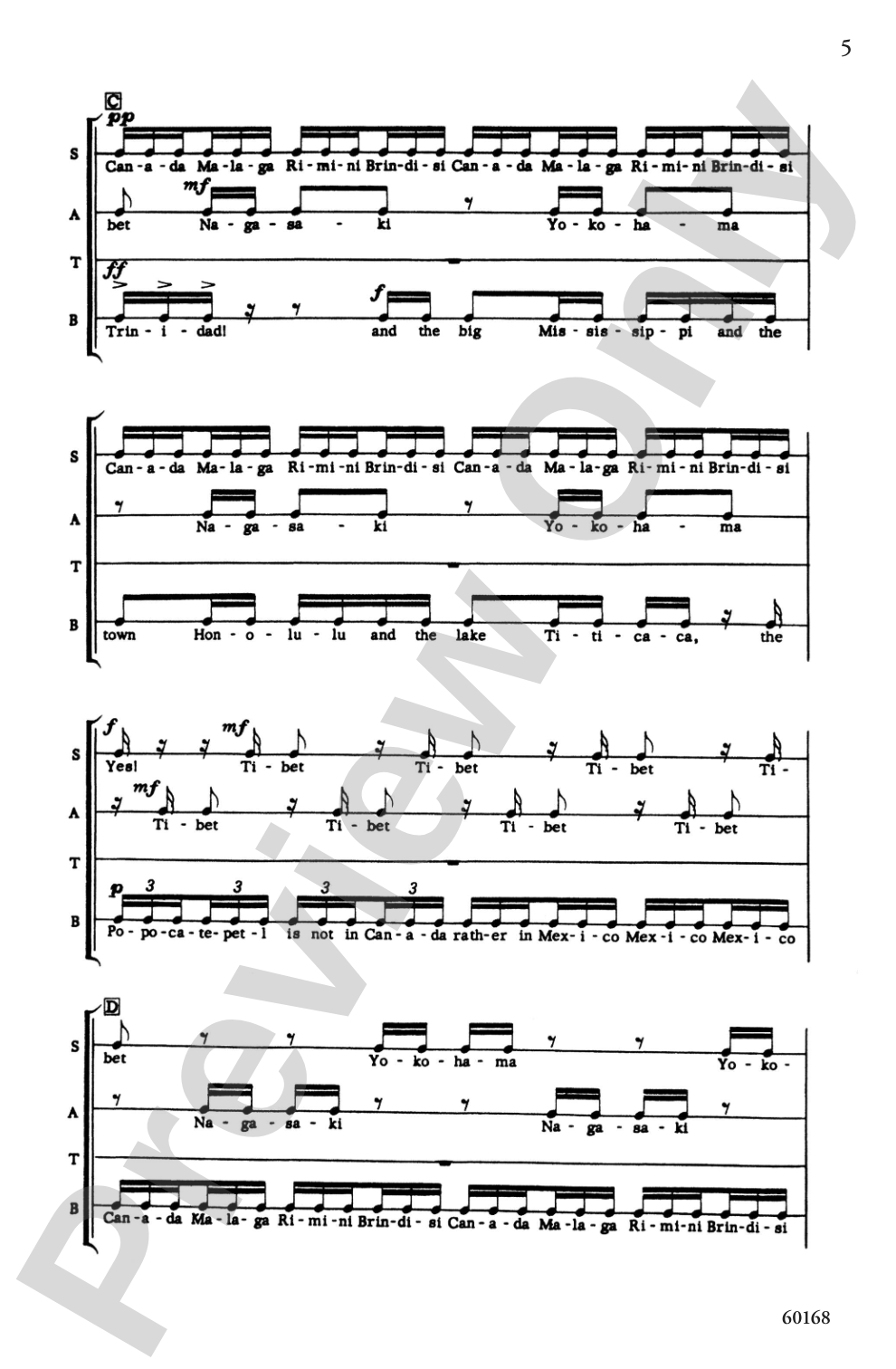

Geographical Fugue: SATB, a cappella (for Speaking Chorus) Choral Octavo
By Ernst Toch
Item: 00-PO-0007725
$2.20
Minimum order quantity: 20 copies
Pickup currently not available
Related Items
Geographical Fugue: SATB, a cappella (for Speaking Chorus) Choral Octavo |
$2.20
|
View |
Description


Geographical Fugue: SATB, a cappella (for Speaking Chorus) Choral Octavo isn't in MakeMusic Cloud just yet...but it could be. Let us know you'd like to see it, and you'll help shape what comes next. In the meantime, start a free trial and dive into thousands of interactive titles your students can play along with today.
Request This Title
Tell us you want it.
Start Your Free Trial
Explore everything that's ready to play right now.
Sample Audio
No sample audio found.
Sample Video
No sample videos found.
Additional Details
Publisher:
Alfred Music
Page Count:
16
SKU:
00-PO-0007725
More about this title
About the Composer: Ernst Toch
Ernst Toch (1887, 1964) was an Austrian-American composer and pedagogue whose output ranged from symphonies and operas to inventive choral works that challenged conventional thinking about ensemble music. He fled Nazi Germany in 1933 and eventually settled in Los Angeles, where he taught composition and continued to write music that blended intellectual rigor with accessibility and wit.
Toch had a particular gift for the human voice and understood how to write for choirs in ways that were both vocally grateful and musically adventurous. His choral music frequently incorporated theatrical elements, spoken text, and rhythmic precision that demanded singers think beyond traditional note-singing. In the American choral tradition, he represents a generation of European composers who enriched our concert halls with a distinctly modern sensibility.
Why we love this
This piece breaks the mold of traditional choral writing by treating spoken language as a rhythmic and textural instrument rather than mere lyrical vehicle. Directors gravitate to it because it offers genuine novelty in concert programming, engages singers in a fundamentally different kind of vocal expression, and never fails to capture an audience's full attention with its playful, percussive approach to geography and language.
What to expect
Geographical Fugue is playful and cerebral at once, combining the intellectual rigor of fugal construction with the lighthearted absurdity of reciting place names in rhythmic unison. As the piece builds, the overlapping spoken layers create a thrilling sense of controlled chaos, where precision and humor intertwine to create something both musically satisfying and genuinely entertaining.
Who it's for
This work suits SATB choruses with solid blend and secure pitch, particularly those comfortable with unconventional scoring and willing to embrace spoken-word techniques. It's ideal for concert choirs seeking a program opener or palette cleanser, and for ensembles that want to introduce audiences to twentieth-century choral innovation without demanding extensive technical vocalism.
How to get the most out of it
- Establish clear rhythmic precision with the spoken passages; the impact of the work depends on crisp articulation and unified timing across all voice parts.
- Treat the geography-based text as musical material with its own sonorous qualities. Experiment with how different geographic names resonate when spoken as a group, considering vowel colors and consonant attacks.
- Balance the sung and spoken sections carefully so that neither dominates; the work thrives on the interplay between melodic singing and rhythmic speaking.
- Rehearse the piece with attention to dynamics and inflection in the spoken parts. Over-dramatization can undermine the piece's wit, while insufficient energy flattens its humor.
How to use it
Program this as a contrasting centerpiece in a concert that otherwise features traditional choral literature; its novelty and accessibility make it a natural audience favorite between more introspective works. It also serves beautifully as a season opener or festival showcase piece, demonstrating your choir's versatility and willingness to explore beyond conventional boundaries.
Skills your students will build
- Coordinating spoken and sung text within a single ensemble framework
- Maintaining rhythmic precision during simultaneous multi-part spoken passages
- Understanding fugal structure and how thematic material develops through imitation
- Blending and balancing SATB voice parts while integrating spoken-word techniques
- Interpreting twentieth-century choral notation and experimental compositional approaches