Gentle Annie Sheet Music Preview

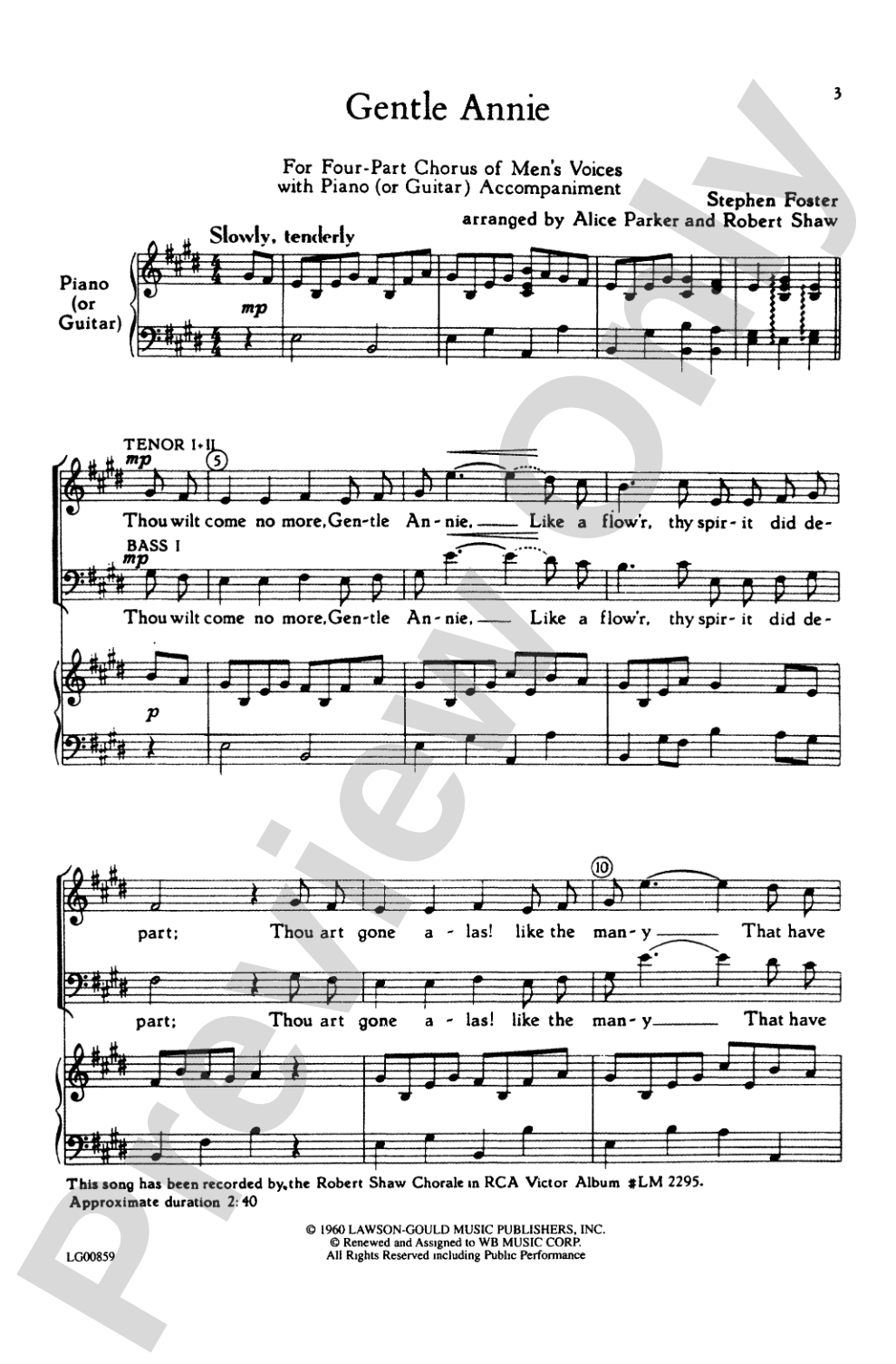
Gentle Annie: TTBB Choral Octavo

By Stephen Foster / arr. Robert Shaw and Alice Parker

Item: 00-PO-0003005

Digital Download
$2.25

Minimum order quantity: 20 copies

Description

Gentle Annie: TTBB Choral Octavo isn't in MakeMusic Cloud just yet...but it could be. Let us know you'd like to see it, and you'll help shape what comes next. In the meantime, start a free trial and dive into thousands of interactive titles your students can play along with today.

Sample Audio
No sample audio found.
Sample Video
Additional Details
Series: Alfred Archive Edition: Lawson-Gould Music Publishers
Publisher: Alfred Music
Page Count: 8
SKU: 00-PO-0003005

More about this title

About the Composer: Stephen Foster

Stephen Foster (1826-1864) stands as one of America's most prolific songwriters, composing over 200 songs that became the soundtrack of 19th-century American life. His gift for memorable melodies and accessible harmony made his work immediately popular across all social classes, from parlor singers to concert halls. Foster's legacy extends far beyond his lifetime; his songs remain central to American choral and vocal repertoire because they balance genuine emotional sincerity with technical accessibility.

Foster's compositions shaped American secular music during a formative period. Though he died in poverty and relative obscurity, his work has endured through countless arrangements and performances by every generation of musicians since. For choral directors, Foster's songs offer an entry point into authentic American repertoire while providing rewarding musical material for singers of all levels.

Why we love this

Robert Shaw and Alice Parker's arrangement brings crystalline clarity to Foster's melody while honoring the period style the original deserves. The flexible voicing options (TB/TTB/TBB/TTBB) mean you can program this with virtually any mixed ensemble configuration, making it a genuinely practical addition to a repertoire folder. The Shaw-Parker touch gives singers manageable yet musically satisfying voice parts that don't sacrifice the song's gentle, introspective character.

What to expect

This is intimate, nostalgic music that conjures parlor singing and genuine sentiment without sentimentality. Foster's melody unfolds with quiet dignity, accompanied by warm harmony that feels both familiar and freshly arranged. There's an honesty to the piece; it doesn't ask for dramatic gestures, only for singers to inhabit its gentle, reflective space with sincerity.

Who it's for

Mixed choral ensembles performing at intermediate to advanced levels will find this arrangement both musically rewarding and immediately accessible. Small chamber choirs, community choruses, and men's vocal groups can all draw from the voicing flexibility to include this American standard in their concerts. Directors seeking repertoire that connects students to authentic American musical heritage will value Foster's direct emotional appeal.

How to get the most out of it

  • Shape the melody's natural phrasing by thinking of long lines rather than note-to-note: this folk melody breathes best when each phrase feels unhurried and connected.
  • Balance the inner voices carefully so they support the tune without overwhelming it; Foster's harmony is simple and beautiful only when each voice layer remains transparent.
  • Keep the tempo steady and moderate; resist the urge to drag through sentimental moments, which will undermine the piece's genuine warmth.
  • Use the flexible voicing options to optimize blend and balance for your specific group size and voice distribution.

How to use it

Program this alongside other American repertoire (Copland, Barber, or other Foster arrangements) to create a thematic concert segment celebrating indigenous American song. It works beautifully as a concert encore or as part of a pops program that traces the evolution of American melodies. The modest forces required and flexible voicing make it ideal for smaller community concert settings or as a bridge piece between more complex contemporary works.

Skills your students will build

  • Balance between melodic and harmonic roles in simple four-part writing
  • Sustaining legit tone quality through sparse, exposed textures
  • Interpreting period style and rubato appropriate to 19th-century American song
  • Flexibility in ensemble voicing and regrouping based on available singers

You May Also Like