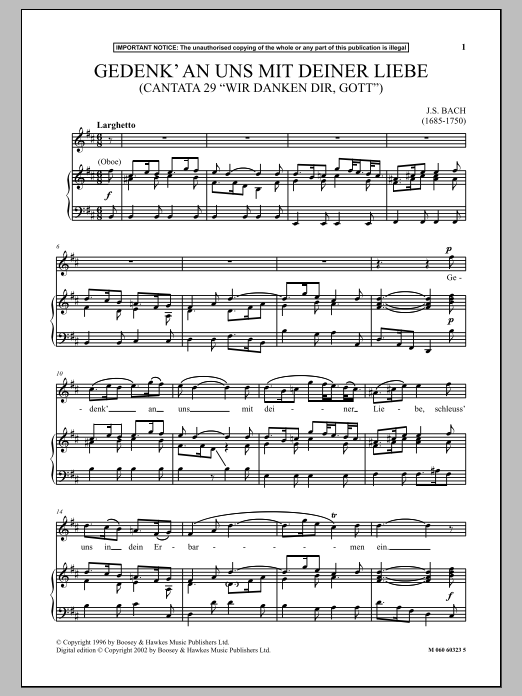
Gedenk An Uns Mit Deiner Liebe (Cantata 29 Wir Danken Dir, Gott ) Sheet Music Preview

Gedenk An Uns Mit Deiner Liebe (Cantata 29 Wir Danken Dir, Gott ): Piano Vocal

As performed by Johann Sebastian Bach

Item: 35-DS00238082

Digital Download
$5.99
Description

Gedenk An Uns Mit Deiner Liebe (Cantata 29 Wir Danken Dir, Gott ): Piano Vocal isn't in MakeMusic Cloud just yet...but it could be. Let us know you'd like to see it, and you'll help shape what comes next. In the meantime, start a free trial and dive into thousands of interactive titles your students can play along with today.

Sample Audio
No sample audio found.
Sample Video
Additional Details
Publisher: Hal Leonard
Page Count: 4
SKU: 35-DS00238082

More about this title

About the Artist: Johann Sebastian Bach

Johann Sebastian Bach (1685-1750) composed over 200 cantatas during his tenure as Cantor at St. Thomas Church in Leipzig, creating a sacred music legacy that defined the genre for centuries. His cantatas blend intricate counterpoint, memorable chorales, and expressive vocal writing to explore theological themes with both intellectual rigor and emotional depth. For music educators, Bach's cantatas represent the pinnacle of baroque vocal craft: they teach harmonic language, voice leading, and the relationship between text and music simultaneously.

Why we love this

This aria from Cantata 29 gives singers a chance to explore baroque vocal expression without the extreme technical demands of Bach's most virtuosic writing. The piano reduction opens the work to musicians working in smaller ensembles or voice studios, making this sacred gem accessible beyond large institutional settings.

What to expect

A moment of intimate prayer set to music; the writing feels conversational and direct despite its formal baroque architecture. There is warmth in the harmonic language and sincerity in the text underlay, inviting performers to connect with the spiritual content rather than treat the piece as pure abstraction.

Who it's for

Solo singers preparing sacred repertoire, voice teachers seeking baroque material that balances musicality with approachable technical demands, and chamber ensembles pairing voice with keyboard. Advanced high school singers and undergraduate voice students will find rewarding interpretive challenges here.

How to get the most out of it

  • Shape the melody in phrases that follow the text's natural breathing points rather than harmonic cadences; baroque phrasing often extends across bar lines
  • Let the piano's contrapuntal lines breathe independently; avoid locking rigidly with the vocal part on every sixteenth note
  • Approach ornamentation (if present) as optional and tasteful rather than obligatory; a clean, well-shaped line can outshine over-decorated passagework
  • Explore the text's emotional arc across the full piece; even a short aria benefits from deliberate expressive choices that build meaning

How to use it

This aria serves well as a solo during sacred or holiday services, or as a concert piece pairing with other baroque vocal works. Its modest four-page length makes it ideal for recital programmings where you want concentrated expressive power rather than extended virtuosity.

Skills your students will build

  • Baroque ornamentation and stylistically appropriate articulation
  • Text expression and theological interpretation in German
  • Voice leading and harmonic awareness through keyboard accompaniment
  • Phrase shaping across the contrapuntal texture
  • Sustained line projection with minimal vibrato in period style

You May Also Like