
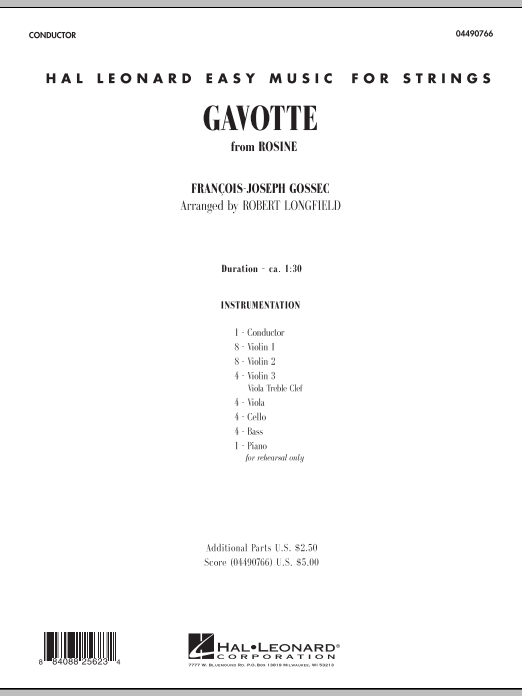

Gavotte (from "Rosine"): String Orchestra Conductor Score & Parts
By Francois-Joseph Gossec / Arranged by Robert Longfield
Grade: 2-3
Item: 35-PK00116926
$40.00
Pickup currently not available
Buy Extra Parts (Digital PDF Download)
| Product | Price | Quantity |
|---|---|---|
| Gavotte (from "Rosine") - Full Score | $6.00 | |
| Gavotte (from "Rosine") - Violin 1 | $7.00 | |
| Gavotte (from "Rosine") - Violin 2 | $7.00 | |
| Gavotte (from "Rosine") - Violin 3 (Viola Treble Clef) | $7.00 | |
| Gavotte (from "Rosine") - Viola | $7.00 | |
| Gavotte (from "Rosine") - Cello | $7.00 | |
| Gavotte (from "Rosine") - Bass | $7.00 | |
| Gavotte (from "Rosine") - Piano | $7.00 |
Parts Added to Cart!
Description
An outstanding teaching piece that can serve as an introduction to many aspects of ensemble playing including cut-time and pizzicato. Robert also gives each section interesting and important melodic parts in a well-balanced arrangement for younger players. Dur: 1:30


Gavotte (from "Rosine"): String Orchestra Conductor Score & Parts isn't in MakeMusic Cloud just yet...but it could be. Let us know you'd like to see it, and you'll help shape what comes next. In the meantime, start a free trial and dive into thousands of interactive titles your students can play along with today.
Request This Title
Tell us you want it.
Start Your Free Trial
Explore everything that's ready to play right now.
Sample Audio
No sample audio found.
Sample Video
No sample videos found.
Additional Details
Publisher:
Hal Leonard
SKU:
35-PK00116926
More about this title
About the Composer: Francois-Joseph Gossec
Francois-Joseph Gossec (1734–1829) was a Belgian-born composer who spent much of his career in France, where he became a prominent figure in Parisian musical life. He composed symphonies, chamber music, and vocal works that bridged the Classical and early Romantic periods, earning respect from contemporaries like Haydn and Mozart. His gift for clear melodic writing and orchestration made his works natural choices for teaching ensemble skills across generations.
Why we love this
Longfield's arrangement respects Gossec's elegant melodic lines while distributing substantial material across all four string parts, ensuring no one sits idle. The balance between technical challenge and playability makes this a genuine confidence builder for younger orchestras; students actually sound polished after learning it. Cut-time and pizzicato arrive here as natural musical demands rather than abstract concepts, which is exactly how they should be introduced.
What to expect
Graceful and courtly, this Gavotte carries the refined poise of 18th-century French instrumental music. The piece breathes with natural elegance; even at a moderate tempo, it conveys sophistication without bombast, inviting students into a world where precision and restraint create beauty.
Who it's for
Intermediate to advancing Grade 2 and Grade 3 string orchestras ready to work with cut-time signatures and multiple articulation styles without sacrificing musical shape. This works equally well for chamber orchestras in academic settings or community youth orchestras looking for accessible yet dignified repertoire.
How to get the most out of it
- Establish the cut-time pulse cleanly in early rehearsals by tapping quarter notes rather than half notes; this prevents the piece from dragging and clarifies the rhythmic outline.
- Shape the melodic line with subtle dynamic swells in the first violins; Gavotte form thrives on phrase clarity, and singers' phrasing translates beautifully to strings.
- Balance the pizzicato sections by having violas and cellos play with consistent attack and release; sloppy pizzicato will muddy the transparency of this Classical texture.
- Give each section their featured moments; when viola or cello carries melody, ask second violins and violas to voice their supporting lines with awareness of harmonic color rather than default dynamics.
How to use it
Program this as a curtain-raiser or palate-cleanser between larger works; its 1:30 duration and bright Classical character make it ideal for opening a concert or filling a transition moment. The piece also serves as a solid unit within a thematic program exploring Baroque and Classical string writing, where it demonstrates how the language evolved across composers and centuries.
Skills your students will build
- Reading and performing cut-time signatures with confidence
- Executing clean pizzicato attacks with rhythmic precision
- Balancing sectional melody and accompaniment roles
- Phrasing in the Classical style with shape and lift
- Maintaining stylistic consistency across bow changes and articulation shifts