
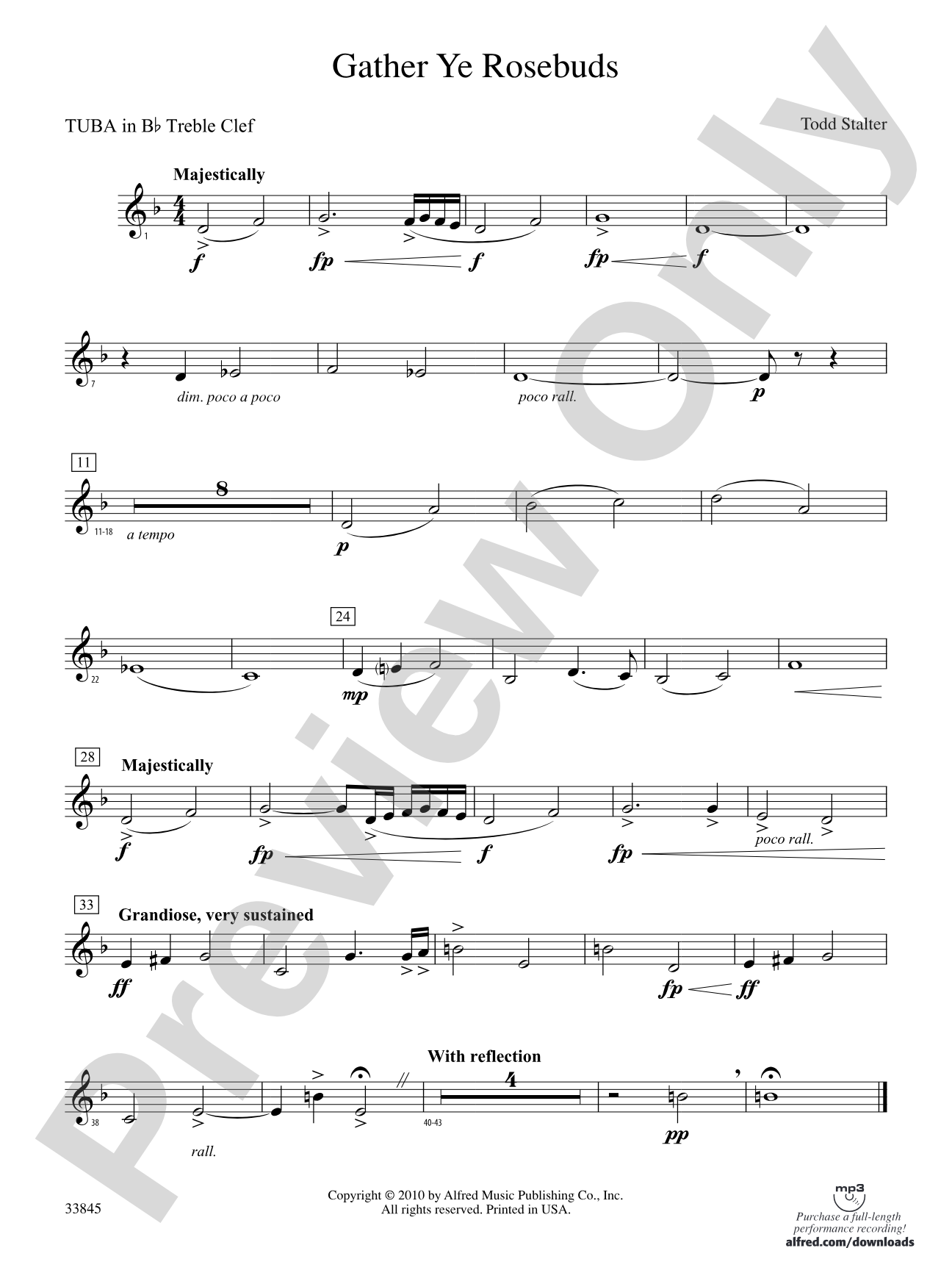

Gather Ye Rosebuds: (wp) B-flat Tuba T.C.
By Todd Stalter
Grade: 2 (Medium Easy)
Item: 00-PC-0014576_wpTBBTC
$3.00
Pickup currently not available
Description
Gather Ye Rosebuds takes its title from a line in a poem by Robert Herrick. The poem exhorts us to take advantage of the time we have been given, for all too soon it will be gone. The work opens with a bold statement in the winds, giving way to a plaintive melody in the flute. The music builds to a glorious climax using the power of the full sonority of the winds, and ends softly, in a reflective mood.


Don't just read it, hear it, play along with it, and watch your students grow with it. In MakeMusic Cloud, Gather Ye Rosebuds: (wp) B-flat Tuba T.C. comes alive with professional accompaniment, adjustable tempo, and built-in practice tools that turn solo practice into real progress.
Open in the Player
Jump straight in and assign it today.
Start Your Free Trial
Open this title and explore the full library in minutes.
Sample Audio
1
Audio File
--:--
0:00
0:00
Sample Video
No sample videos found.
Additional Details
Series:
Young Symphonic
Publisher:
Alfred Music
Page Count:
120
SKU:
00-PC-0014576_wpTBBTC
More about this title
About the Composer: Todd Stalter

Todd Stalter built his reputation over 34 years as Director of Bands at Eureka High School in Illinois, where his ensembles earned 16 state marching band championships, consistent superior ratings at IHSA contests, and invitations to perform at Orchestra Hall in Chicago and Walt Disney World. His conducting experience spans All-State bands in Georgia and Delaware, numerous honor bands, and regional ensembles including the Rockford Wind Ensemble and Prairie Winds. He holds memberships in the Illinois State Marching Band Championships Hall of Fame and maintains an active schedule as an adjudicator, clinician, and presenter at state music education conferences.
As a composer, Stalter's works for band and string orchestra are performed across the United States and appear on state contest and festival lists nationwide. Several of his compositions are featured in the GIA publication "Teaching Music Through Performance in Band," establishing his voice as an important contributor to the educational band repertoire. He earned his Bachelor of Music Education (cum laude) and Master of Music in Trumpet Performance from Illinois State University, where he studied with faculty including Richard Lehman, Solo Cornet of "The President's Own" United States Marine Band.
Why we love this
This piece balances accessibility with genuine musical substance. The Grade 2 writing lies well for young ensembles while the form and dynamic arc demand real attention to phrasing and ensemble balance, giving your students something meaningful to rehearse and audiences something substantial to hear. The textural journey from bold opening statement to reflective close provides a complete musical experience in concert or contest settings.
What to expect
The piece opens with assertive energy in the winds before pivoting to the quiet, searching quality of a flute solo. As voices layer in, the texture grows fuller and richer, building toward a triumphant peak that showcases the band's combined power. The return to softness creates a reflective coda, leaving listeners in a contemplative frame of mind.
Who it's for
This work suits beginning to early intermediate concert bands ready to tackle multi-section forms and dynamic contrasts. It works equally well for groups preparing for festival or contest performance and for concert programming where you want substantial yet accessible repertoire.
How to get the most out of it
- Shape the opening wind statement with a unified attack and clear release; this bold moment sets the emotional context for everything that follows.
- Support the flute melody with balanced harmonic accompaniment in the lower voices, allowing the lyrical line to emerge without overwhelming it.
- Build gradually toward the climax by layering dynamics and instrumental colors; avoid rushing the phrase or hitting full volume too early.
- Use the final soft section to refocus your ensemble's attention on intonation and blend; the reflective mood depends on controlled, sustained tone quality.
How to use it
Program this after a lighter opener to deepen your concert's emotional arc, or use it as the anchor of a festival set where its combination of technical clarity and expressive maturity will impress adjudicators. Its title and introspective close also work well as a closing piece for a concert with a thematic focus on reflection or the passage of time.
Skills your students will build
- Dynamic control across a full range from bold forte statements to sustained pianissimo passages
- Ensemble balance when supporting a featured melodic line
- Phrase shaping and longer-line thinking across multi-section forms
- Attention to intonation in sustained chords and final soft textures
- Stylistic variety: transitioning between energetic and reflective musical moods