
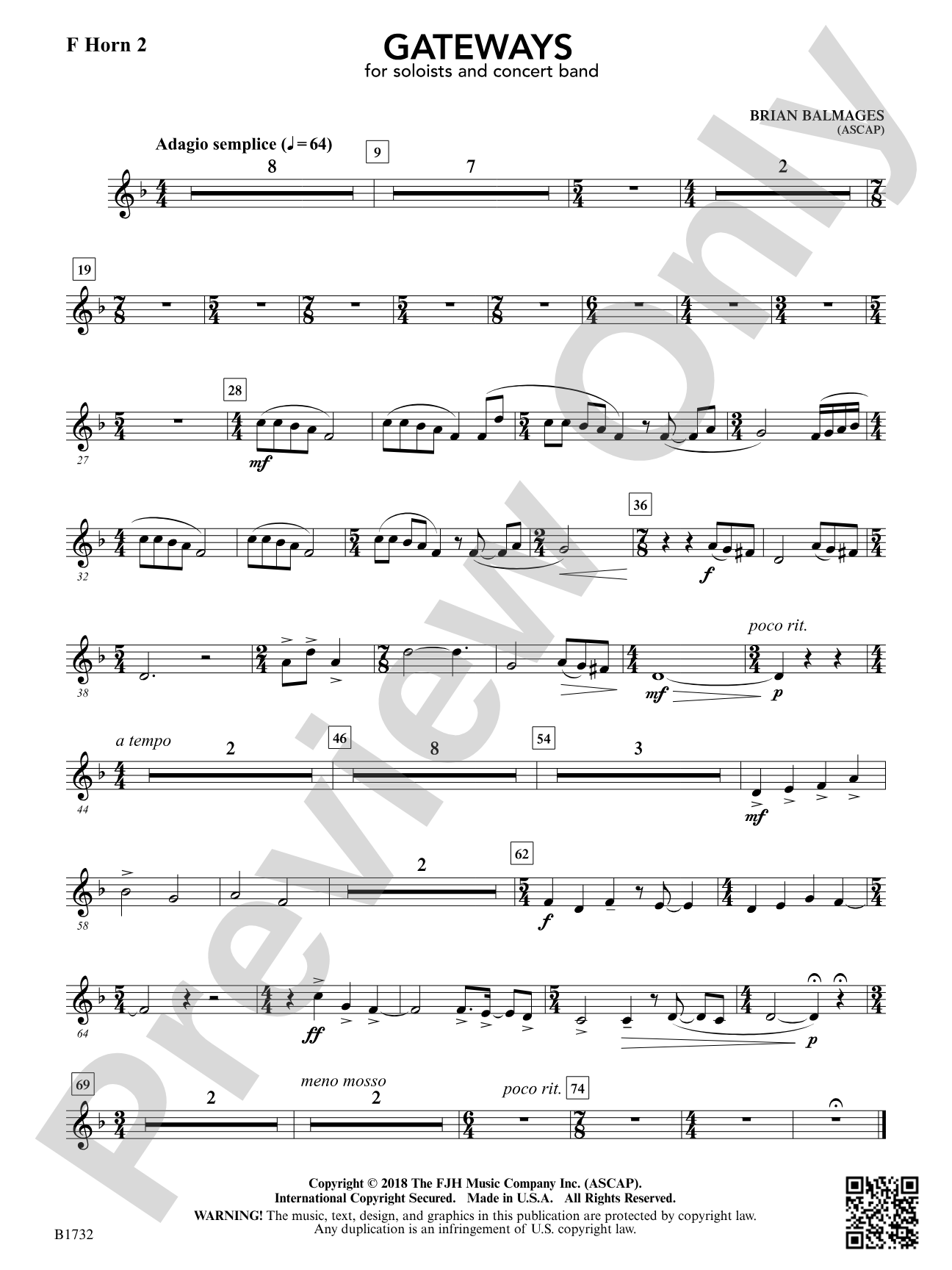

Gateways: F Horn 2
By Brian Balmages
Grade: 3.5
Item: 98-PC-DB1732_H2
$7.00
Pickup currently not available
Description
Written as a duet for any two instruments and band, this work represents the idea of moving through a gate from one phase of life into the next. Perfect for featuring a specific section, group of talented students, or all of your seniors. Feature just two soloists or mix and match different instruments throughout the piece. The options are limitless!


Gateways: F Horn 2 isn't in MakeMusic Cloud just yet...but it could be. Let us know you'd like to see it, and you'll help shape what comes next. In the meantime, start a free trial and dive into thousands of interactive titles your students can play along with today.
Request This Title
Tell us you want it.
Start Your Free Trial
Explore everything that's ready to play right now.
Sample Audio
1
Audio File
--:--
0:00
0:00
Sample Video
Additional Details
Series:
FJH Concert Band
Publisher:
The FJH Music Company, Inc.
SKU:
98-PC-DB1732_H2
More about this title
About the Composer: Brian Balmages

Brian Balmages has established himself as a composer and conductor working across orchestral, band, and chamber idioms at every performance level, from elementary school ensembles to professional orchestras. His music has reached audiences at Carnegie Hall, the Kennedy Center, Sydney Opera House, and the Toronto Centre for the Arts. He is a member of the American Bandmasters Association, received the A. Austin Harding Award from the American School Band Directors Association, and won the 2020 NBA William D. Revelli Composition Contest for Love and Light.
Balmages holds alumni status from both James Madison University (which honored him with its inaugural Distinguished Alumni Award from the School of Visual and Performing Arts) and the University of Miami, where he was commissioned to compose for the inauguration of the institution's sixth president. His music was performed at the 2013 Presidential Inaugural Prayer Service, and he regularly conducts all-state ensembles, university groups, and professional orchestras worldwide, with notable guest appearances at the Midwest Clinic, Western International Band Clinic, and Teatro dell'Aquila in Italy. He currently serves as Director of MakeMusic Publications and Digital Education for Alfred and MakeMusic.
Why we love this
Balmages gives you genuine flexibility here: the duet framework means you can spotlight two strong soloists, rotate different instrument combinations throughout the piece to feature multiple students, or build the piece entirely around your senior class. The Grade 3.5 scoring keeps the band part accessible while allowing the solo line to shine, making this rewarding for both featured students and the supporting ensemble. Programming a work with this kind of curricular versatility means one piece can meet multiple recognition and performance goals.
What to expect
The piece evokes transition and progression, moving through distinct musical gates as if crossing thresholds into new chapters. The duet takes on a lyrical, almost conversational quality as the two soloists dialogue with and support each other above the band's grounded accompaniment.
Who it's for
Band directors seeking a flexible vehicle for honoring graduating seniors, recognizing a standout section, or celebrating multiple talented soloists within a single concert work. This piece is equally suited to programs that want a dignified, accessible feature for a band awards ceremony or a special recognition concert.
How to get the most out of it
- Rehearse the soloists with just the band's foundational harmonic layer first, then layer in the full accompaniment once they're confident with their entrances and phrasing.
- If rotating multiple instrument pairs through the same solo part, ensure consistent tone quality and articulation by having all featured soloists rehearse together before their individual turns.
- Balance the featured duet so it sits above the ensemble without drowning the band's contribution; the piece works because both roles matter equally.
How to use it
Consider placing this near the close of a concert as a meaningful sendoff for seniors, or program it mid-set as a high-profile feature that celebrates individual musicianship. The thematic content around passage and renewal makes it particularly fitting for spring concerts, graduations, or year-end celebrations.
Skills your students will build
- Playing an exposed solo role with ensemble support
- Balancing volume and tone as a featured musician against band accompaniment
- Ensemble listening and responding to soloists' phrasing and timing
- Transitioning between tonal and stylistic sections as a band unit
- Collaborative musicmaking across different instrumental sections