
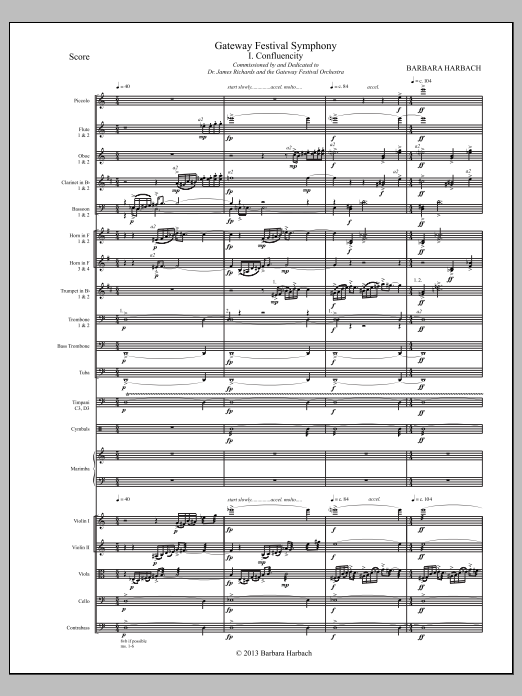

Gateway Symphony Orchestra: Full Orchestra Conductor Score & Parts
By Barbara Harbach
Item: 35-PK00291420
$29.75
Pickup currently not available
Buy Extra Parts (Digital PDF Download)
Parts Added to Cart!
Description
I. Confluencity depicts the confluence of the Missouri and Mississippi rivers with the ebb and flow of two rivers playing and colliding, producing turbulence in early spring with melting snows and winds that whip the waters into a dangerous, dramatic frenzy. II. Sunset: St. Louis is inspired by Sara Teasdale's poem, Sunset: Saint Louis. The themes reflect the structure and majesty of the city's natural and historic monuments coupled with the city's myriad cultural influences. III. After Forever begins with a dramatic trumpet call-to-arms, reminding us of the struggle that Dred and Harriet Scott waged to win their independence, and reflects the pivotal role Missouri played in the Civil War, and the lasting, enduring strength of its people. Duration: 19:00


Discover MakeMusic Cloud: thousands of interactive titles your students can play along with today.
Sample Audio
No sample audio found.
Sample Video
No sample videos found.
Additional Details
Publisher:
Hal Leonard
SKU:
35-PK00291420
More about this title
About the Composer: Barbara Harbach
Barbara Harbach is an accomplished composer whose work draws deeply from American history, geography, and literary tradition. Her orchestral writing balances programmatic storytelling with sophisticated harmonic and structural development, making her scores accessible to ambitious ensembles while offering substantive musical challenges.
Why we love this
Harbach has crafted three movements that function as both standalone concert pieces and a cohesive narrative arc through Missouri's landscape and legacy. The orchestration demands serious musicianship without requiring a massive ensemble, and each movement's distinct character gives conductors room to explore contrasting interpretive approaches within a single work.
What to expect
The opening movement churns with the raw power of spring flooding, all rushing water and atmospheric turbulence. By the second movement, the music settles into architectural grandeur tempered by lyrical introspection, before the final movement surges back with urgent, declarative strength that affirms human resilience.
Who it's for
This work suits advanced high school or community orchestras ready for 19 minutes of substantive, dramatically engaging repertoire with clear educational value. It appeals to programs seeking American compositions that weave together history, place, and artistic vision.
How to get the most out of it
- Study the literary and historical references before rehearsal. Understanding Teasdale's poetry and the Dred Scott case transforms how you shape phrasing and help students grasp the emotional arc.
- Balance the competing thematic material in the first movement by clearly delineating which sections represent each river; rhythmic precision from the rhythm section anchors the 'collision' passages.
- Let the trumpet call in the third movement breathe. Its dramatic power relies on the orchestra recognizing it as a turning point, not rushing the tempo.
- Record a run-through early in rehearsals to hear how the full 19-minute arc lands and identify places where transitions need tightening.
How to use it
This three-movement suite works beautifully as a complete concert centerpiece, allowing you to build a program around American themes or regional history. It also functions as a thematically coherent closer to a concert, sending audiences out with both contemplative beauty and stirring affirmation.
Skills your students will build
- Balance and blend across multiple melodic lines occurring simultaneously
- Sustaining intensity through extended climactic passages
- Conducting and executing clear sectional transitions
- Coordinating complex rhythmic figures between woodwinds and strings
- Dynamic shaping of lyrical material in moderate tempos
- Reading and interpreting programmatic intent to inform musical choices