
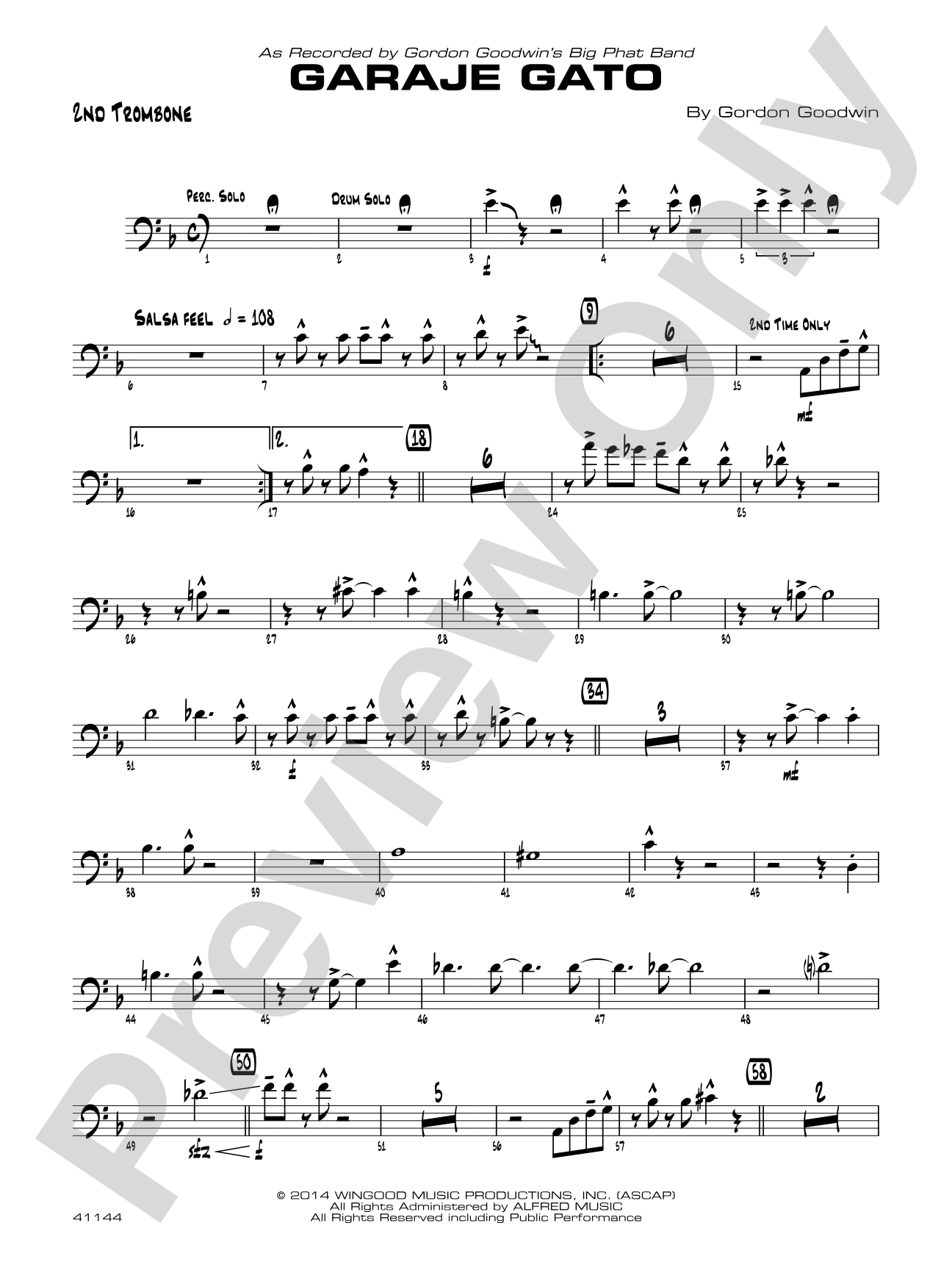

Garaje Gato: 2nd Trombone
By Gordon Goodwin
Grade: 6 (Professional / Very Advanced)
Item: 00-PC-0016280_TN2
$3.00
Pickup currently not available
Description
Latin music should be a part of every band's repertoire. You'll love the fire and rhythmic emphasis of Gordon Goodwin's Garaje Gato, as well as the harmonic and melodic richness. With half note = 108 BPM, solo space is included for all saxes, trumpet 3, and trombone 1, plus Latin percussion parts. As recorded by the Big Phat Band. Plenty of excitement! (6:51)


Don't just read it, hear it, play along with it, and watch your students grow with it. In MakeMusic Cloud, Garaje Gato: 2nd Trombone comes alive with professional accompaniment, adjustable tempo, and built-in practice tools that turn solo practice into real progress.
Open in the Player
Jump straight in and assign it today.
Start Your Free Trial
Open this title and explore the full library in minutes.
Sample Audio
1
Audio File
--:--
0:00
0:00
Sample Video
No sample videos found.
Additional Details
Series:
Gordon Goodwin Series
Publisher:
Alfred Music
Page Count:
102
SKU:
00-PC-0016280_TN2
More about this title
About the Composer: Gordon Goodwin

Gordon Goodwin began composing at five years old, writing complete works rather than fragments. His talent accelerated early: by thirteen, he had already completed his first big band chart. This trajectory led him into film and television scoring, where his orchestrations shaped soundtracks for Bad Boys II, Con Air, Gone in 60 Seconds, Remember the Titans, and other major releases. His screen work has earned him three Emmy Awards and multiple Grammy nominations.
In 2000, Goodwin founded Gordon Goodwin's Big Phat Band, establishing himself as both composer and bandleader for one of Los Angeles' most dynamic jazz ensembles. The Big Phat Band's albums have consistently earned Grammy recognition, with their debut becoming the first commercially released DVD Audio title. Beyond his own band, Goodwin has written for and performed alongside Christina Aguilera, Quincy Jones, Ray Charles, and Sarah Vaughn, and has conducted major symphony orchestras across North America and Europe.
Why we love this
Goodwin writes with the sensibilities of a film composer and the rhythmic precision of a jazz master. The Latin textures and harmonic sophistication here make this a serious piece that audiences recognize as professional-grade material, yet the solos and groove remain entirely playable by advanced student ensembles. You get genuine artistry without compromise.
What to expect
Heat and precision in equal measure. The Latin percussion ignites immediately, pulling the horns into a lean, forward groove. Solo spaces feel inviting yet demanding, allowing individuals to shine while the ensemble's syncopated backgrounds keep everything locked and alive.
Who it's for
Advanced jazz ensembles and professional groups ready for genuine big band literature. This is repertoire for students who have strong reading skills, secure intonation, and the rhythmic independence to navigate jazz time and Latin grooves without constant conducting.
How to get the most out of it
- Lock the Latin percussion parts early in sectionals. The clave and tumbao lines define the pocket; once rhythm section players hear these clearly, the entire ensemble settles into the groove naturally.
- Give soloists time to internalize the harmonic language. The chord changes are jazz-informed and sometimes unexpected. Individual practice with the accompaniment recording (if available separately) pays dividends.
- Balance the high-register trumpet and sax lines against the Latin percussion foundation. This piece thrives when percussion doesn't get buried under the horn section's energy.
- Rehearse transitions into and out of solo sections carefully. The momentum should never drop when moving between ensemble statements and individual features.
How to use it
Feature this on a concert celebrating Latin jazz traditions or as a centerpiece for any program seeking professional-level energy. The recorded Big Phat Band version gives audiences context and excitement, especially if announced before the ensemble's performance.
Skills your students will build
- Playing with swing feel and Latin clave over half-note tempos (half note = 108 BPM)
- Comping and accompanimental figures for jazz soloists
- Reading and performing extended jazz harmonies (seventh chords, extensions, alterations)
- Ensemble precision within syncopated, layered arrangements
- Solo improvisation and phrasing over jazz changes
- Latin percussion orchestration and clave-based rhythm coordination