
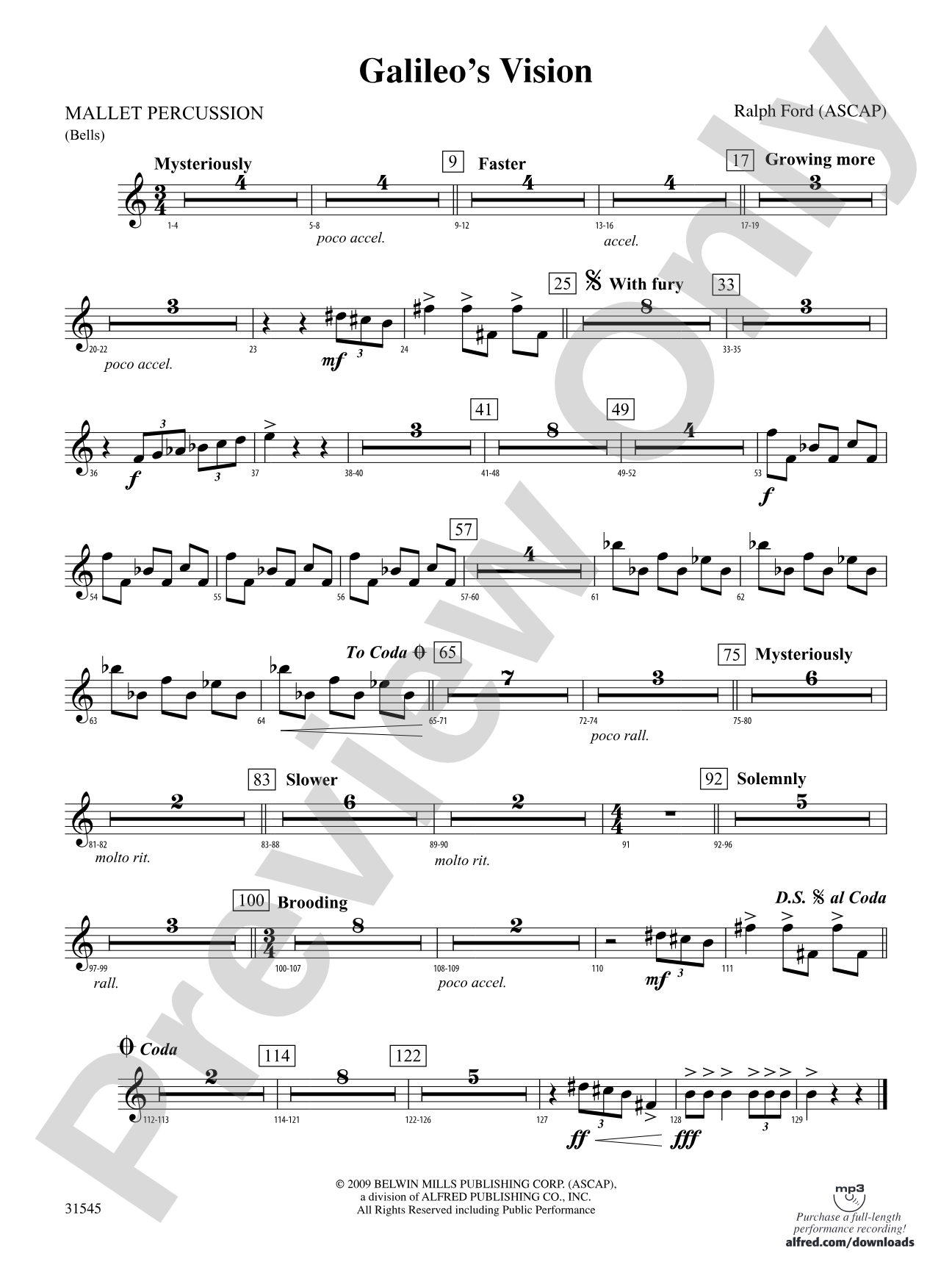

Galileo's Vision: Mallets
By Ralph Ford
Grade: 3.5
Item: 00-PC-0001733_M1
$5.99
Pickup currently not available
Description
Composed in the style of Holst, this piece celebrates the scientific accomplishments derived from the vision of Galileo, including our GPS system! Think how far we have come! Beginning with an ominous flowing bass ostinato that builds to a bold climax, this piece employs tri-tone shifts encouraging aural skills as students listen to the ever-changing tonal center. Dissonant, intense and sure to thrill!


Don't just read it, hear it, play along with it, and watch your students grow with it. In MakeMusic Cloud, Galileo's Vision: Mallets comes alive with professional accompaniment, adjustable tempo, and built-in practice tools that turn solo practice into real progress.
Open in the Player
Jump straight in and assign it today.
Start Your Free Trial
Open this title and explore the full library in minutes.
Sample Audio
1
Audio File
--:--
0:00
0:00
Sample Video
No sample videos found.
Additional Details
Series:
Belwin Intermediate Full Orchestra
Publisher:
Alfred Music
Page Count:
238
SKU:
00-PC-0001733_M1
More about this title
About the Composer: Ralph Ford
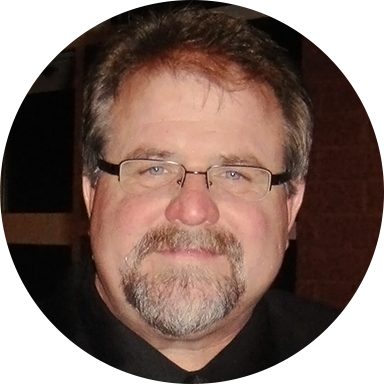
Ralph Ford brings three decades of dual experience as both a university educator and prolific composer for major publishing houses. Beginning his arranging work at age fifteen in Panama City, Florida, he went on to earn his Master of Science degree from Troy State University while simultaneously serving as staff arranger and instructor in the university's band program. His tenure as Director of Jazz Ensemble I spanned fifteen years during his undergraduate and early professional years.
Since 1999, Ford has worked as an exclusive composer and arranger for the Belwin division of Alfred Music, contributing more than 250 titles across orchestra, concert band, jazz ensemble, and marching band. Beyond education and composition, his portfolio includes extensive work in media production, broadcast, and advertising, with credits ranging from live radio broadcasts and television scoring to commercial jingles and video production. His music has been premiered by university, military, professional, community, and school ensembles internationally.
Why we love this
Ford's gift for programmatic storytelling shines here: a piece about human discovery and technological achievement that doesn't need to explain itself. The tri-tone shifts keep students listening actively to shifting tonal centers rather than settling into predictable harmonic ground, making it genuinely educational listening. At Grade 3.5, the orchestration balances accessibility with genuine sophistication.
What to expect
A journey that begins murky and uncertain, swirling through shifting harmonic centers as if searching, before breaking into bold clarity and triumph. The dissonance feels tense and purposeful rather than chaotic; it mirrors the intellectual struggle and ultimate breakthrough of scientific discovery. Students will feel the architecture of ambition and achievement beneath their fingers.
Who it's for
Orchestras and full ensemble programs at the intermediate level looking for contemporary repertoire with real substance. This piece works equally well for concert programs and festival competition entries where you want to showcase student musicianship and artistic growth rather than technical flashiness.
How to get the most out of it
- Emphasize the bass ostinato in the opening sections. It's the gravitational center of the piece; if the low brass and strings lock it in, the harmonic ambiguity above lands harder for the audience.
- Prepare your ensemble for the tri-tone shifts by discussing them in rehearsal before diving into full passages. Point out where the tonal center moves and ask students what they hear changing.
- Bring out the dissonance in the climactic sections deliberately rather than trying to smooth it. The intensity comes from the friction, not from making it pretty.
- Work the transitions into the bold climax carefully. The build needs steady momentum; rushing it flattens the dramatic arc.
How to use it
This makes an outstanding centerpiece for a concert themed around human achievement, innovation, or the intersection of science and art. Pair it with contemporary pieces or with classical works by composers who bridged centuries (Holst's influence is clear here). It also stands alone powerfully in festival or contest settings where you want adjudicators to hear artistic maturity.
Skills your students will build
- Listening for tonal center shifts and tri-tone relationships
- Balancing dissonance and tension within an ensemble texture
- Sustaining musical momentum through a multi-section climactic arc
- Coordinating independent ostinati across orchestral sections
- Interpreting programmatic intent through instrumental color and dynamics