
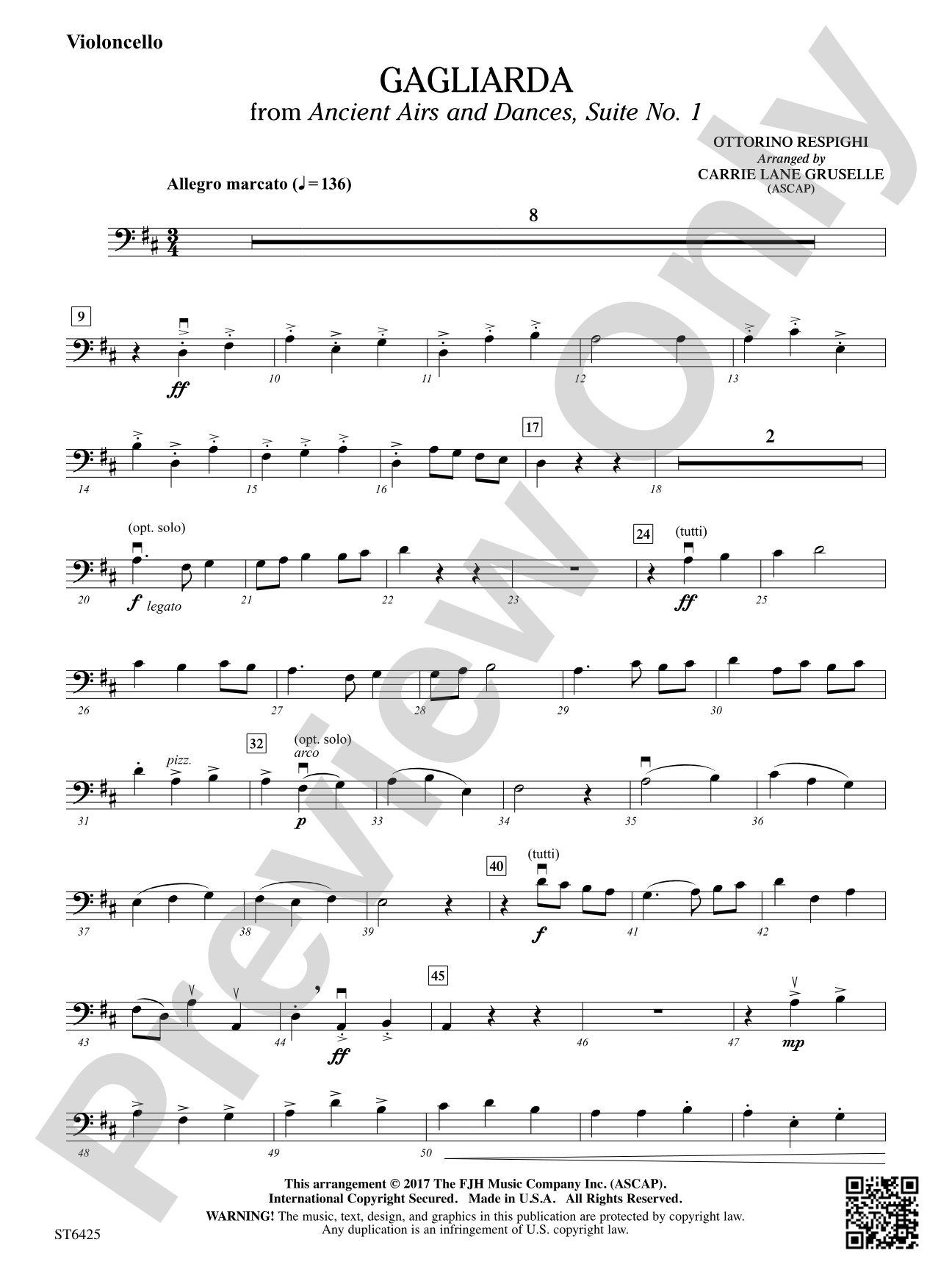

Gagliarda: Violoncello
By Ottorino Respighi / arr. Carrie Lane Gruselle
Grade: 2.5
Item: 98-PC-DST6425_VC1
$7.00
Pickup currently not available
Description
Borrowing a tune form Vincenzo Galilei, father of the famous astronomer Galileo, Respighi brings a bright and energetic taste of the Renaissance to the concert hall. Triple meter, irregular melodic patterns, dotted rhythms, independence of voices, contrasting textures and dynamics are all studied in this wonderful work by a master composer.


Gagliarda: Violoncello isn't in MakeMusic Cloud just yet...but it could be. Let us know you'd like to see it, and you'll help shape what comes next. In the meantime, start a free trial and dive into thousands of interactive titles your students can play along with today.
Request This Title
Tell us you want it.
Start Your Free Trial
Explore everything that's ready to play right now.
Sample Audio
1
Audio File
--:--
0:00
0:00
Sample Video
Additional Details
Series:
FJH Developing Strings
Publisher:
The FJH Music Company, Inc.
SKU:
98-PC-DST6425_VC1
More about this title
About the Composer: Ottorino Respighi
Ottorino Respighi (1879-1936) was an Italian composer and conductor whose mastery of orchestration and ability to weave historical musical material into fresh concert works shaped twentieth-century classical music. His fascination with the past extended beyond mere quotation; he studied older music deeply and understood how to present it to modern audiences with clarity and brilliance.
Respighi's legacy rests largely on works that honor Renaissance and Baroque composers while speaking directly to contemporary ears. His arrangements and original compositions built on historical themes demonstrate his conviction that great musical ideas, when skillfully reharmonized and orchestrated, never lose their power to engage performers and listeners alike.
Why we love this
Respighi's gift for transparent orchestration shines throughout this piece, making it ideal for orchestras at this level who want to sound polished without drowning in technical complexity. The work sits perfectly at grade 2.5, offering genuine musical substance rather than simplification; students encounter real compositional choices (contrasting textures, independent voices, rhythmic variety) that challenge their musicianship. A director can build rehearsal time around something meaningful here, not just a filler arrangement.
What to expect
Bright, dance-like energy infuses the writing from the outset, with the Galilei melody announcing itself clearly before Respighi builds in layers of supporting voices and rhythmic independence. The irregular melodic patterns keep the ear engaged; this is not square or predictable writing. Triple meter, dotted rhythms, and textural shifts create a sense of forward motion and playfulness that feels both historically rooted and vibrant.
Who it's for
String orchestras at grades 2-3 who are ready to engage with genuine masterwork arrangements rather than simplified pedagogical pieces. This is also ideal for ensembles preparing for contests or festivals, since the work demands technical accuracy while remaining accessible. Directors seeking repertoire that teaches students about Renaissance music and compositional craft will find a substantial vehicle here.
How to get the most out of it
- Balance the independent voice lines carefully in passages where multiple sections carry melodic material simultaneously. Respighi gives each voice something purposeful to play, and clarity depends on subtle dynamic adjustment between parts.
- Observe the dotted rhythms with precision; they define the piece's rhythmic character and energy. Rushing these figures flattens the Renaissance-era character Respighi is evoking.
- Use the contrasting dynamics as structural markers. The shifts between bright, energetic passages and quieter moments help define form and keep the ensemble engaged over the work's span.
- Shape the opening melody as a gift to the audience; it comes directly from Vincenzo Galilei and deserves the clarity and warmth that only careful phrasing can provide.
How to use it
Program this as an opening work or mid-concert brightener; its energy and relatively compact length make it ideal for establishing a positive tone in any concert. It pairs naturally with other Renaissance or Baroque-inspired works, or stands alone as a refreshing contrast to Romantic-era repertoire. Consider using it early in the season to build confidence in your ensemble before tackling more complex contemporary or advanced-level works.
Skills your students will build
- Independence of voices within a unified orchestral sound
- Dotted rhythms in triple meter
- Reading and balancing contrasting textures and dynamics
- Irregular melodic patterns and phrasing
- Articulation clarity in fast, energetic passages