
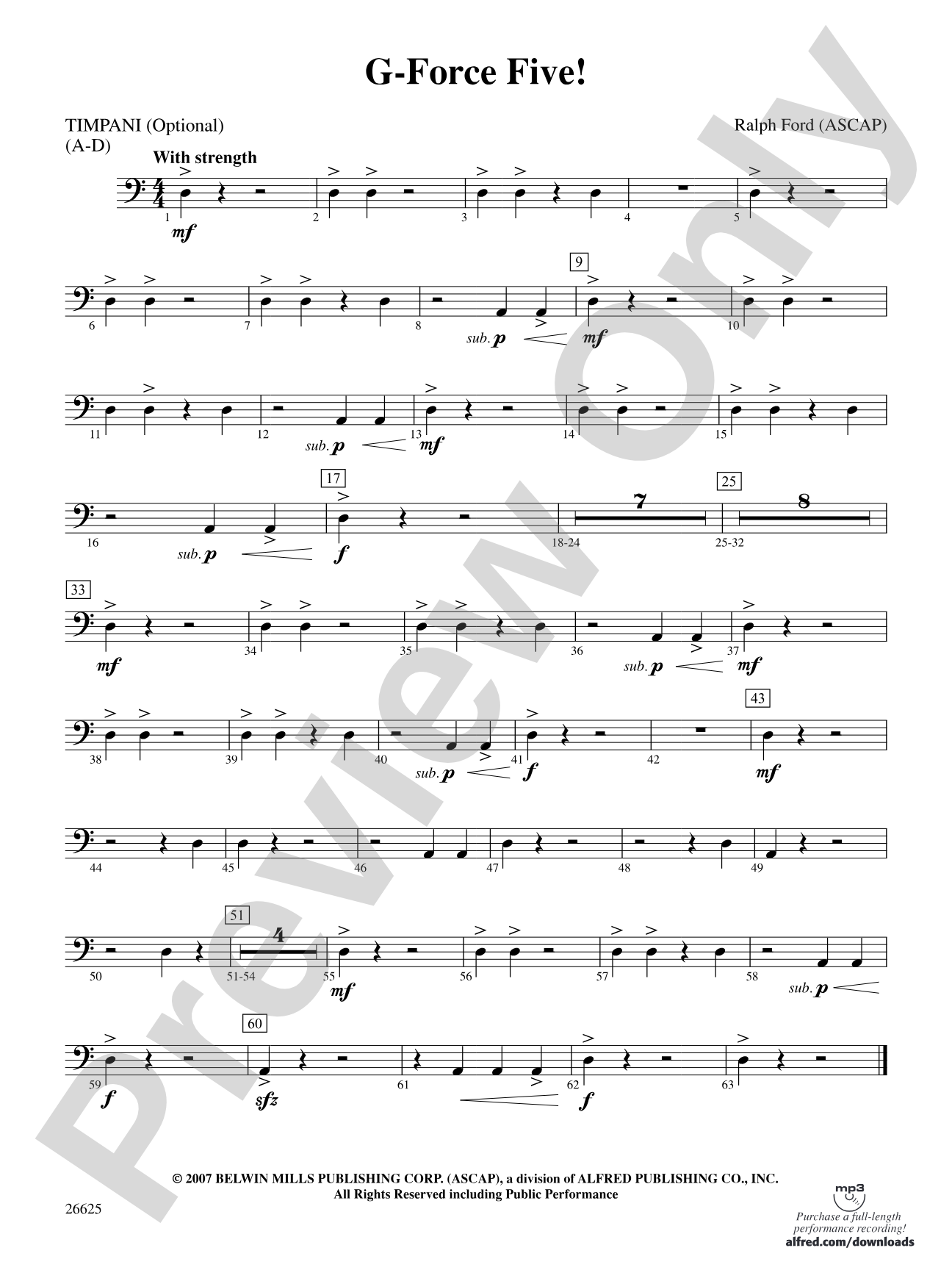

G-Force Five!: Timpani
By Ralph Ford
Grade: 2
Item: 00-PC-0001129_TMP
$5.99
Pickup currently not available
Description
An exciting work where all sections share the melody using primarily the D natural minor scale---perfect for a first festival experience! Optional piano and timpani parts provide harmonic support. The low tom and triangle parts, playable by selected students, give extra musical pull. This title is available in MakeMusic Cloud.


Don't just read it, hear it, play along with it, and watch your students grow with it. In MakeMusic Cloud, G-Force Five!: Timpani comes alive with professional accompaniment, adjustable tempo, and built-in practice tools that turn solo practice into real progress.
Open in the Player
Jump straight in and assign it today.
Start Your Free Trial
Open this title and explore the full library in minutes.
Sample Audio
1
Audio File
--:--
0:00
0:00
Sample Video
No sample videos found.
Additional Details
Series:
Belwin Beginning String Orchestra
Publisher:
Alfred Music
Page Count:
40
SKU:
00-PC-0001129_TMP
More about this title
About the Composer: Ralph Ford

Ralph Ford brings three decades of composition and arrangement experience across multiple genres and mediums. Beginning his professional career at fifteen, he has worked in university education, broadcast media, advertising, and commercial production while maintaining an active composing practice. He has served on university music faculties teaching orchestration, arranging, theory, and applied studies, and currently works as an exclusive composer and arranger for Alfred Music's Belwin division, with over 250 published titles for orchestras, bands, jazz ensembles, and marching groups performed internationally.
Ford's work spans traditional concert music, media production, and commercial scoring. He has premiered pieces with university, military, professional, and school ensembles worldwide, earned recognition for advertising and animation work, and produced content for broadcast, recording, and digital platforms. His background as both educator and working composer informs his writing for student ensembles.
Why we love this
Ford writes with genuine consideration for what Grade 2 string players can accomplish together. By anchoring the piece in D natural minor and distributing the melody across sections, he ensures every student feels the forward momentum of the music rather than sitting on accompanying notes. The optional percussion parts transform a straightforward orchestration into an ensemble event where non-string players also contribute meaningfully.
What to expect
Energetic and direct, the piece projects motion and purpose without technical overload. The D natural minor tonality gives it a minor-key vitality, while the primary reliance on the D scale keeps the harmonic language accessible and the intonation demands manageable for developing ensembles.
Who it's for
String orchestras preparing for their first festival or contest experience will find a piece that builds confidence through shared responsibility and clear structure. Young players benefit from the scalewise writing and straightforward harmonic language while staying engaged by the frequent melody trading between sections.
How to get the most out of it
- Balance the melody as it passes between sections by cueing each entrance clearly in rehearsal; mark parts so players know when they're in the foreground versus supporting.
- Keep the tempo consistent and energetic from top to bottom; even a Grade 2 ensemble will communicate more confidence when the piece moves with purpose.
- Use the optional timpani and piano to anchor harmonic clarity if your ensemble is still developing intonation in the minor tonality; remove them once players stabilize the harmonic center.
- Assign the low tom and triangle parts to dependable players who can maintain steady rhythm independent of the string sections; these parts add percussion color without doubling existing lines.
How to use it
Program this as a contest or festival entry where a confident, well-prepared Grade 2 piece strengthens your program balance. It also works well as a concert opener when you want to showcase your full orchestra and percussion section without competing with more advanced repertoire on the same program.
Skills your students will build
- Playing melodies in D natural minor tonality
- Balancing between melody and supporting sections through section transitions
- Ensemble rhythmic precision and synchronization
- Reading and performing optional percussion parts (timpani and unpitched percussion)
- Sustaining consistent intonation across the full ensemble in minor-key harmony