
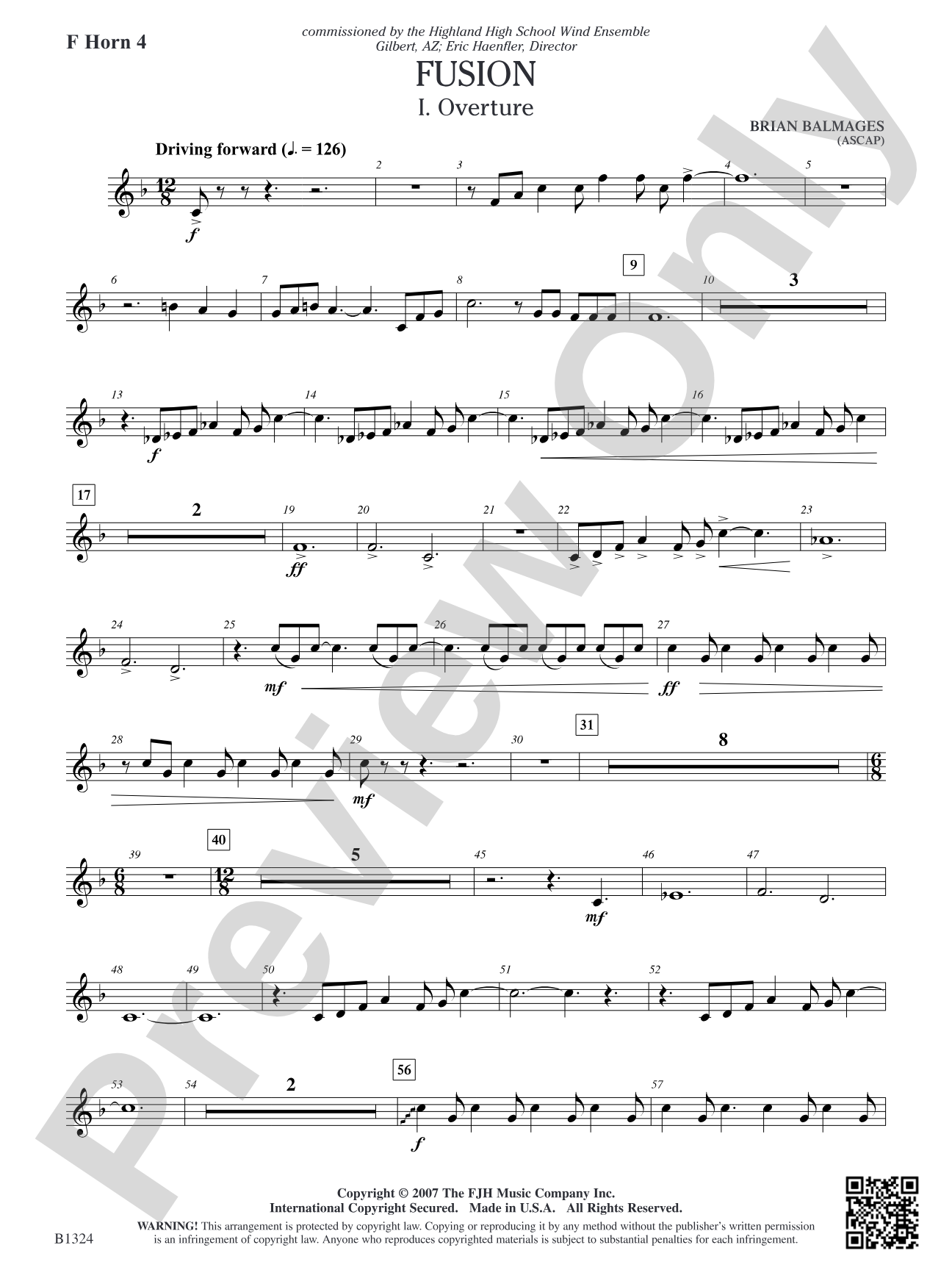

Fusion: F Horn 4
By Brian Balmages
Grade: 4.5;5
Item: 98-PC-DB1324_H4
$7.00
Pickup currently not available
Description
Just as its title suggests, this three-movement contemporary work draws from various types of pop music and dance forms, and sets them in a symphonic framework. The opening movement, Overture, is a short fanfare based loosely on Irish dance rhythms and melodies. The second movement, Ballad, receives its inspiration from various aspects of pop ballads, though no direct references are made. Dense harmonies and interesting textures play an important role throughout the movement. The final movement, Fusion, is a literal combination of rock, funk, swing, and classical in a contemporary setting. Intense and driving, this is an excellent concert finale! You may even want to consider performing the last movement alone as an encore.


Don't just read it, hear it, play along with it, and watch your students grow with it. In MakeMusic Cloud, Fusion: F Horn 4 comes alive with professional accompaniment, adjustable tempo, and built-in practice tools that turn solo practice into real progress.
Open in the Player
Jump straight in and assign it today.
Start Your Free Trial
Open this title and explore the full library in minutes.
Sample Audio
1
Audio File
--:--
0:00
0:00
Sample Video
No sample videos found.
Additional Details
Series:
FJH Symphonic Band
Publisher:
The FJH Music Company, Inc.
SKU:
98-PC-DB1324_H4
More about this title
About the Composer: Brian Balmages

Brian Balmages has built a reputation as a composer and conductor working across orchestral, band, and chamber idioms with equal fluency. His works have been heard in prestigious venues including Carnegie Hall, the Kennedy Center, and the Sydney Opera House, performed by ensembles ranging from professional symphony orchestras to elementary school bands. He received the A. Austin Harding Award from the American School Band Directors Association and won the 2020 NBA William D. Revelli Composition Contest for Love and Light. As a guest conductor, Balmages maintains an active schedule with all-state and regional groups, university ensembles, and professional orchestras worldwide.
Balmages was honored with the inaugural James Madison University Distinguished Alumni Award and was commissioned by the University of Miami to compose for the inauguration of its sixth president. His work was performed during the 2013 Presidential Inaugural Prayer Service. He currently serves as Director of MakeMusic Publications and Digital Education for Alfred and MakeMusic. An elected member of the American Bandmasters Association, Balmages continues to expand the concert band repertoire with music that bridges contemporary vernacular styles and classical tradition.
Why we love this
Balmages captures the energy of popular idioms without sacrificing musical substance. The three-movement arc gives the piece genuine architecture, and the closing movement delivers the kind of satisfying, high-octane finale that audiences remember. This is concert band writing that respects both the ensemble's capabilities and contemporary musical tastes.
What to expect
The opening announces itself with bright, lilting fanfare energy rooted in folk tradition. The middle movement invites the ensemble to explore rich harmonic color and textural intimacy, before the final movement ignites the stage with unbridled rock and funk propulsion wrapped in classical sophistication. This is music that feels alive and current without abandoning musicianship.
Who it's for
Band directors seeking a contemporary concert work that bridges classical structure and modern idiom for groups at the 4.5-5 level. This piece works equally well for festival competition, concert programming, or as a teaching tool to explore how vernacular genres function within a symphonic framework.
How to get the most out of it
- Attend closely to the dense harmonic language in the Ballad movement. Balance and blend among the inner voices will determine whether these textures read as sophisticated or muddy, so rehearse by section color before combining the full ensemble.
- The opening movement's connection to Irish dance rhythms lives in the lilt of the line, not the tempo. Resist rushing the Overture; let the dancers' lift emerge naturally from phrasing rather than speed.
- Lock the rock and funk grooves in the final movement with your rhythm section first. Once the drums, bass, and keyboard establish the pocket, layer in the horns and reeds to build intensity progressively.
How to use it
Program the entire three-movement work as a substantial centerpiece that showcases your band's range and technical facility. Alternatively, consider closing your concert with the Fusion movement alone, using its high-energy finale to leave the audience energized. Either approach works well on festival adjudication schedules.
Skills your students will build
- Reading and executing mixed meters and syncopated rhythms in rock and funk contexts
- Balancing complex inner voices and extended harmonies
- Articulation and phrasing control across contrasting musical styles
- Ensemble cohesion in groove-based passages
- Dynamic control and textural awareness in dense harmonic writing